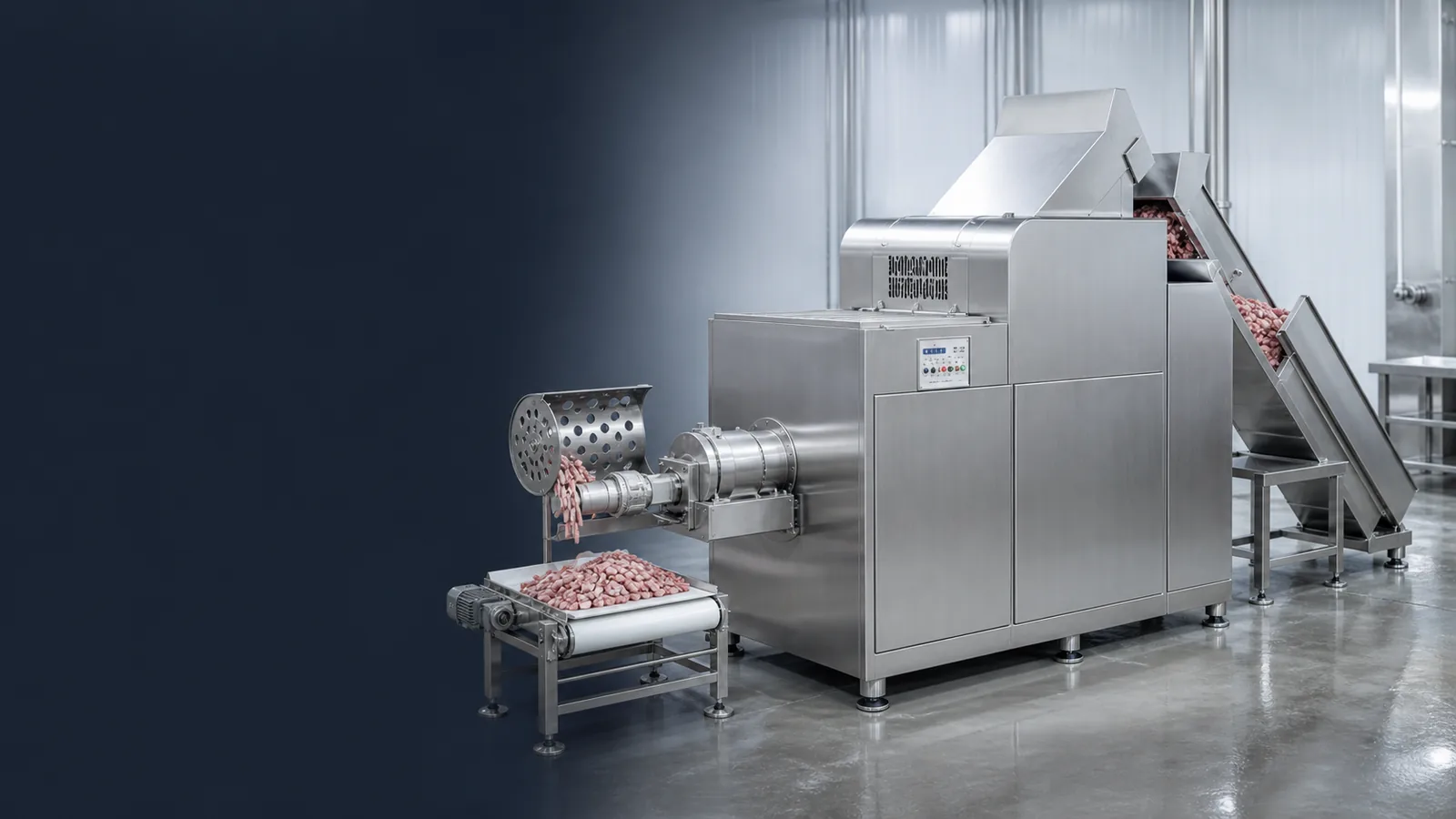
Cold-chain equipment for reducing, mixing and shaping raw meat into controlled strips or pellets before separate freezing and freeze drying.
Integrated raw-meat forming
JCJ-250 Frozen Meat Pellet Extruder
Automatic lifting, five-knife frozen-meat crushing, mixing and PLC-controlled extrusion in one stainless-steel cell. Published capacity is 800–1000 kg/h for freeze-dried pet-food strips and pellets.
Raw strips and pellets before a separate drying stage
This category focuses on the JCJ-250 raw-meat forming route. The linked product record combines lifting, frozen-meat size reduction, mixing and extrusion into strips or pellets. Here, extrusion describes shaping the prepared meat; it should not be confused with high-temperature cooking and expansion of dry kibble. Freezing and freeze drying remain separate downstream operations.
Input condition
Share the species, recipe, incoming block or piece size and material temperature. Identify whether the supply is frozen or thawed and how it reaches the machine.
Finished geometry
Provide strip or pellet dimensions and the required appearance. Include a photograph of the desired piece and explain how it will be transferred.
Receiving operation
Describe the conveyor, tray loading and separate freezing or freeze-drying equipment. Pieces leaving the former must fit the receiving arrangement.
Review the forming result through the next operation
A piece that looks correct at the outlet may behave differently during transfer and tray loading. Discuss sticking, stretching, separation and the spacing needed by the next process. The useful comparison is the accepted product arriving at the receiving stage under representative conditions. Catalog output belongs to a stated product and configuration; it is not a universal rate for every recipe.
Recipe changes
List the different meats, inclusions and piece formats to be produced. Ask which tooling and changeover work belong to the offered arrangement.
Preparation boundary
Identify whether upstream crushing and mixing are included or already available. Avoid specifying the same duty twice when connecting an integrated cell.
Machine schedule
Use the JCJ-250 page for the published technical data, then confirm the selected feed, forming and receiving configuration in the proposal.
Choose a different route for wet-filled products
Canned, tray-packed or pouch-packed wet pet food requires a different project discussion around filling, closing and thermal processing. Those systems belong to the wet pet-food line category. This page remains the entry point for the raw shaping stage, while the related meat-processing page addresses upstream preparation choices.
Questions before the next discussion
Does the JCJ-250 freeze-dry the product?
No. It prepares and forms the meat. The freezing and freeze-drying stages require separate equipment and process review.
Does the word pellet mean cooked kibble?
Not on this route. The linked machine shapes raw meat into portions; it is not described as an expanded dry-kibble cooking extruder.
Discuss the right configuration for your product
Send the incoming material, finished product, required output and available factory information. Include the page or model reference so the discussion starts with the right equipment duty.