
High-Speed Automatic Dumpling Machine
A narrow, high-capacity line that feeds rested dough, rolls it through four stages, meters filling, forms handmade-style dumplings and recovers wrapper trim.
Coordinate sheeting, filling and forming
Product quality depends on the complete relationship between dough condition, sheet reduction, filling rheology, mold geometry and discharge handling.
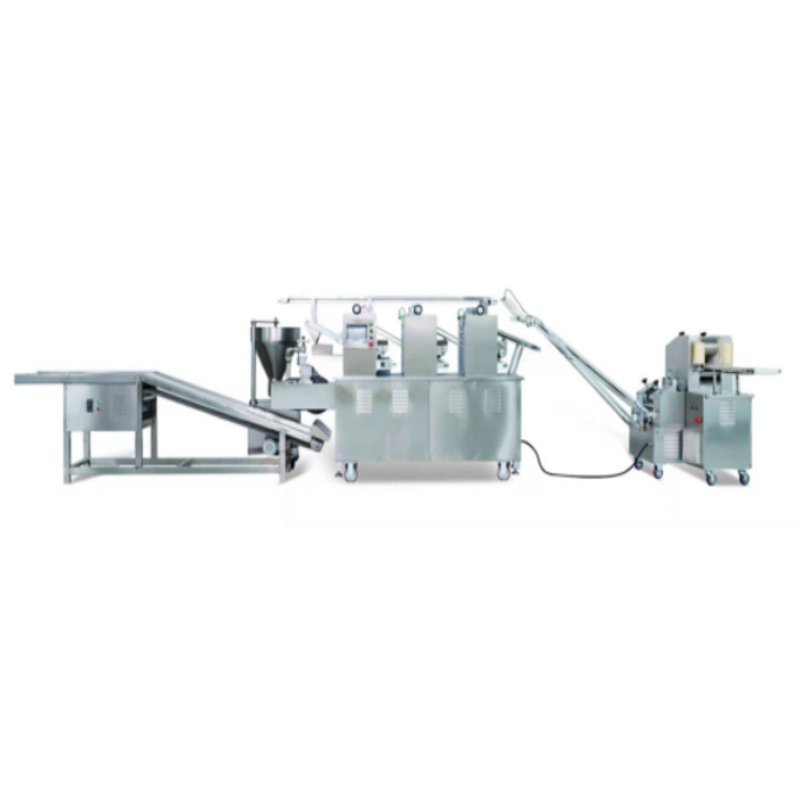
Designed for repeatable industrial forming
Coordinated motion stabilizes dough transport, filling timing and mold position.
PLC or industrial-computer control supports product changeover and repeat settings.
Stainless-steel construction and removable contact parts support sanitation.
Finished shape and seal profile are engineered around approved product samples.
Technical specifications
| Model | Capacity | Product weight | Air pressure | Power | Weight | Dimensions |
|---|---|---|---|---|---|---|
| ZPJ-II | 60,000–70,000 pcs/h | 5–20 g | 0.4 MPa | 9.5 kW | 1500 kg | 7000 × 850 × 1500 mm |
The source URL contains ZSJ-II, but the product description and technical table consistently identify the machine as ZPJ-II. ZPJ-II is used on this page.
Four-stage rolling, sealed filling and trim recovery
ZPJ-II is designed for continuous frozen-dumpling production. Rested, folded dough enters automatic feeding and passes through four independently controlled rolling stages. Progressive reduction develops a uniform wrapper without forcing final thickness in one aggressive pass. Photoelectric sensing coordinates dough supply with forming demand; filling and extrusion-forming modules then create the dumplings before conveyor discharge.
The published 60,000–70,000 pieces per hour applies within the stated 5–20 g range and must be reconciled with mold layout and acceptance criteria. Scheduled sanitation, dough changes and freezer loading affect realized hourly output. Although the source URL contains “ZSJ-II,” its product description and specification table consistently identify ZPJ-II, which is retained here.
Multiple rolling surfaces and single-side adjustment allow thickness and alignment correction while maintaining a continuous dough band.
The movable, adjustable filling system is designed to reduce leakage and manage juicy fillings while keeping dosing aligned with the forming station.
Excess wrapper material is returned for controlled reuse. The acceptable ratio must protect dough hydration, age, color, texture and food-safety controls.
Cleaning parts are removable, supporting a defined disassembly, allergen verification, inspection and restart procedure.
Upstream continuity
Mixers, resting equipment and dough handling need to supply uniform material continuously. A buffer strategy prevents every batch change from stopping the line. Filling temperature, particle distribution and free juice must also remain controlled.
Downstream capacity
At this output, inspection, flouring, product spacing and the IQF freezer must accept the same flow. The 7 m machine footprint also needs service clearance and safe sanitation-part removal routes.
ZPJ-II high-speed dumpling line FAQ
Which products fit the published capacity?
The official range is associated with 5–20 g dumplings. Weight, mold positions and material behavior must be confirmed before contractual output is set.
Why use four dough rollers?
Progressive reduction creates a stable thin sheet while allowing independent alignment and thickness control.
Can trim be reused without a limit?
No. Returned material changes dough age and hydration; the acceptable proportion must be established through product-quality and food-safety testing.
Who is this line for?
It suits frozen-food factories, central kitchens and large producers with adequate mixing, material handling and freezing capacity.
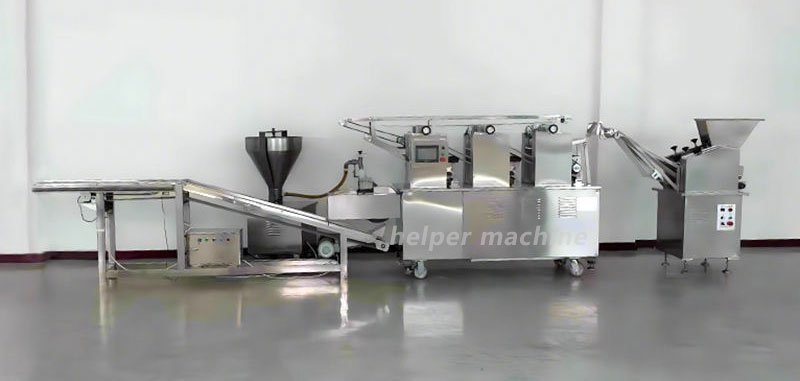
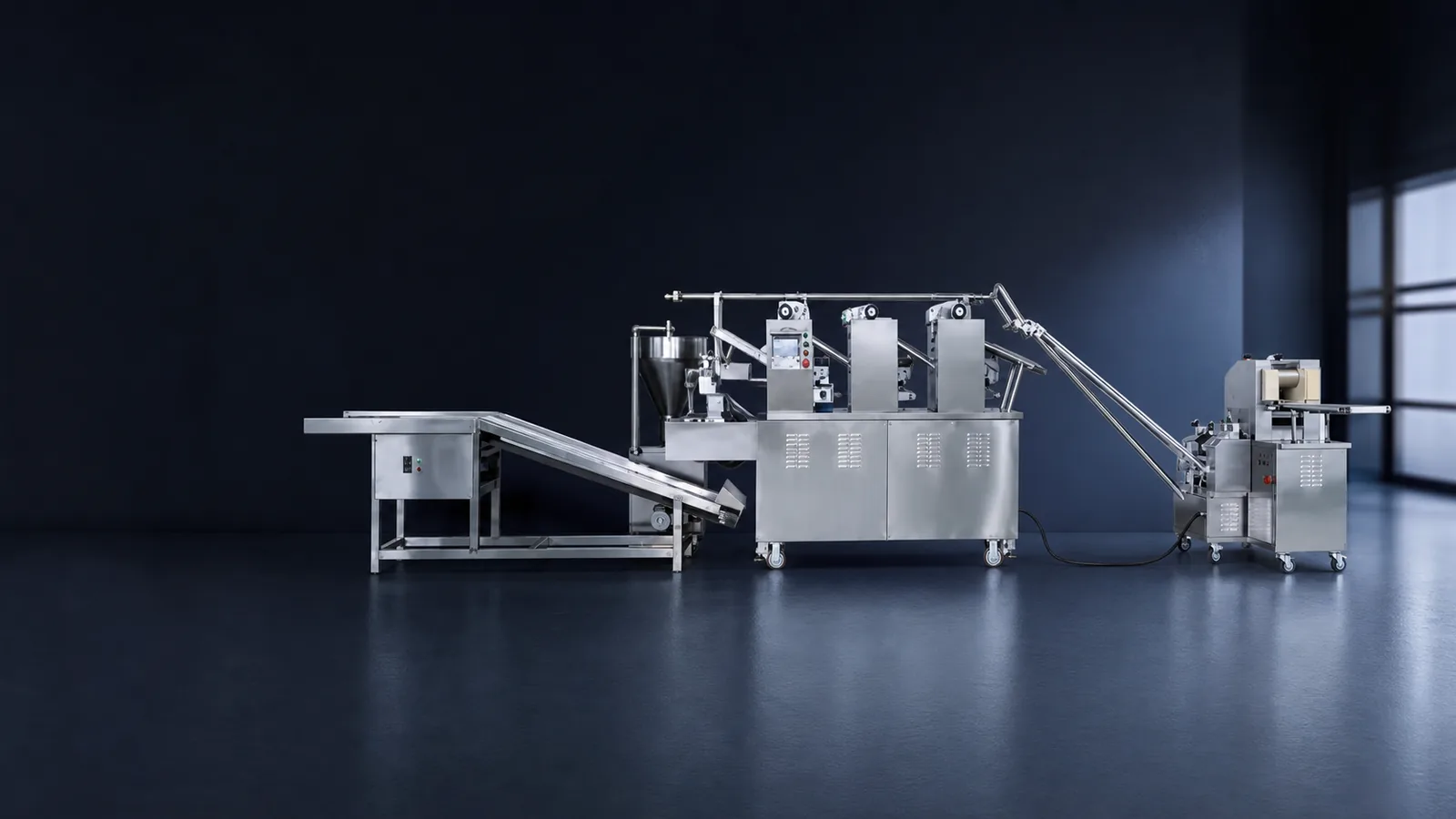
Machine configuration and forming area
Information required for accurate selection
Specify High-Speed Automatic Dumpling Machine from the finished product backwards
A reliable quotation starts with the product and process target rather than a catalogue capacity alone. Provide piece shape, target weight, wrapper thickness, filling particle size, dough-to-filling ratio and downstream cooking or freezing. Samples, drawings and representative raw materials allow the supplier to identify the working configuration and any limits that should appear in the signed specification.
Published capacity is a reference condition, not an unconditional guarantee for every recipe. Sustainable performance must be measured as accepted product after normal rejects and interruptions. The acceptance plan should record piece-weight variation, seal integrity, wrapper damage, filling giveaway, reject rate and accepted pieces per hour. Agree the run duration, staffing, utility conditions and sampling frequency before the factory acceptance test so both parties evaluate the same result.
Confirm voltage and frequency, connected load, compressed air, water, drainage, exhaust or refrigeration where applicable. Check loading height, discharge direction, service clearance, floor loading and the real interface with upstream and downstream equipment.
Review dough and filling contact parts, mould access, residue recovery, allergen changeover and sanitation verification. The sanitation method must suit the machine’s electrical protection and the factory’s documented food-safety program.
Use the intended material and product format. Record start-up loss, stable output, quality variation, alarms, downtime, cleaning time and changeover time. Repeat critical checks after installation with actual site utilities and trained operators.
Send product photos or samples, formula where relevant, target hourly output, shift pattern, pack or downstream format, factory layout and utility schedule. Mark mandatory requirements separately from optional future expansion.
Related decision path
Continue from this page
Configure the machine around your product
Send product samples or drawings, dough and filling formulas, target output and available floor space.
Ready to discuss your project?
Use our single online inquiry form to send your product, capacity, utility and layout requirements.
Go to contact formApplication fit
Applications for High-Speed Automatic Dumpling Machine
Best suited to formed dumplings, gyoza, wonton, shumai or khinkali when the tooling, wrapper condition and filling properties are validated for the required product. Final suitability should be confirmed with representative product trials and the agreed acceptance criteria.