
Who should use this guide?
Product costing teams
Build a controlled bill of packaging materials for each sellable SKU and case configuration.
Packaging and production teams
Separate theoretical use from startup, trim, reject and end-of-roll losses.
Equipment project teams
Compare formats and machines without hiding material waste inside one average number.
The calculator's screening formula
The online calculator applies one waste percentage to the complete material basket. This is transparent for early screening, but a detailed cost model should apply a measured loss rate to each component.
Worked example
| Component | Input | Cost per pack |
|---|---|---|
| Film | 8 g at 4.20/kg | 0.0336 |
| Tray, pouch or container | Purchased unit cost | 0.0800 |
| Label and coding consumables | Label, ink, ribbon or solvent | 0.0120 |
| Shipping carton | 0.72/carton ÷ 12 accepted packs | 0.0600 |
| Other materials | Absorbent pad, closure or insert | 0.0080 |
| Base material cost | Sum before waste | 0.1936 |
| Waste allowance | 5% screening allowance | 0.00968 |
| Total | Per accepted pack | 0.20328 |
At 200,000 accepted packs/month = 40,656/month
All figures remain in the input currency. Machine, labor, utility, maintenance, freight, warehousing and capital costs are not included unless separately added.
Define the packaging hierarchy
Sales pack
Film, pouch, tray, lid, bottle, cap, absorbent pad, label and direct-contact components.
Case pack
Carton, liner, divider, tape, case label and other grouping materials.
Distribution unit
Pallet, stretch wrap, straps, corner boards, reusable crates and cold-chain materials.
State which levels are included. A low primary-pack cost can create a higher secondary or logistics cost if package dimensions reduce case or pallet utilization.
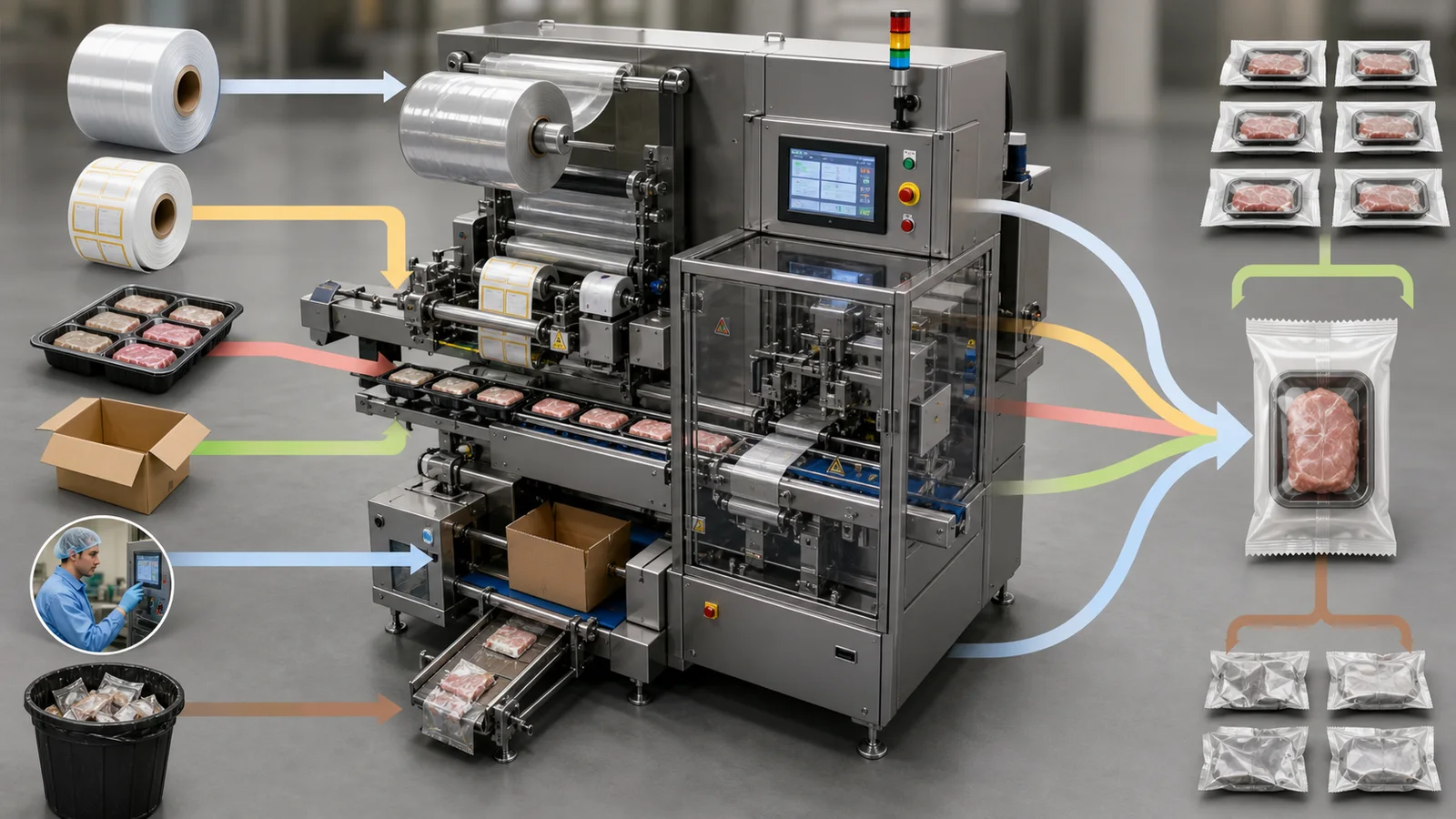
Theoretical film use versus actual consumption
For design comparison, film mass may be derived from web width, cut length, thickness, density, lane count and the number of webs or layers. Verify units and supplier tolerances.
For actual costing, use issued material less verified reusable returns, divided by accepted packs. Include cores and non-film weight only when they are part of the purchased-cost basis.
Compare actual with theoretical to expose startup web, side trim, sealing rejects, print registration loss, splice loss and residual roll ends.
Do not count waste twice
Use separate component yields in a production model:
| Loss category | Typical evidence | Correct cost treatment |
|---|---|---|
| Startup and setup | Material issued before first accepted pack | Allocate by run or SKU, not across an unrelated annual average |
| Trim and matrix | Measured film geometry or collected mass | Include in actual film use |
| Seal or forming reject | Rejected complete packs by cause | Include all components already consumed |
| Print and coding reject | Line reject record | Include pack and coding consumables |
| End-of-roll and splice | Roll reconciliation | Allocate to the material and run creating the loss |
| Damaged carton or label | Warehouse and line issue record | Apply its own component yield |
Use accepted packs as the denominator
Theoretical output, machine cycles and filled packs are not necessarily saleable packs. Divide cost by packs meeting seal, weight, coding, label, appearance and release requirements. Keep product loss and packaging loss connected but separate: a seal reject can waste both food and packaging.
For carton allocation, use the normal number of accepted packs actually packed per carton. Handle partial cases, samples and promotional formats explicitly rather than assuming every carton is full.
Build the purchase-cost basis
- Supplier unit price and effective date.
- Currency and exchange-rate basis.
- Freight, insurance, duty and non-recoverable tax.
- Minimum order quantity and price break.
- Roll width, length, net film mass, cores and pallet quantity.
- Tooling, printing plates, cylinders and artwork setup.
- Rebates, credits, returned packaging and recoverable scrap value.
- Obsolescence risk from artwork or product changes.
A cheaper price per kilogram can increase cost per pack when roll width, sealability, gauge variation or line performance creates more waste.
Keep conversion cost separate
Material cost
Purchased packaging components consumed per accepted pack.
Conversion cost
Packaging labor, electricity, gas, vacuum, compressed air, maintenance and sanitation.
Ownership cost
Machine depreciation or lifecycle cost, tooling, software, service and capital risk.
Logistics cost
Warehousing, pallet utilization, cold chain, freight cube, damage and returns.
Report each layer before presenting a total packaged-product cost. This makes design and equipment tradeoffs visible.
Cost reduction cannot compromise package performance
Lightweighting, thinner film or a lower-cost structure must still satisfy food-contact requirements, barrier, seal integrity, process temperature, shelf life, coding, traceability, distribution and consumer use. Validate the complete food-package-process combination.
Packaging regulation is jurisdiction-specific. For example, Regulation (EU) 2025/40 establishes EU packaging lifecycle, sustainability, labeling, waste-prevention and producer-responsibility requirements with phased application. It is not a universal specification for every market, but it illustrates why compliance and end-of-life obligations belong in packaging decisions.
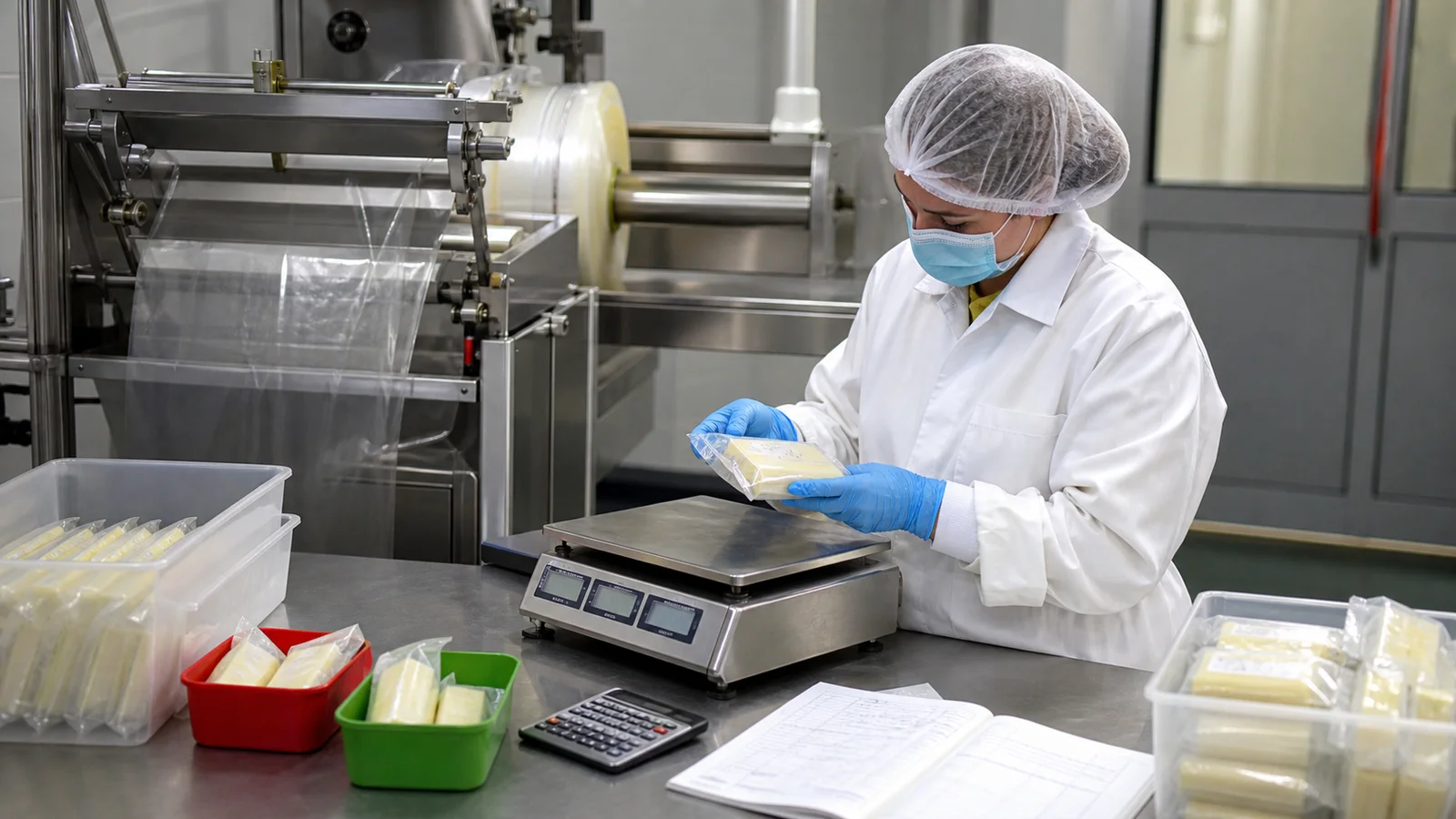
Eight-step packaging cost method
- Freeze the SKU and format. Record net content, package structure, dimensions and case pack.
- Create the bill of materials. List primary, secondary and selected transport components.
- Normalize purchase prices. Include currency, freight, duty, MOQ and tooling basis.
- Calculate theoretical use. Establish the design mass or component count per pack.
- Run a controlled trial. Reconcile issued, returned, rejected and accepted quantities.
- Apply loss by component. Do not use one percentage after measured data exist.
- Add conversion and logistics separately. Avoid hiding operating cost inside material.
- Control revisions. Recalculate after price, gauge, artwork, dimensions, machine or case-pack changes.
Minimum packaging-cost record
SKU and GTIN; package specification revision; primary, secondary and transport bill of materials; supplier and price date; currency and landed-cost basis; film width, thickness, density and roll data; theoretical use; issued and returned quantities; accepted packs; rejects by cause; cartons and case pack; tooling allocation; conversion-cost boundary; reviewer and next price review.
Frequently asked questions
How is packaging cost per pack calculated?
Add all packaging materials consumed and divide their landed cost by accepted packs on the same run or reporting boundary.
Should film scrap be included twice?
No. Include it in actual grams per accepted pack or as a separate loss factor, not both.
Does material cost include machine depreciation?
No. Machine, labor, utility, maintenance and logistics belong in separate conversion and ownership layers.
Should every component use one waste rate?
Only during early screening. Replace it with measured film, tray, label and carton yields after trials.
Can the cheapest film have the lowest cost per pack?
Not necessarily. Gauge, width, sealability, waste, line speed, shelf life and damage can outweigh the quoted price per kilogram.
Calculate the material screening cost
Start with the package bill of materials, then validate actual consumption against accepted packs during production.
Open the Packaging Cost per Pack Calculator | Calculate Packaging Film Consumption | Explore Food Packaging Equipment
Primary references
- GS1 Package and Product Measurement Standard - consistent package dimensions and gross-weight measurement.
- GS1 GTIN Management Standard, package dimensions and gross weight - trade-item identification implications of packaging changes.
- NIST AMS 200-7, The Manufacturing Cost Guide: A Primer (2019) - standardized manufacturing cost categories and material-cost context.
- U.S. EPA Sustainable Materials Management Hierarchy - source reduction, reuse and packaging lightweighting context.
- Regulation (EU) 2025/40 on packaging and packaging waste - current EU packaging lifecycle, sustainability, labeling and waste requirements.
Food-contact, labeling, environmental and producer-responsibility requirements vary by market. Confirm current legislation and customer specifications before changing a package.