
Direct answer
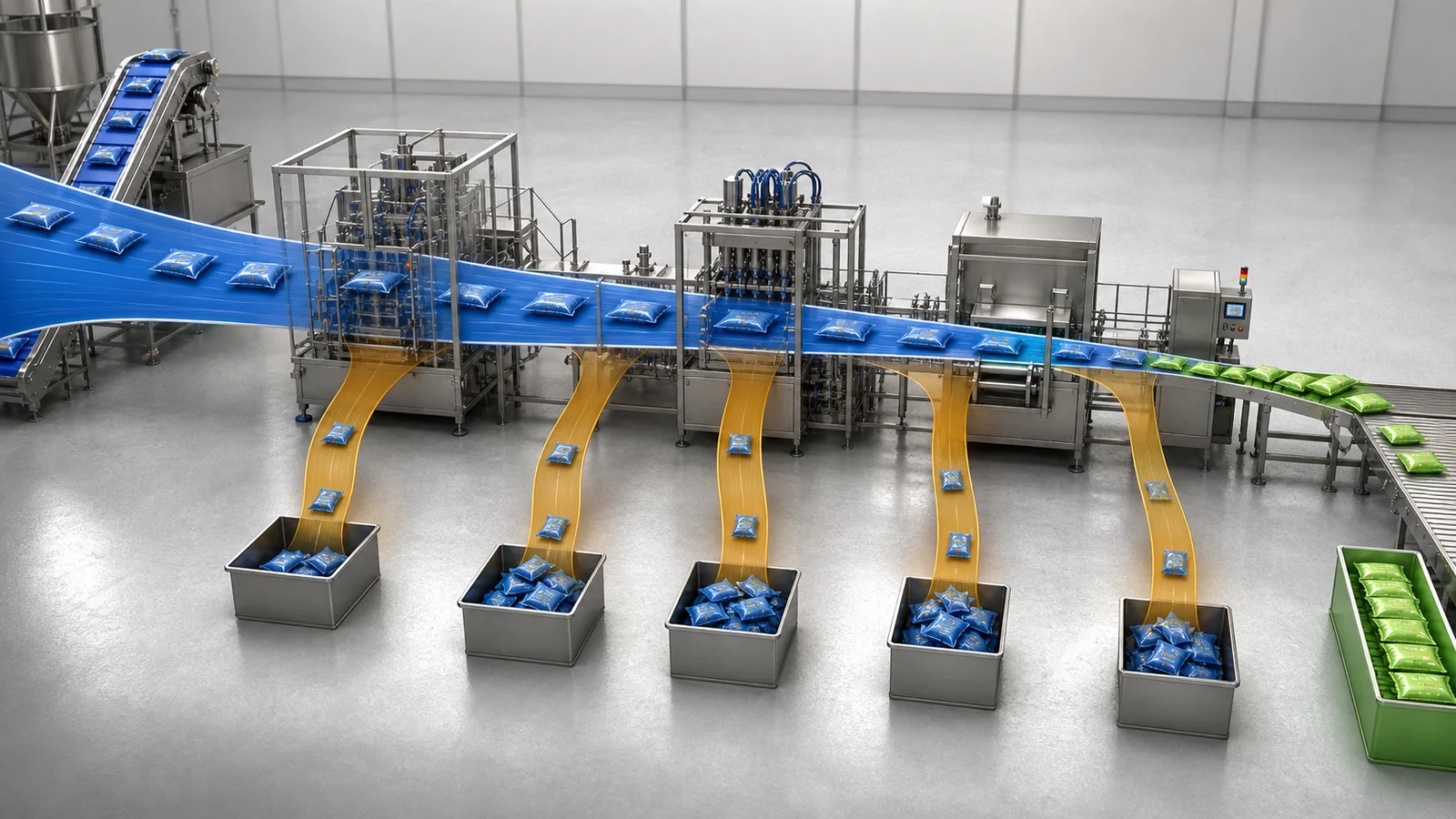
Nominal capacity is a reference maximum or rated throughput under specified or implied conditions. Effective production output is the conforming product produced over a defined period after time, speed and quality losses. For planning, calculate each loss separately, apply the result to the actual product and then confirm that every connected machine can sustain the required rate.
Six capacity terms that should not be mixed
| Term | Practical definition | Use |
|---|---|---|
| Nominal or rated rate | Published or designed rate under a stated reference condition. The supplier must state product, format, settings and test basis. | Early comparison only. |
| Demonstrated gross rate | Total units or mass discharged during a controlled run, including output later rejected. | Performance-rate evidence. |
| Accepted running rate | Conforming output divided by actual running time. | Product-specific machine capability. |
| Effective shift output | Conforming output during a defined shift, including normal planned and unplanned losses. | Production and investment planning. |
| Capacity utilization | How much of an identified capacity was used over a period. Its meaning depends on the chosen capacity denominator. | Operations review, not machine specification alone. |
| Material yield | Accepted product mass compared with material input mass. | Recipe, trim, cooking-loss and cost analysis. |
Build a time-and-output waterfall
A reliable estimate keeps the denominators visible. Begin with the scheduled shift and remove planned non-production time. Then measure whether the machine was available, whether it ran at the reference speed and whether the output met the agreed specification.
OEE = Availability x Performance x QualityNIST describes OEE as the product of availability or uptime, performance relative to design speed, and quality or first-pass yield. Define the exact time and count rules used at your plant.
Availability
Run time / planned production time. State whether setup, changeover, cleaning, waiting for material and downstream blockage count as planned or unplanned loss.
Performance
Actual total output / theoretical output during run time. It captures reduced speed and small stops that do not appear as downtime.
Quality
Accepted output / total output. Define acceptance criteria and treatment of rework. This is not automatically the same as mass yield.
Effective shift output
Nominal rate x planned production time x OEE. Use this shortcut only when all factors use compatible boundaries and units.
Worked example: plan 4,000 kg of accepted product per shift
Step 1: establish net planned production time
An 8-hour shift includes 30 minutes of breaks, 45 minutes of sanitation and 30 minutes of planned changeover. Net planned production time is therefore 6.25 hours.
4,000 / (6.25 x 0.90 x 0.92 x 0.98) = 788.7 kg/hAt an 800 kg/h nominal rate and the same assumptions, expected accepted shift output is about 4,057 kg. The 57 kg difference is not automatically enough design margin: variability, product mix, start-up behavior and upstream or downstream constraints still require review.
Food-production losses that catalogue rates omit
Product and recipe
Dough hydration, filling viscosity, meat temperature, vegetable size, inclusions and package format can change stable speed and reject rate.
Hygiene and allergens
Cleaning, inspection, drying, pre-operation checks and allergen changeover consume scheduled time and should not disappear from the production model.
Thermal and batch cycles
Heating, holding, cooling, loading and unloading create batch timing that cannot be represented by an instantaneous machine rate.
Upstream and downstream flow
Starvation, blocked discharge, insufficient cooling, packaging stops and buffer limits reduce whole-line output even when the core machine is available.
Machine capacity is not line capacity
For a serial line, the slowest sustained operation is an initial bottleneck candidate, but the real constraint can change with product mix, batch release, buffers and downtime. NIST research on multi-job systems shows that throughput and bottlenecks can vary with the production mix, so a simple average of individual product rates is not a reliable mixed-product capacity.
Total required run time = Sum of (accepted quantity for product i / accepted running rate for product i) + changeover and release timeEvaluate each product with its own rate, yield, tooling and sanitation requirement. Then place the resulting runs into the actual shift schedule.
For batch-to-continuous interfaces, compare the batch release interval with downstream consumption. A mixer that averages 1,000 kg/h may still starve an 800 kg/h line if product arrives in large batches separated by long discharge and cleaning periods.
Turn capacity into an acceptance requirement
A purchase specification should define the evidence needed to claim capacity. Agree the test before manufacturing, not after a short demonstration has been completed.

Common capacity-planning mistakes
- Dividing daily demand by the full shift while ignoring breaks, cleaning and changeover.
- Using an unloaded mechanical cycle rate as food-product throughput.
- Applying one unexplained efficiency percentage to every factory and product.
- Mixing kilograms per hour, pieces per minute and packs per minute without product weight or pack count.
- Treating OEE quality rate and ingredient-to-product mass yield as the same measure.
- Using average machine capacities without testing which step constrains the combined line.
- Averaging speeds across several products instead of calculating required run time for each product.
- Reporting a short stable interval while excluding startup, refill, stops, rejects and recovery.
Nominal and effective capacity FAQ
Is nominal machine capacity the same as production output?
No. Nominal capacity is a reference rate. Shift output also depends on planned production time, availability, operating performance, quality and connected-line constraints.
How do I calculate the nominal rate required for a project?
Divide required accepted output by planned production time and by the separate availability, performance and quality factors. Use decimal factors and document their evidence.
Does OEE include material yield?
Not necessarily. OEE quality generally compares good output with total output. Material yield compares accepted product mass with ingredient input mass and should be calculated separately when needed.
Should cleaning be included in availability?
It depends on the chosen time model. Planned cleaning can be removed before availability is calculated, or included as planned loss in a broader utilization measure. The important requirement is to define the boundary and apply it consistently.
What capacity should be placed in an equipment contract?
Specify minimum accepted output for the agreed product, test duration, staffing, utilities, quality limits and measurement method. Attach the FAT protocol and avoid relying on an unexplained catalogue maximum.
Research basis and further reading
- ISO 22400-2:2014, Key performance indicators for manufacturing operations management - ISO states that the standard presents KPIs with formulas, elements, time behavior and units. ISO currently lists the 2014 edition as published and due to be replaced by ISO/DIS 22400-2.
- NIST AMS 300-11, Recommendations for Collecting, Curating, and Re-Using Manufacturing Data - defines OEE as availability multiplied by performance and quality, and emphasizes contextualized manufacturing data.
- NIST IR 8188, Key Performance Indicators for Process Control System Performance Analysis - distinguishes throughput rate, output yield, equipment availability, production effectiveness and capacity utilization.
- NIST, Multi-Job Production Systems - explains that throughput and bottlenecks in serial systems can depend on the product mix.
Scope note: This guide provides an engineering planning method. It does not reproduce the full ISO standard, guarantee a specific machine output or replace product trials, contractual acceptance criteria and qualified line engineering.
Calculate the production rate your project needs
Use the Production Capacity Calculator for a first estimate, then document the assumptions and send the result with your product specification and shift plan.
Open Production Capacity Calculator