
Mechanical filling
The catalog describes a mechanical filling structure driven by a servo motor.
Servo-driven mechanical portioning for meat paste and meat blocks, with an interface for a double clipper to form a filling and closing line.
View specifications Request a quotation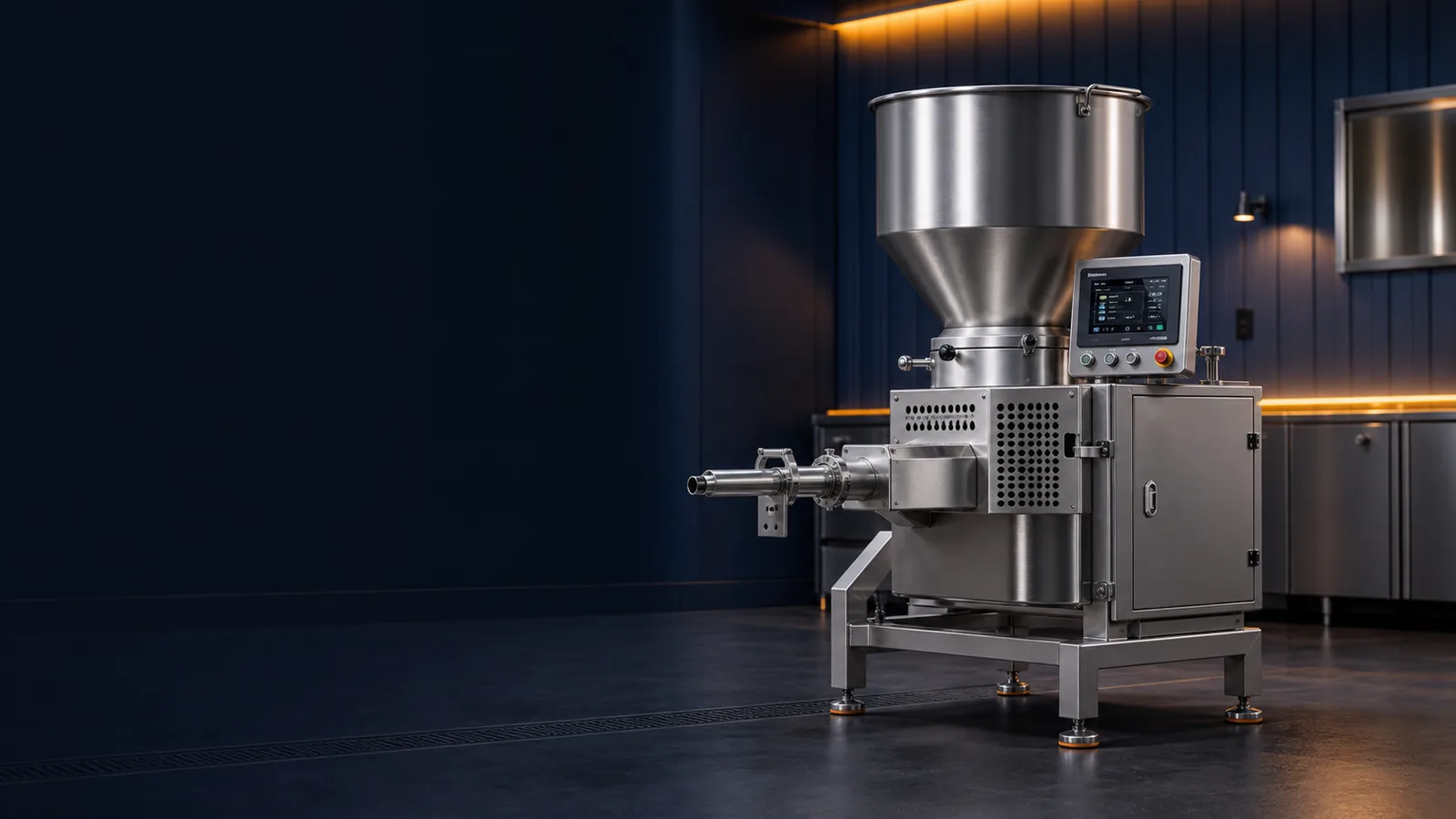
The catalog describes a mechanical filling structure driven by a servo motor.
Suitable for minced meat and meat blocks within the agreed filling setup.
Connect to a compatible double clipper for consecutive filling and closing.
The enclosure and meat-contact parts are stainless steel for cleaning access.
| Model | 2JG-7200 |
|---|---|
| Portioning range | 5–9,999 g |
| Filling capacity | 5,500 kg/h |
| Hopper volume | 180 L |
| Power | 3 kW |
| Voltage | 380 V |
| Weight | 300 kg |
| Dimensions | 1100 × 900 × 1650 mm |
Capacity depends on the material and process. Confirm the selected configuration, utilities and acceptance conditions in the quotation.
The 2JG-7200 is the mechanical option in this product family. It uses servo-driven filling and is listed for minced meat and meat blocks. It does not add the vacuum de-aeration used by a ZKG vacuum filler, so the product trial should confirm whether air removal is needed for the required appearance and texture.
The published interface allows connection to a compatible double clipper. Confirm filling horn geometry, clipper signal exchange, stop-and-restart behavior and emergency-stop integration as one system. A filler and clipper that work separately are not automatically a stable line.
The listed 5,500 kg/h is a model reference, not a guaranteed finished-product rate. Product temperature, viscosity, particle size, portion weight, hopper replenishment and downstream clipping can lower accepted output.
Run the actual recipe at its normal filling temperature. Include the largest meat pieces or inclusions expected in production and check for smearing, bridging, air pockets and visible damage after filling.
Test the smallest, normal and largest commercial portions. Record average weight, variation, start-up rejects and end-of-hopper behavior instead of accepting a single demonstration weight.
Test normal production, a downstream pause, casing or clip change, low product level and restart. The agreed control logic should prevent uncontrolled filling when the clipper or next machine is not ready.
Confirm which product-contact parts are removable, the tools required, drainage, cleaning chemistry and safe access around the hopper, filler outlet and connected clipper. Time a realistic changeover during acceptance.
Send the product name, recipe type, filling temperature, largest particle, minimum and maximum portion weight, casing or container, target accepted output and planned working hours. Add the clipper model, available 380 V supply, hopper-loading method, room layout and sanitation requirements. These inputs let the quotation define the actual interface and acceptance test instead of repeating only the catalog maximum.
Compare sausage filler configurations · Review compatible clipping equipment
Send the product, incoming condition, required output and available factory space. Include the required electrical supply and the machines before and after this operation.
Contact HELPER