
Industrial Dual-Auger Frozen Meat Grinder
Prepare controlled particles at production scale with a broad feed hopper, dual-auger material path and adjustable-frequency operation. JR-D160 bridges medium grinders and the larger D250/D300 platforms.
Balance feed rate, grind quality and temperature
JR-D160 serves sausage, dumpling and bun fillings, meatballs, patties, pet food and other ground-meat recipes. A feeding auger presents product to the grinding auger, helping maintain flow through the broad hopper while the selected knife and plate determine particle size.
Variable frequency provides a commissioning range, but speed cannot compensate for incorrect preparation. Block dimensions, core temperature, bone and fascia, fat level and plate open area determine throughput, motor load and product appearance.
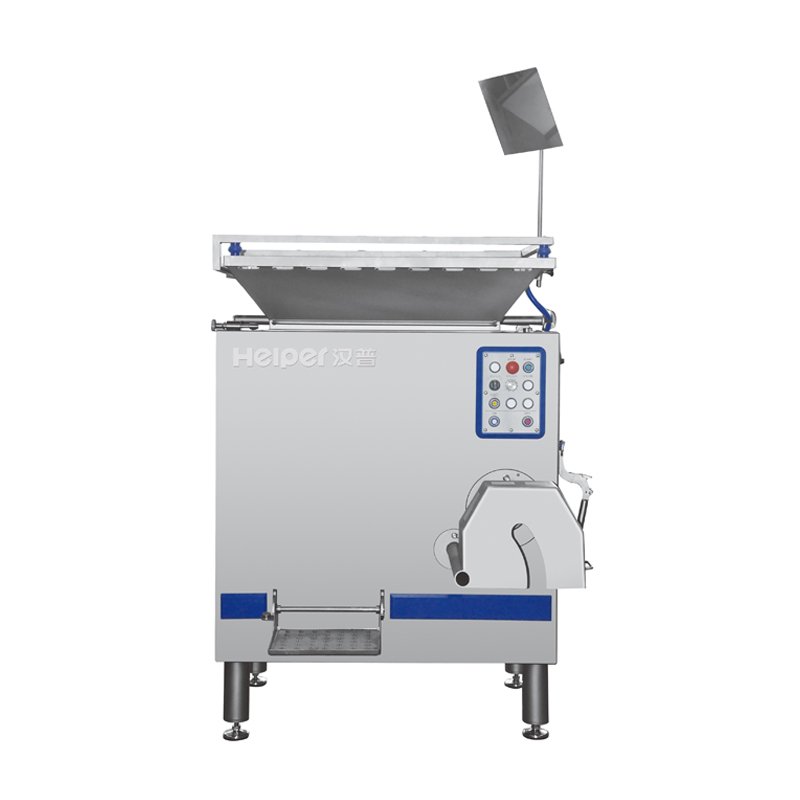
Large hopper and accessible grinding head
Separate feed and grinding actions support stable loading under variable product conditions.
Adjustable operation supports controlled product trials and recipe setup.
The broad inlet suits engineered bin loading with suitable guarding.
External locking and access support knife, plate and auger changeover.
JR-D160 technical specifications
| Model | Capacity | Current power | Speed | Current dimensions | Construction |
|---|---|---|---|---|---|
| JR-D160 | 3,000–4,000 kg/h* | 33 kW* | Adjustable frequency | 1475 × 1540 × 1972 mm | SUS304 series design |
*The current exact English page publishes 33 kW and the dimensions above. An older official PDF lists 15 kW, 136 rpm, 1,200 kg and 1600 × 1080 × 1460 mm. These appear to be different revisions and must not be combined. Require the offered revision, approved GA, motor list and capacity guarantee.
Feed, controls and grinder-head configuration
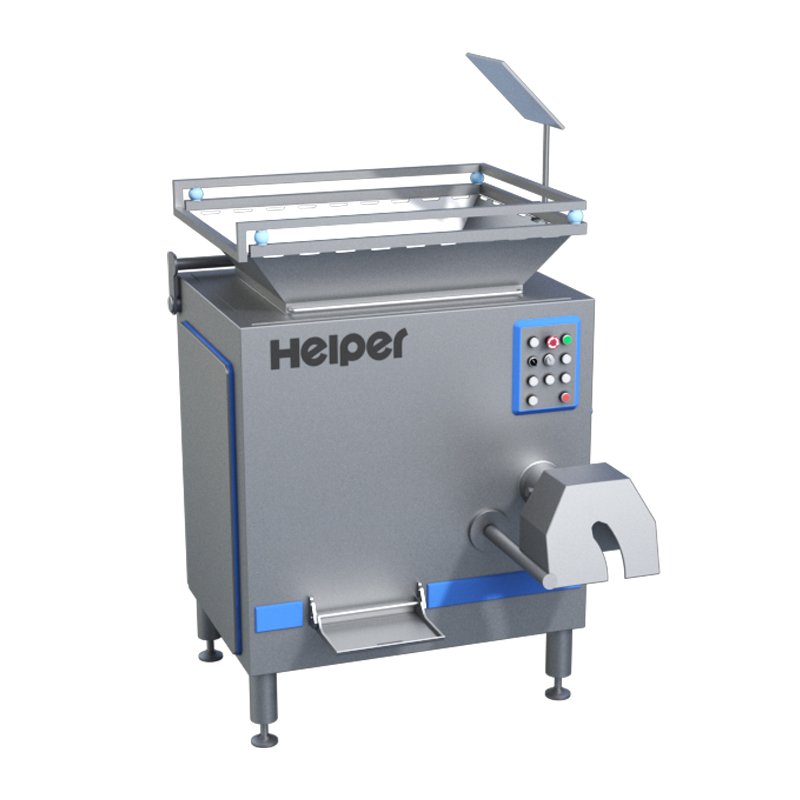
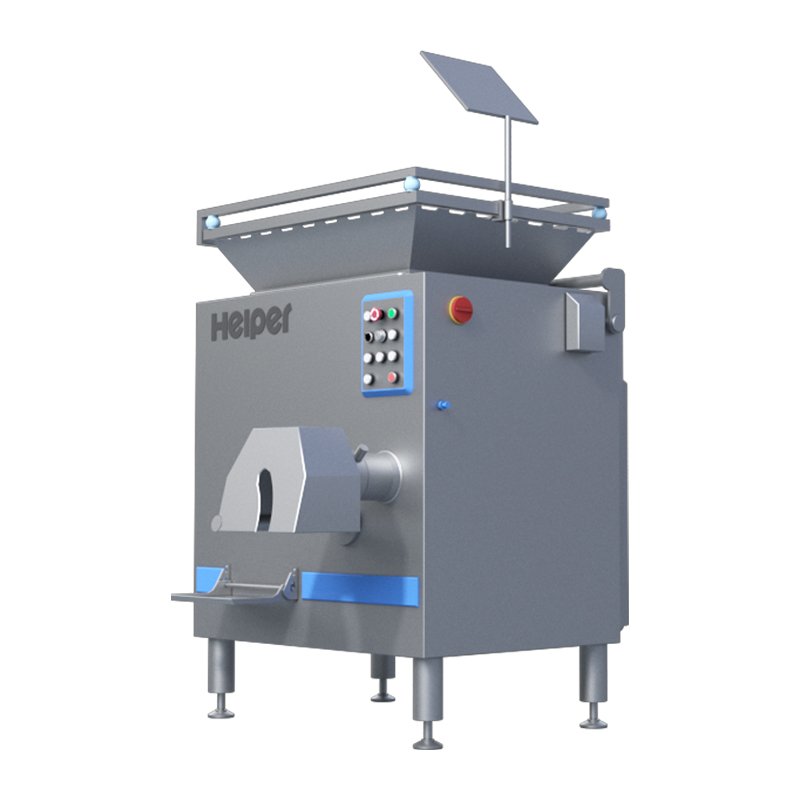
Confirm the offered revision before layout approval
The power and dimensions conflict substantially across official channels. Procurement must not combine the current 33 kW drive with an older compact footprint or weight. One coherent quotation should state motor ratings, net weight, feed opening, outlet height and service clearance.
Upstream handling
Define block preparation, cart size, tipping height and interlocks. Use a pre-breaker or flaker when material cannot enter safely. Loading equipment must match the actual hopper and batch mass.
Downstream balance
Match the grinder to mixer, bowl cutter, emulsifier or forming capacity. Include buffer handling so it does not cycle against a full downstream stage.
Sanitation
Lock out energy before removing guards, plate, knife or augers. Validate access to both augers, hopper corners, seals, outlet and floor beneath the machine.
Performance test
Use representative cold product and the contracted plate. Measure good kg/h, particle distribution, temperature rise, motor load, residual fascia, vibration and cleaning time.
JR-D160 grinder FAQ
Is JR-D160 rated 15 kW or 33 kW?
The current page states 33 kW while the older PDF states 15 kW. Treat them as different revisions and require the offered machine's motor list.
Can it grind frozen blocks directly?
The series is promoted for frozen duty around -18°C. Actual block geometry, hardness and inlet compatibility require testing.
Why use adjustable frequency?
It helps commission feed behavior for different products and plates. Approved operating limits must come from the manufacturer.
Is a verified product video available?
No exact playable video was found on the official page. Request a dated test recording of the offered revision.
Specify Industrial Dual-Auger Frozen Meat Grinder from the finished product backwards
A reliable quotation starts with the product and process target rather than a catalogue capacity alone. Provide incoming product temperature, block dimensions, cut geometry, blade configuration, loading method and downstream handling. Samples, drawings and representative raw materials allow the supplier to identify the working configuration and any limits that should appear in the signed specification.
Published capacity is a reference condition, not an unconditional guarantee for every recipe. Sustainable performance must be measured as accepted product after normal rejects and interruptions. The acceptance plan should record cut-size distribution, fines, smearing, product temperature rise, yield and accepted kilograms per hour. Agree the run duration, staffing, utility conditions and sampling frequency before the factory acceptance test so both parties evaluate the same result.
Confirm voltage and frequency, connected load, compressed air, water, drainage, exhaust or refrigeration where applicable. Check loading height, discharge direction, service clearance, floor loading and the real interface with upstream and downstream equipment.
Review blade access, trapped product, safe lockout, removable guards and sanitation verification. The sanitation method must suit the machine’s electrical protection and the factory’s documented food-safety program.
Use the intended material and product format. Record start-up loss, stable output, quality variation, alarms, downtime, cleaning time and changeover time. Repeat critical checks after installation with actual site utilities and trained operators.
Send product photos or samples, formula where relevant, target hourly output, shift pattern, pack or downstream format, factory layout and utility schedule. Mark mandatory requirements separately from optional future expansion.
Configure the correct JR-D160 revision
Send material, block dimensions, temperature, plate size, target output, voltage and layout.
Ready to discuss your project?
Use our single online inquiry form to send your product, capacity, utility and layout requirements.
Go to contact formApplication fit
Applications for Industrial Dual-Auger Frozen Meat Grinder
Best suited to frozen or tempered meat preparation before mixing, forming or further size reduction, within the confirmed block and temperature envelope. Final suitability should be confirmed with representative product trials and the agreed acceptance criteria.