
High-Speed Meat Slicer
Automatically slice chilled fresh or cooked meat with servo-controlled feeding and an accessible cantilever blade assembly. Select the compact 160 mm format or the wider, pneumatic QP-360 around product section, temperature and required thickness.
Coordinate product firmness with servo feed
The QP series uses a conveyor to present product to a high-speed cutting assembly. Servo-controlled feeding regulates the advance for accurate thickness while the blade and blade lip work together to support clean separation. The published applications cover fresh and cooked meats, making the series suitable for central kitchens, ready meals and industrial ingredient preparation.
QP-160 and QP-360 are not simply width variants. They have different temperature windows, cut ranges, blade speeds and cutting heights. QP-360 also lists compressed air, indicating a different actuation package. Select from actual product geometry and utilities rather than assuming the larger model is universally preferable.
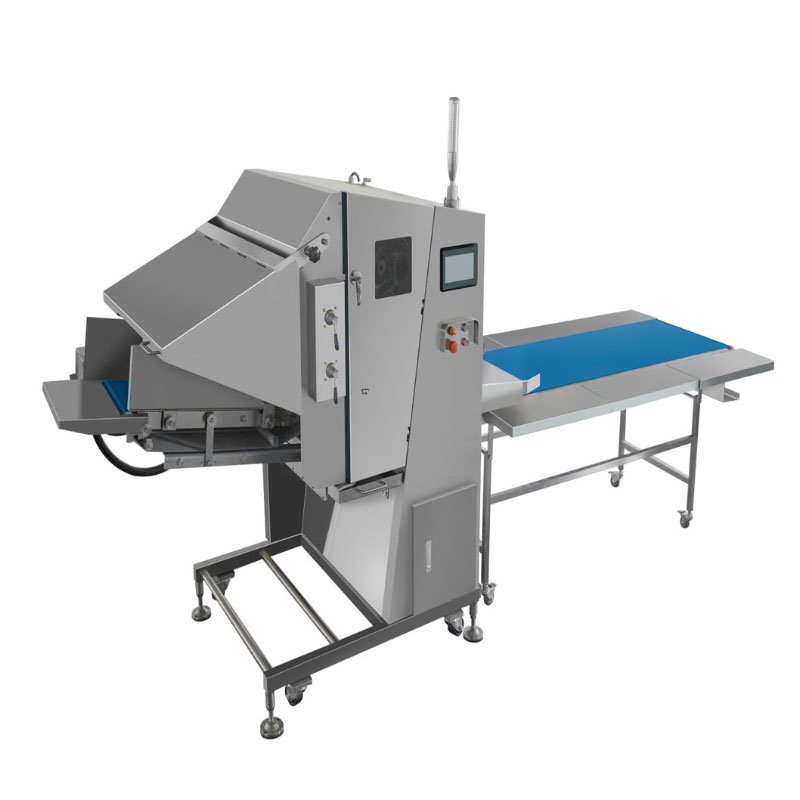
Accessible blade group and controlled feeding
Accurate, rapid product advance supports repeatable digital thickness settings.
The blade group is designed for easier removal, replacement and sanitation access.
Guard monitoring protects operators when accessing the cutting area.
The published 750 W geared-motor feature emphasizes starting torque and smooth cutting; confirm model-specific motor schedule.
QP-160 and QP-360
| Model | Blade speed | Slice thickness | Temperature | Air pressure | Power | Belt / height | Dimensions |
|---|---|---|---|---|---|---|---|
| QP-160 | 60–260 rpm | 1–30 mm | -3 to 5°C | Not stated | 1.3 kW | 160 / 80 mm | 2450 × 726 × 1610 mm |
| QP-360 | 10–300 rpm | 0.5–18 mm | -5 to 2°C | 0.4–0.8 MPa | 3 kW | 360 / 190 mm | 3770 × 1152 × 1925 mm |
The exact page does not publish kg/h, weight, voltage or maximum product length. Blade speed is not equivalent to accepted slices per minute. Confirm belt speed, loading pattern, utilities and a signed general-arrangement drawing before ordering.
Use product trials to validate thin-slice quality
Temperature and texture
Provide meat type, cooked state, casing, fat content, dimensions, and surface/core temperatures. Warmer soft product may smear; colder product increases cutting force.
Choose by section
QP-160 suits smaller pieces and a broader 1–30 mm range. QP-360 accepts a wider and taller product and offers 0.5 mm settings, but requires compressed air.
Blade sanitation
Lock out power and isolate air before removing guards or the cantilever assembly. Clean blade, lip, belts, return path and discharge, then verify switch operation.
Factory test
Record good slices/min, thickness distribution, tears, folds, adhesion, temperature rise, giveaway, operator count, changeover and cleaning time.
QP high-speed slicer FAQ
Which model can cut 0.5 mm slices?
QP-360 publishes a 0.5–18 mm range. Demonstrate 0.5 mm with the actual product because firmness and adhesion affect quality.
Does QP-160 require compressed air?
The table states zero in its pressure column, while QP-360 requires 0.4–0.8 MPa. Confirm the final pneumatic diagram.
Is this the Chinese-site bacon slicer?
No. The Chinese machine has different power, dimensions and speed and no matching QP model designation, so its data is excluded.
Is an exact video available?
The official page labels a machine video but no reusable exact QP media URL was resolved. Request a current test for the selected model.
Specify High-Speed Meat Slicer from the finished product backwards
A reliable quotation starts with the product and process target rather than a catalogue capacity alone. Provide incoming product temperature, block dimensions, cut geometry, blade configuration, loading method and downstream handling. Samples, drawings and representative raw materials allow the supplier to identify the working configuration and any limits that should appear in the signed specification.
Published capacity is a reference condition, not an unconditional guarantee for every recipe. Sustainable performance must be measured as accepted product after normal rejects and interruptions. The acceptance plan should record cut-size distribution, fines, smearing, product temperature rise, yield and accepted kilograms per hour. Agree the run duration, staffing, utility conditions and sampling frequency before the factory acceptance test so both parties evaluate the same result.
Confirm voltage and frequency, connected load, compressed air, water, drainage, exhaust or refrigeration where applicable. Check loading height, discharge direction, service clearance, floor loading and the real interface with upstream and downstream equipment.
Review blade access, trapped product, safe lockout, removable guards and sanitation verification. The sanitation method must suit the machine’s electrical protection and the factory’s documented food-safety program.
Use the intended material and product format. Record start-up loss, stable output, quality variation, alarms, downtime, cleaning time and changeover time. Repeat critical checks after installation with actual site utilities and trained operators.
Send product photos or samples, formula where relevant, target hourly output, shift pattern, pack or downstream format, factory layout and utility schedule. Mark mandatory requirements separately from optional future expansion.
Select QP-160 or QP-360
Send product dimensions and temperature, thickness and tolerance, required good output, utilities and downstream handling.
Ready to discuss your project?
Use our single online inquiry form to send your product, capacity, utility and layout requirements.
Go to contact form