
Multifunctional Cooked Meat Slicer
Slice small cooked meat portions on a compact stainless conveyor platform designed for meat plants, central kitchens and large canteens. Choose the finer-setting QP-120 or the broader-range, heavier QP-140 after a trial with your real product.
Continuous cutting for prepared-food operations
QP-120 and QP-140 are presented for small pieces of cooked meat rather than frozen blocks or large chilled primals. Product travels through the machine on a short conveyor and passes the guarded cutting group. This makes the family relevant where repeatable portion geometry, reduced manual knife work and a compact processing footprint matter.
The published information places the machines in meat factories and large canteens and states that they can be integrated into automated production lines. Upstream spacing and downstream collection still need engineering: confirm how portions are presented, whether they overlap, and how fragile slices are transferred without folding.
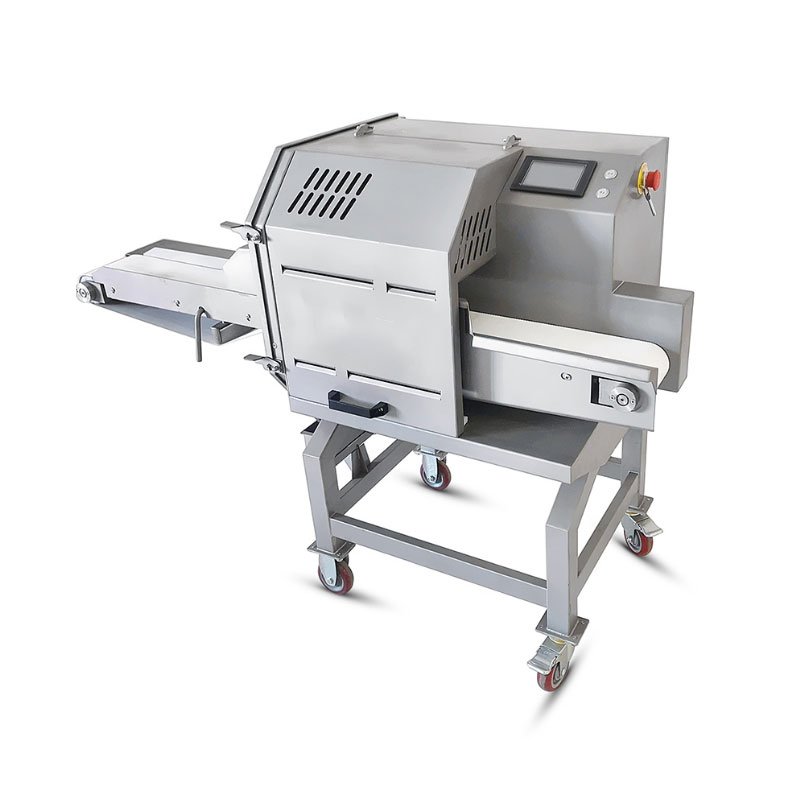
Designed around production-room practicality
Food-zone stainless surfaces support routine washdown planning and corrosion resistance.
Short infeed and discharge sections support continuous product presentation and line connection.
The ordinary configuration uses inverter control; the smart configuration is listed with PLC control.
The enclosed blade area separates the operator from the cutting mechanism during production.
QP-120 and QP-140 comparison
| Model | Conveyor width | Blades | Slice setting | Power | Weight | Dimensions |
|---|---|---|---|---|---|---|
| QP-120 | 120 mm | 3 | 1–13 mm | 1.1 kW | 165 kg | 1330 × 630 × 1250 mm |
| QP-140 | 140 mm | 2 | 1–120 mm | 1.5 kW | 600 kg | 1500 × 625 × 1050 mm |
The unusually large difference in weight and thickness range indicates materially different configurations, not merely a 20 mm belt-width change. Confirm the blade arrangement, meaning of the QP-140 maximum setting, voltage, throughput, product envelope and final general-arrangement drawing in the quotation. No unsupported capacity or cutting-speed value is added here.
Choose from the finished product—not the model number alone
Start with slice geometry
QP-120 publishes three blades and a finer 1–13 mm setting range. QP-140 lists two blades and a much broader 1–120 mm range. Send photographs, cooked portion dimensions and the target slice thickness so the factory can establish which mechanism is appropriate.
Control texture and temperature
Cooked pork, beef, poultry and formed products behave differently. Fat, connective tissue, casing, moisture, cooking loss and core temperature can change tearing or adhesion. A trial should reproduce the production recipe and temperature.
Plan the line interfaces
For automated use, define belt height, direction, upstream pitch, required gap between portions and discharge method. Verify that downstream weighing, tray loading or mixing equipment can accept the slice orientation and rate.
Build a cleanable routine
Isolate and lock out electrical power before opening guards. Validate access to the blades, conveyor faces, belt returns, guide points and discharge zone. Document dismantling sequence, approved chemicals, inspection points and restart checks.
Turn “good slicing” into measurable criteria
Before purchase, agree on representative product batches and acceptance limits. Record target thickness and distribution, complete versus torn slices, sticking or folding, product loss, stable running time, operator input, changeover duration and cleaning time. Also confirm motor and control-panel ratings against local utility and hygiene requirements.
Published capacity and cutting speed are not available for this exact family, so required output should be demonstrated rather than estimated from blade count. A timed test with weighed good product gives a defensible line capacity and exposes any feeding bottleneck.
QP cooked-meat slicer FAQ
What products are QP-120 and QP-140 intended to cut?
The exact source describes small pieces of cooked meat and identifies meat plants and large canteens as typical users. Suitability for a specific recipe must be confirmed by trial.
Which model is better for thin slices?
QP-120 publishes a 1–13 mm range and three blades. QP-140 publishes 1–120 mm and two blades. Thin-slice quality still depends on portion firmness, geometry and temperature.
Can the machine connect to an automatic line?
Yes, line integration is a published feature. Confirm conveyor height, direction, controls, product spacing and the required upstream/downstream handshakes during engineering.
Is an exact product video available?
No stable, reusable video for the exact QP-120/140 family was verified. Request a current factory video or a witnessed trial using the selected model and your product.
Configure your QP slicer
Send product type, recipe, portion dimensions and temperature, required slice thickness and good output, operating hours, utilities and line-interface details.
Ready to discuss your project?
Use our single online inquiry form to send your product, capacity, utility and layout requirements.
Go to contact formApplication fit
Applications for Multifunctional Cooked Meat Slicer
Best suited to cooked or chilled meat portions that need repeatable slices while controlling product deformation, surface quality and yield. Final suitability should be confirmed with representative product trials and the agreed acceptance criteria.