
Frozen Meat Dicer
Cut large tempered frozen meat pieces into controlled 20–50 mm portions with a continuous conveyor, two-stage knife system and servo-regulated feed. The QD-420 combines a 420 mm belt with HMI recipe control for repeatable industrial production.
Coordinate conveyor travel with two cutting directions
QD-420 is built around a wide conveyor and enclosed cutting head rather than a batch chamber. Official information describes two knife groups: a vertical cutter handling up to 50 mm thickness and a rolling-cutter group whose spacing can be configured. Servo control regulates conveyor travel so the longitudinal step remains consistent with the selected recipe.
The machine is published for frozen meat between -6°C and -10°C and raw pieces up to 120 mm high. These are equipment limits, not permission to load every product at the extremes simultaneously. Block width, length, fat content, shape and core-temperature variation must be reviewed before the final knife layout is released.
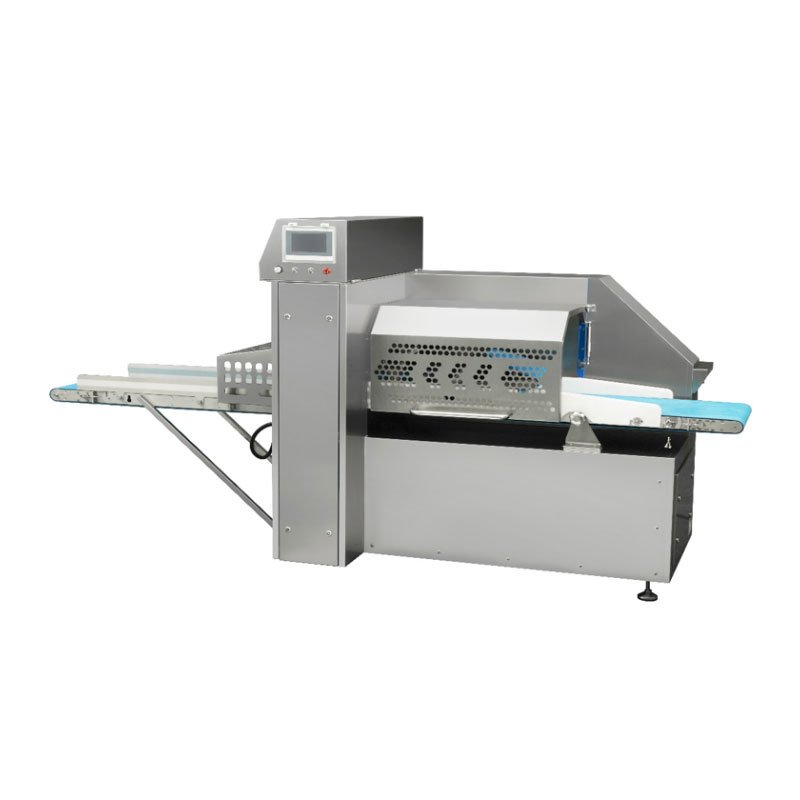
Wide belt, recipe control and guarded cutting zone
Regulated belt movement supports repeatable cut length instead of relying on manual indexing.
Rolling-cutter spacing is selected around the required 20–50 mm result and actual material behavior.
The HMI provides the operator interface for setup and production control. Confirm recipe access levels and languages.
The published stainless body and guarded cutting head suit hygienic production; sanitation details require project review.
QD-420 technical specifications
| Cutting size | 20–50 mm, configured blade group | Meat temperature | -6°C to -10°C |
|---|---|---|---|
| Maximum cut thickness | 50 mm | Maximum product height | 120 mm |
| Cutting speed | 90–110 cycles/min | Installed power | 7 kW |
| Conveyor belt | 1630 × 420 mm | Protection rating | IP65, published |
| Machine weight | 890 kg | Overall dimensions | 3120 × 1120 × 1700 mm |
No dependable kg/h capacity is stated on the exact official page. Cycle rate cannot be converted to output without actual loading dimensions, spacing, gaps and yield. Confirm voltage, frequency, blade drawing, feed limits and final general-arrangement drawing in the commercial proposal.
Translate cube size into a verified cutting recipe
The advertised 20–50 mm range describes configurable cutting dimensions, but real output is influenced by product compression and the relationship between conveyor step, vertical cutter and rolling blade spacing. Define allowable dimensional tolerance and measure all three axes during a product trial.
Temperature discipline
A soft surface around a hard core can smear externally while overloading the knife internally. Measure both surface and core temperatures across several blocks, and document tempering time before the test.
Blade configuration
List every required finished size. Ask the supplier to identify the corresponding blade group, change parts, safe handling tools, storage method, changeover time and sharpening procedure.
Hygienic changeover
Isolate energy before opening the guard. Clean belt joints, side guides, the underside return path, rolling cutters, vertical knife interfaces and discharge surfaces. Confirm which assemblies are tool-free and which cannot be washed directly.
Factory acceptance test
Report good kg/h, size distribution, fines, smear, temperature rise, yield, operator count, clean-down time and restart checks. Use the buyer's normal product rather than uniform demonstration blocks.
QD-420 frozen meat dicer FAQ
How does QD-420 differ from DRQD-350/400/450?
QD-420 is a long conveyor machine for larger pieces with vertical and rolling cutter groups. DRQD is a separate three-dimensional series with a different drum-based architecture and smaller published cut range.
Can it process meat colder than -10°C?
The exact page publishes -6°C to -10°C. Colder operation should not be assumed; it requires a documented factory test and approval of knife loading and cut quality.
Is 90–110 cycles/min the production capacity?
No. It is cutting speed. Accepted kilograms per hour depends on piece dimensions, feed gaps, recipe and the percentage of saleable output.
Was an exact QD-420 video found?
No reusable exact-model video was found on the current official page or corroborating public listings. Request a current test video with the selected blade layout and actual product.
Specify Frozen Meat Dicer from the finished product backwards
A reliable quotation starts with the product and process target rather than a catalogue capacity alone. Provide incoming product temperature, block dimensions, cut geometry, blade configuration, loading method and downstream handling. Samples, drawings and representative raw materials allow the supplier to identify the working configuration and any limits that should appear in the signed specification.
Published capacity is a reference condition, not an unconditional guarantee for every recipe. Sustainable performance must be measured as accepted product after normal rejects and interruptions. The acceptance plan should record cut-size distribution, fines, smearing, product temperature rise, yield and accepted kilograms per hour. Agree the run duration, staffing, utility conditions and sampling frequency before the factory acceptance test so both parties evaluate the same result.
Confirm voltage and frequency, connected load, compressed air, water, drainage, exhaust or refrigeration where applicable. Check loading height, discharge direction, service clearance, floor loading and the real interface with upstream and downstream equipment.
Review blade access, trapped product, safe lockout, removable guards and sanitation verification. The sanitation method must suit the machine’s electrical protection and the factory’s documented food-safety program.
Use the intended material and product format. Record start-up loss, stable output, quality variation, alarms, downtime, cleaning time and changeover time. Repeat critical checks after installation with actual site utilities and trained operators.
Send product photos or samples, formula where relevant, target hourly output, shift pattern, pack or downstream format, factory layout and utility schedule. Mark mandatory requirements separately from optional future expansion.
Validate your QD-420 recipe
Send block dimensions, surface and core temperatures, required three-axis size, tolerance, kg/h and sanitation standard.
Ready to discuss your project?
Use our single online inquiry form to send your product, capacity, utility and layout requirements.
Go to contact form