
Automatic Frozen Meat Dicer
Turn tempered frozen blocks into controlled 1–30 mm portions with automatic feeding and a compact high-speed cutting platform. QD-300 is intended for prepared blocks up to 300 mm wide and 35 mm thick.
Match automatic feed speed to product condition
QD-300 is presented as an automatic dicer for frozen meat blocks around 35 mm thick. The official specification expands that application to a -8°C to 0°C cutting window, a maximum width of 300 mm and selectable 1–30 mm cut size. Its stated maximum 200 cycles per minute positions it for rapid, repeated cutting rather than large-height block handling.
This machine should not be merged with QD-420. QD-420 accepts product up to 120 mm high and uses a 420 mm conveyor for 20–50 mm portions; QD-300 is the faster, smaller-section option. DRQD remains the separate three-dimensional solution for fine cubes, strips and slices.
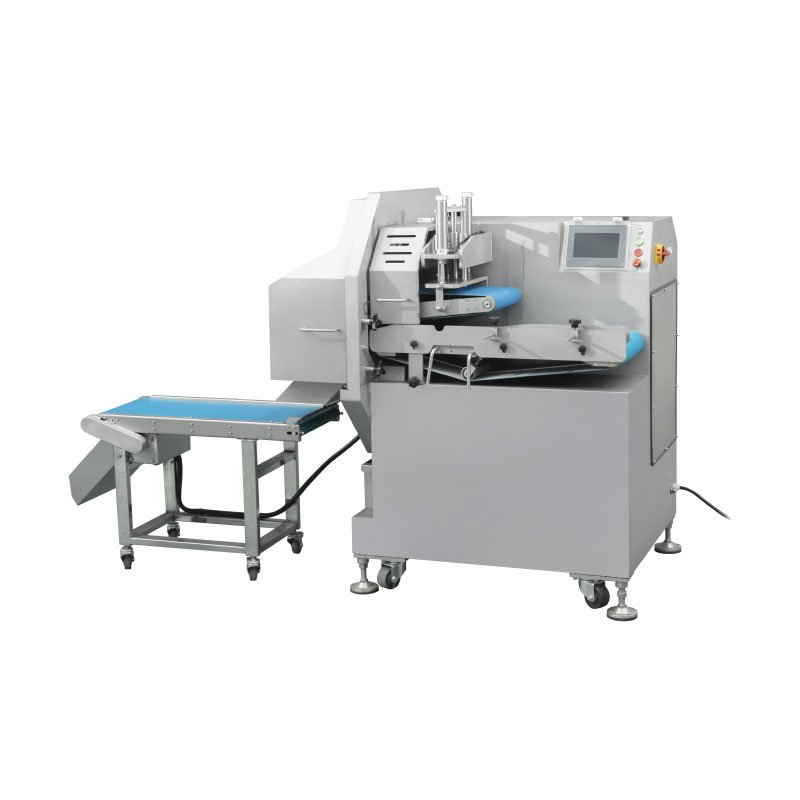
Integrated cutter with separate discharge conveyor
The guarded belt arrangement supports repeatable presentation to the cutting zone and reduces manual indexing.
Up to 200 cycles per minute is published. Actual sellable kg/h still depends on block loading, gaps, cut size and yield.
The official construction is stainless steel for food-processing use. Confirm contact-material certificates for the delivered configuration.
The pictured auxiliary conveyor transfers portions away from the cutter. Confirm included scope, height and downstream interface.
QD-300 technical specifications
| Maximum frozen block | 420 × 230 × 680 mm | Cutting size | 1–30 mm |
|---|---|---|---|
| Maximum width | 300 mm | Maximum thickness | 35 mm |
| Cutting temperature | -8°C to 0°C | Maximum cutting speed | 200 cycles/min |
| Published accuracy | 0.1 mm | Equipment power | 7 kW |
| Overall dimensions | 1255 × 1025 × 1355 mm | Material | Stainless steel |
The published maximum-block dimensions appear larger than the separate maximum width and 35 mm thickness statements, so they may describe incoming stock before preparation rather than the active cutting envelope. Obtain a signed loading drawing and test the actual block format before contracting. Voltage, weight and kg/h are not stated on the exact page.
Convert cycle speed into accepted product output
A cycle-rate claim does not establish capacity. Smaller 1–10 mm settings may change blade loading and fines, while thicker portions change the number of finished pieces per block. Define the percentage of output that must remain inside dimensional tolerance.
Resolve the loading envelope
Provide minimum and maximum block length, width and thickness plus photographs. Ask the factory to mark the usable inlet and active knife width on the general-arrangement drawing.
Temperature control
Measure surface and core temperatures at loading. A warm surface can smear while a colder core increases cutting force, causing dimensional variation even when the positioning system repeats accurately.
Cleaning procedure
Lock out power before accessing belts, guides or cutters. Include the upper belt, lower return, discharge conveyor, guard interfaces and internal seams in sanitation verification. Record removal and reassembly time.
Acceptance test
Use normal production blocks and report good kg/h, dimensional distribution, fines, smear, temperature rise, operator count, cleaning time, alarm response and restart consistency.
QD-300 automatic dicer FAQ
Is QD-300 a smaller QD-420?
No. They have different architectures and operating envelopes. QD-300 focuses on prepared blocks up to 35 mm thick and 1–30 mm cuts at higher cycle speed.
Does 0.1 mm accuracy guarantee every meat piece?
No. It is a published machine accuracy figure. Finished-product variation also depends on temperature, compression, geometry, blade condition and feeding.
Can QD-300 cut fully hard-frozen meat below -8°C?
The exact page specifies -8°C to 0°C. Colder duty requires factory approval and a representative-product test; it should not be assumed.
Is an exact-model video available?
No reusable, exact QD-300 video was found in current official public records. Request a dated factory trial showing the proposed cut size and raw material.
Specify Automatic Frozen Meat Dicer from the finished product backwards
A reliable quotation starts with the product and process target rather than a catalogue capacity alone. Provide incoming product temperature, block dimensions, cut geometry, blade configuration, loading method and downstream handling. Samples, drawings and representative raw materials allow the supplier to identify the working configuration and any limits that should appear in the signed specification.
Published capacity is a reference condition, not an unconditional guarantee for every recipe. Sustainable performance must be measured as accepted product after normal rejects and interruptions. The acceptance plan should record cut-size distribution, fines, smearing, product temperature rise, yield and accepted kilograms per hour. Agree the run duration, staffing, utility conditions and sampling frequency before the factory acceptance test so both parties evaluate the same result.
Confirm voltage and frequency, connected load, compressed air, water, drainage, exhaust or refrigeration where applicable. Check loading height, discharge direction, service clearance, floor loading and the real interface with upstream and downstream equipment.
Review blade access, trapped product, safe lockout, removable guards and sanitation verification. The sanitation method must suit the machine’s electrical protection and the factory’s documented food-safety program.
Use the intended material and product format. Record start-up loss, stable output, quality variation, alarms, downtime, cleaning time and changeover time. Repeat critical checks after installation with actual site utilities and trained operators.
Send product photos or samples, formula where relevant, target hourly output, shift pattern, pack or downstream format, factory layout and utility schedule. Mark mandatory requirements separately from optional future expansion.
Validate QD-300 for your block format
Send block dimensions, temperatures, target size and tolerance, required good kg/h and downstream conveyor height.
Ready to discuss your project?
Use our single online inquiry form to send your product, capacity, utility and layout requirements.
Go to contact form