
Multi-Piece Frozen Meat Slicer
Automatically feed and slice large or multiple conditioned meat pieces for meat factories, central kitchens and high-volume catering operations. A multi-lane pusher carriage presents product to the guarded cutting tower before slices transfer onto the discharge conveyor.
A production platform for repeated frozen-meat portions
The official HELPER listing positions this machine for large and multiple pieces of meat. Its product image shows several parallel hold-down or pusher elements on the loading carriage, a guarded central cutting tower with operator interface, and a separate discharge conveyor. This architecture is useful where batches of similarly prepared pieces must be presented consistently without relying on a manual deli-style carriage.
The exact model designation and technical table are not published on the current source page. Consequently, this page describes the verified application and visible machine architecture but does not assign capacity, slice thickness, cutting speed, product temperature, chamber dimensions, power or weight. Those values must be tied to the serial configuration offered by HELPER.
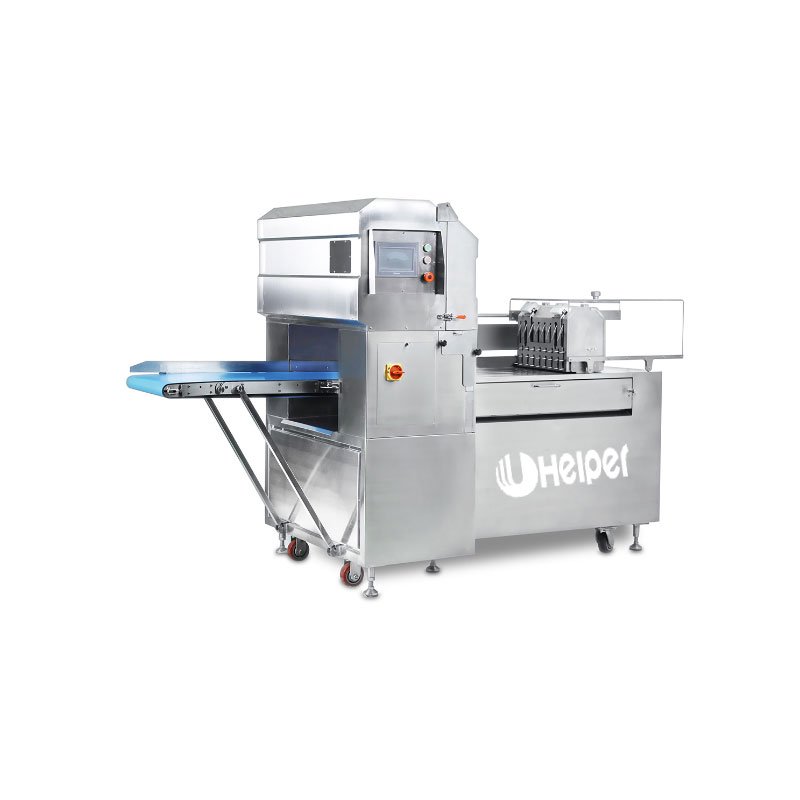
Separate loading, cutting and transfer zones
Several visible restraints allow multiple prepared pieces to be staged for a cutting cycle.
The blade area is enclosed and separated from normal loading and discharge positions.
A screen and physical controls are visible for cycle setup, start/stop and emergency action.
Finished slices leave the cutting zone on a supported conveyor for downstream handling.
Specifications that must be confirmed before purchase
| Engineering item | Required confirmation | Why it matters |
|---|---|---|
| Exact model and revision | Nameplate designation and dated drawing | Prevents data from a visually different slicer being applied |
| Product envelope | Maximum length, width, height, piece count and load | Determines carriage fit and restraint arrangement |
| Temperature window | Permitted surface and core range by product | Controls cutting force, smearing and slice integrity |
| Slice setting | Minimum, maximum, increment and tolerance | Defines whether target portions are achievable |
| Production rate | Cycles/min and accepted kg/h at target thickness | Separates mechanical speed from usable output |
| Utilities and footprint | Voltage, frequency, power, air, dimensions and weight | Supports installation and line planning |
Do not use the QPJ-25A horizontal slicer table for this machine. Cross-site visual comparison shows that QPJ-25A has a different enclosed body, cutting enclosure and conveyor arrangement. It remains a separate HELPER product family.
Frozen does not describe one cutting condition
Define the raw material
Provide species, muscle or formed-product type, bone condition, dimensions, weight distribution and fat content. State whether pieces are deep-frozen, tempered or crust-frozen and measure both core and surface temperature.
Define the required slice
Specify thickness, tolerance, intact-slice percentage and presentation. Very thin slices, shabu portions, steak cuts and downstream grinder feed are different duties and may require different blades or conditioning.
Engineer collection
Confirm belt height, direction and speed, then determine whether slices will fall into a tote, overlap on the belt, feed a weighing system or transfer into packaging. Delicate thin slices require gentler handling than preprocessing flakes.
Assess product remnants
Every restraint and blade system leaves a final remnant. Measure its mass, define whether it can be reworked and include it in yield calculations rather than judging only visual slice quality.
Approve the offered machine with representative product
A witnessed trial should use the same piece dimensions, temperature distribution and recipe expected in production. Record loaded kilograms, accepted slices, remnant and trim weight, thickness distribution, cracking, tearing, compression, temperature rise and stable output over a meaningful run.
Verify guard interlocks, emergency stops, carriage restraint, recipe recovery, alarm handling and safe jam clearance. Time product changeover and complete cleaning of the pusher elements, carriage, cutting enclosure, blade zone, belt top and return path. The signed acceptance record should identify the exact model, software revision, blade, product and test temperature.
Plan access before the machine reaches the factory
Frozen-meat cutting can leave fine particles and fatty deposits around restraints, blade edges and belt transitions. Require a documented lockout and dismantling sequence, approved lifting or handling method for heavy blade components, chemical compatibility, inspection points and post-cleaning restart check.
Ask for the recommended critical spare package, including blades, belt components, seals, restraint parts, safety switches and sensors. Maintenance intervals must correspond to the exact delivered configuration rather than a generic frozen-meat slicer manual.
Frozen meat slicer FAQ
What model is shown on this page?
The current official source does not publish a model designation. Request the exact nameplate model and dated technical sheet with the quotation.
Is this the QPJ-25A horizontal slicer?
No. QPJ-25A has a visibly different enclosure, feed layout and conveyor. Its published specifications are deliberately excluded.
What temperature and thickness can it process?
The exact page does not state either range. Both must be demonstrated with the intended product and recorded in the purchase specification.
Is an exact machine video available?
No stable video for this exact pictured machine was verified. Request a current factory test video tied to the offered model.
Identify and configure the exact slicer
Send product photographs, dimensions, temperature, pieces per load, target thickness and tolerance, accepted kg/h, utilities and downstream handling.
Ready to discuss your project?
Use our single online inquiry form to send your product, capacity, utility and layout requirements.
Go to contact form