
Multi-Blade Horizontal Meat Slicer
Create several uniform horizontal layers in one conveyor pass. The KPJ series is designed for chicken, beef, fish, pork and lamb, with configurable blade spacing from a published minimum of 3 mm.
Split product horizontally through parallel blades
Unlike QKJ circular-blade machines that make repeated cross-slices, KPJ uses multiple horizontally arranged blades above a continuous belt. A compatible piece passes through the guarded cutting zone once and exits as several layers. This makes the series relevant for chicken breast fillets, portioned meat sheets and products that will be stacked, marinated, breaded or cut again downstream.
Official information describes a 3–42 mm horizontal slicing range, while the model table publishes only “minimum 3 mm.” Treat 42 mm as the family upper reference and confirm every required spacing, blade count and maximum product height in the proposed knife drawing.
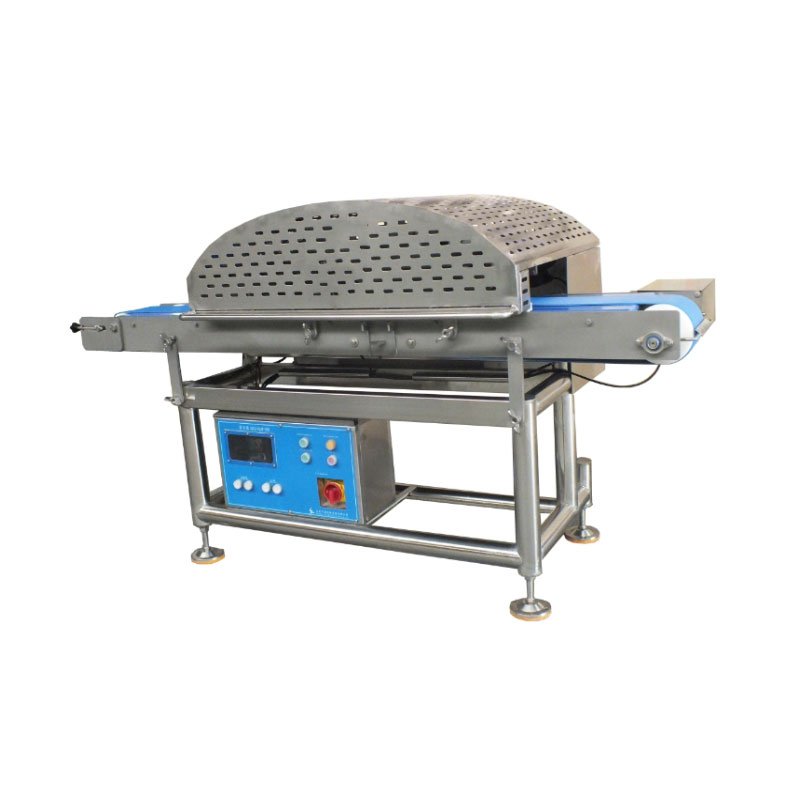
Guarded blades with production-line flexibility
Select the lane arrangement around product width, loading pattern and upstream operator capacity.
Blade count and spacers establish the layer thickness. Each target recipe requires a confirmed set.
The machine is specified with SUS304 and food-grade non-metallic materials.
Published components include branded electrical equipment, inverter control and a Chinese/English interface.
KPJ-200 and KPJ-400
| Model | Belt width | Minimum slice | Power | Weight | Dimensions |
|---|---|---|---|---|---|
| KPJ-200 | 160 mm | 3 mm | 1.3 kW | 220 kg | 2100 × 920 × 1220 mm |
| KPJ-400 | 200 mm | 3 mm | 1.8 kW | 280 kg | 2100 × 1800 × 1220 mm |
The exact page does not publish belt speed, kg/h, maximum product height, voltage or complete blade-spacing combinations. KPJ-400's 1800 mm machine width may reflect a dual-channel layout; confirm channel count and signed GA before procurement.
Control product shape before it reaches the blades
Product presentation
Irregular thickness or curled edges produce uneven layers. Define minimum and maximum product dimensions, loading orientation, core temperature and acceptable compression.
Knife-set ownership
Specify every layer thickness, blade count, spacer arrangement, spare blades, sharpening method, safe handling tool and storage fixture.
Cleaning and safety
Lock out before lifting the perforated guard. Clean belt joints, return path, blade shafts, spacers and discharge. Verify guards and emergency stop before restart.
Acceptance test
Record good kg/h, layer-thickness distribution, tears, incomplete cuts, yield, temperature rise, operator count, knife change time and sanitation duration.
KPJ multi-blade slicer FAQ
How does KPJ differ from QKJ?
KPJ creates several horizontal layers simultaneously with parallel blades. QKJ advances a product through a circular blade to make repeated cross-slices.
Can it cut 3–42 mm layers?
The overview gives that range and the table confirms a 3 mm minimum. Confirm each required spacing and maximum product height with a knife drawing and trial.
Which model should I choose?
Start with usable belt width and required lane count. KPJ-400 is wider and more powerful; do not select solely by model number.
Is an exact product video available?
The official page includes a video heading but no reusable exact KPJ media was resolved. Request a current trial with the proposed blade set.
Specify Multi-Blade Horizontal Meat Slicer from the finished product backwards
A reliable quotation starts with the product and process target rather than a catalogue capacity alone. Provide incoming product temperature, block dimensions, cut geometry, blade configuration, loading method and downstream handling. Samples, drawings and representative raw materials allow the supplier to identify the working configuration and any limits that should appear in the signed specification.
Published capacity is a reference condition, not an unconditional guarantee for every recipe. Sustainable performance must be measured as accepted product after normal rejects and interruptions. The acceptance plan should record cut-size distribution, fines, smearing, product temperature rise, yield and accepted kilograms per hour. Agree the run duration, staffing, utility conditions and sampling frequency before the factory acceptance test so both parties evaluate the same result.
Confirm voltage and frequency, connected load, compressed air, water, drainage, exhaust or refrigeration where applicable. Check loading height, discharge direction, service clearance, floor loading and the real interface with upstream and downstream equipment.
Review blade access, trapped product, safe lockout, removable guards and sanitation verification. The sanitation method must suit the machine’s electrical protection and the factory’s documented food-safety program.
Use the intended material and product format. Record start-up loss, stable output, quality variation, alarms, downtime, cleaning time and changeover time. Repeat critical checks after installation with actual site utilities and trained operators.
Send product photos or samples, formula where relevant, target hourly output, shift pattern, pack or downstream format, factory layout and utility schedule. Mark mandatory requirements separately from optional future expansion.
Configure a KPJ blade set
Send product dimensions and temperature, required layer thicknesses, lanes, good kg/h and downstream process.
Ready to discuss your project?
Use our single online inquiry form to send your product, capacity, utility and layout requirements.
Go to contact form