
Inspect
Remove foreign metal and qualify species, dimensions, moisture, temperature and incoming variability.
Reduce fresh or dry cattle, pig, sheep and fish bones into controlled feed particles for bone meal, broth, marrow extract, gelatin, chondroitin, peptides, pet food, seasonings and biological-product processes.
The SGJ series uses claw-type crushing and optimized blade holders to apply shear and impact across irregular animal bones. The official output range is 5–80 mm, so this equipment should be treated as a primary or intermediate crusher. Fine bone meal or paste normally requires a defined downstream milling, emulsifying or separation stage.
Selection starts with bone species, fresh or dry condition, maximum incoming size, moisture, temperature and required downstream particle distribution. Capacity varies from 100–200 kg/h on SGJ-300 to 3,000–6,000 kg/h on SGJ-1050, but the correct model also depends on bridging risk, feed presentation and the largest piece that can safely enter its chamber.
Remove foreign metal and qualify species, dimensions, moisture, temperature and incoming variability.
Present bone at a controlled rate by hand or conveyor without overfilling or bridging the soundproof hopper.
Alloy-steel claws shear and impact the material; blade setting influences the resulting particle size.
Screen samples, record oversize and fines, monitor motor load, temperature rise and accepted kilograms per hour.
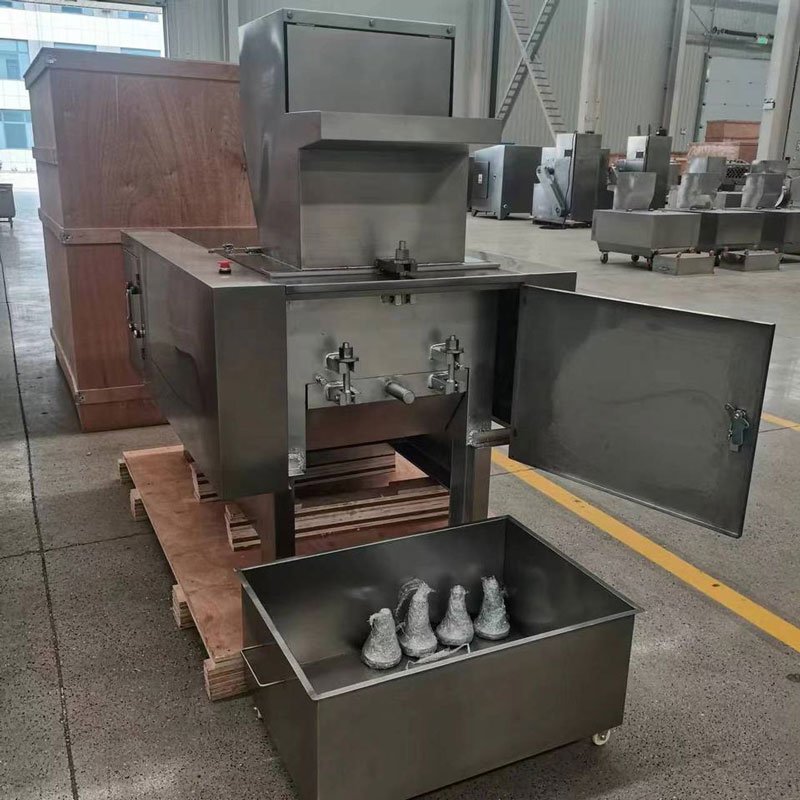
Particle-size adjustment method and screen configuration are not detailed on the exact page. Confirm the supplied rotor, blade gap, screens if applicable and changeover method for every required product.
| Model | Crushing chamber | Capacity | Motor power |
|---|---|---|---|
| SGJ-300 | 290 × 220 mm | 100–200 kg/h | 4 kW |
| SGJ-360 | 360 × 260 mm | 200–400 kg/h | 7.5 kW |
| SGJ-420 | 420 × 280 mm | 300–600 kg/h | 11 kW |
| SGJ-480 | 480 × 330 mm | 400–1,000 kg/h | 15 kW |
| SGJ-510 | 510 × 320 mm | 600–1,500 kg/h | 15 kW |
| SGJ-660 | 660 × 350 mm | 800–2,000 kg/h | 22 kW |
| SGJ-720 | 720 × 500 mm | 1,000–2,500 kg/h | 37 kW |
| SGJ-910 | 910 × 820 mm | 2,000–5,000 kg/h | 55 kW |
| SGJ-1050 | 1050 × 820 mm | 3,000–6,000 kg/h | 75 kW |
The official operating footage is placed after the process and model schedule so buyers can assess loading, crushing and discharge with the correct technical context.
Watch the feed rate, hopper behavior, discharge flow and apparent particle spread. Note whether long or flat pieces bridge, whether output accumulates under the machine and how operators access the collection bin.
Video confirms machine architecture but does not prove capacity or a 5–80 mm distribution for every bone. A witnessed trial must use representative species, moisture and incoming dimensions, followed by sieve analysis.
Larger nominal capacity does not automatically solve uncontrolled feed. If bones exceed the safe hopper or chamber envelope, define upstream sawing or breaking. A metering conveyor should be interlocked to crusher load so it stops before overload or a dangerous jam develops.
For downstream broth or extraction, particle surface area and fines affect heat transfer, filtration and yield. For pet food or bone meal, oversize can overload the next mill while excessive fines increase dust. Specify a particle distribution, not only a maximum size.
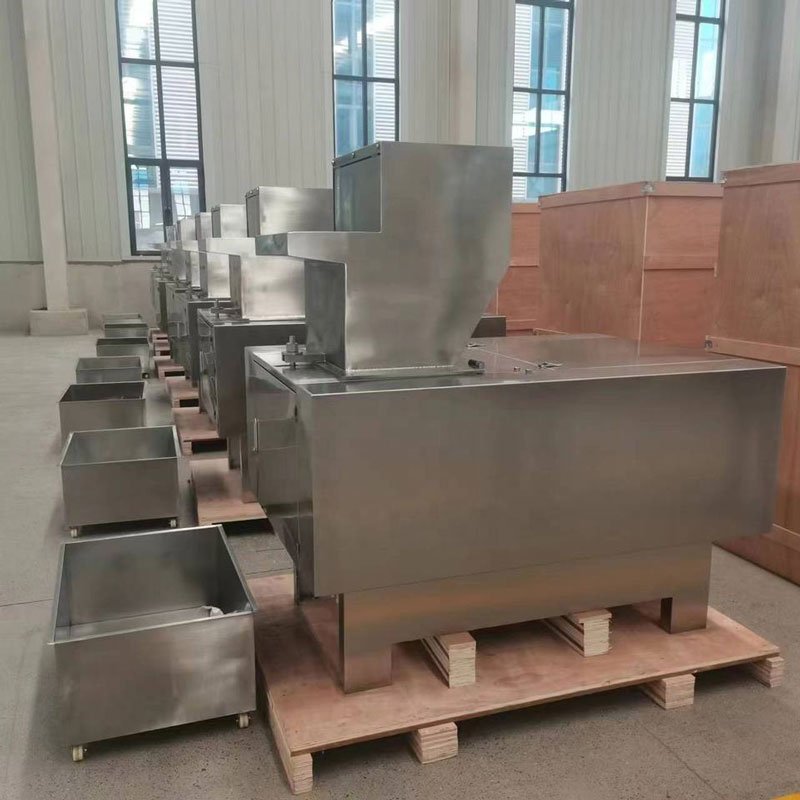
Reduces bones into smaller particles for extraction, milling, broth, pet-food or ingredient processes.
Creates saleable bone-in portions or defined cuts while preserving recognizable product geometry.
Mechanically separates soft tissue from hard material; it is selected by yield and residual-calcium criteria.
Verify reach distances, hopper interlock and conveyor stopping so hands and tools cannot enter the rotor zone.
Lock out power, prove zero motion and use an approved removal method; never reverse or probe an energized chamber.
Define inspection, sharpening, balance, fastener torque and replacement criteria for every blade set.
Demonstrate access to hopper, chamber, blade holders and discharge without creating unsafe manual handling.
Bone fragments can be sharp and heavy, while dry material can create dust. Assess PPE, dust collection, noise, lifting aids and collection-bin ergonomics. Confirm stainless grade, ingress protection, cleaning chemicals, drainage and food-contact documentation in the quotation.
Define the FAT lot by species, fresh or dry condition, moisture, temperature and minimum/maximum dimensions. Record gross input, accepted screened output, oversize, fines, losses, motor current, temperature rise, noise, vibration, bridging and interventions. Run long enough to expose blade heating and accumulation.
Use agreed sieves to quantify particle distribution at each required setting. Demonstrate overload response, feed interlock, emergency stop, restart prevention, safe jam recovery, blade access and full cleaning. For conveyor integration, test upstream stop logic and downstream bin-full or transfer faults.
The official page lists fresh and dry cattle, pig, sheep and fish bones. Maximum geometry and condition still require model-specific trials.
The published output is adjustable from 5 to 80 mm. Fine powder generally requires downstream milling; confirm the full process for the target specification.
The source table contains multiple obvious transcription errors. This page preserves reliable chamber, capacity and power values and requires a signed general arrangement for dimensions.
Yes. The official product page exposes video ID ylv3lLxOgUA, embedded here after the process and specification sections.
Receive an SGJ model review covering chamber size, capacity, power, conveyors, screening, safety and FAT.