
Prepare
Sort species and anatomy, remove foreign objects and reduce pieces to the validated feed geometry.
Recover usable mechanically separated meat from chicken, duck, goose, rabbit and fish materials in one primary separation step. Select capacity, pressure configuration and line handling around the required yield, texture and residual-bone specification.
The QGJ series processes chicken and other poultry frames, necks, wings, whole or segmented birds, rabbit and fish materials. A feed screw transports raw material into a perforated separation zone where controlled pressure encourages soft tissue through the openings while a harder bone-rich fraction exits separately.
This product is different from a bone crusher, which reduces all incoming bone, and from a chicken-leg deboner, which preserves a recognizable muscle piece. QGJ output is mechanically separated meat intended for products such as sausages, luncheon meat, meatballs, bacon formulations and ground-meat products. Regulatory naming and permitted uses vary by market and must be confirmed locally.
Sort species and anatomy, remove foreign objects and reduce pieces to the validated feed geometry.
Feed at a stable temperature and rate; QGJ-220 and larger models require a feed conveyor.
Screw pressure moves soft tissue through the separation element while the bone-rich fraction discharges separately.
Measure meat yield, residual bone/calcium, texture, temperature, bone loss and accepted kilograms per hour.
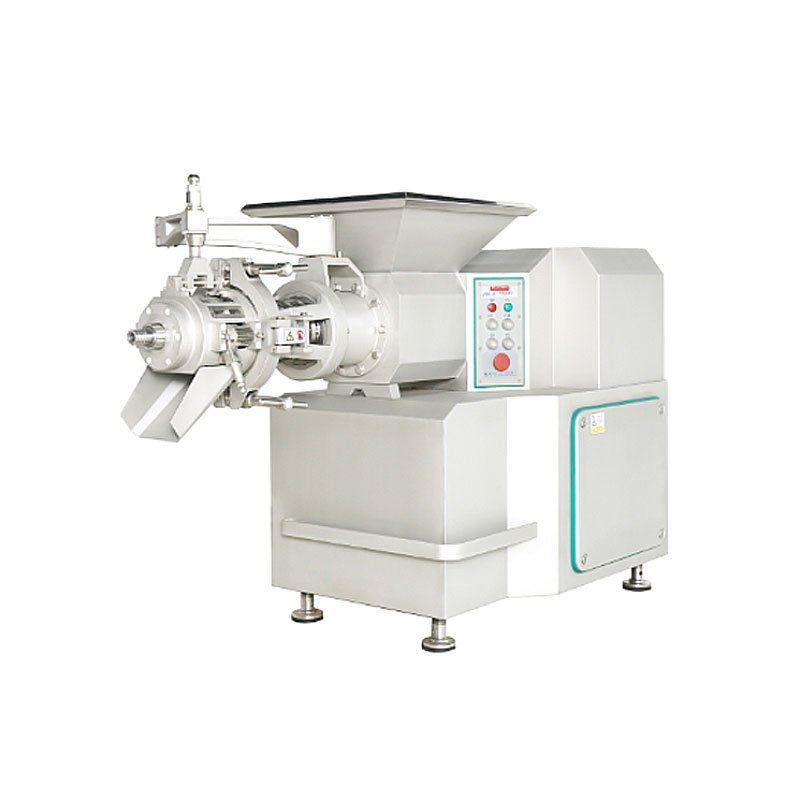
The exact pages do not publish hole diameter, pressure setting, screw speed, wear-part life or water addition. These variables directly influence yield, texture and hard-particle carryover and must be defined in the quotation and product trial.
| Model | Capacity | Power | Weight | Dimensions |
|---|---|---|---|---|
| QGJ-100 | 300–350 kg/h | 6.5 / 8 kW | 350 kg | 1440 × 630 × 970 mm |
| QGJ-130 | 600–800 kg/h | 13 / 16 kW | 800 kg | 1990 × 820 × 1300 mm |
| QGJ-160 | 1200–1500 kg/h | 18.5 / 22 kW | 1350 kg | 2130 × 890 × 1400 mm |
| QGJ-180 | 2000–3000 kg/h | 22 / 28 kW | 1500 kg | 2420 × 1200 × 1500 mm |
| QGJ-220 | 3000–4000 kg/h | 45 kW | 2150 kg | 2700 × 1450 × 1650 mm |
| QGJ-300 | 4000–5000 kg/h | 75 kW | 4200 kg | 3300 × 1825 × 1985 mm |
The verified HELPER video is positioned here, after the process and model table, so engineering teams can assess the actual machine architecture with the right performance questions in mind.
Observe feed continuity, pressure-head arrangement and where meat and bone-rich fractions leave the machine. Note any manual intervention and how collection or conveyors would connect.
Footage confirms design, but yield, bone content, temperature rise and texture depend on species, anatomy, pretreatment, screen and pressure. Only a controlled product trial can establish those values.
Weigh prepared feed, accepted meat, bone-rich discharge, retained material and process losses.
Use the destination market's validated laboratory method; do not rely on visual inspection or mouthfeel.
Evaluate fiber retention, particle structure, color, oxidation and functionality in the intended formulation.
Measure incoming and outgoing streams because pressure and friction can increase product temperature.
The English main site claims a 65%–90% production rate depending on raw material. The Group page says bone content can be as low as ≤0.9 g/kg, also product dependent. Neither is a universal guarantee. A higher pressure may recover more soft tissue while increasing bone fines or changing texture, so the project specification needs limits for all three outcomes.
The screw, separation element, pressure components and discharge restriction determine how material moves and separates. Wear can gradually alter yield and hard-particle carryover even when operators do not change a setting. Establish inspection dimensions, replacement criteria and a reference product test after service.
Ask for screen or separation-head options, hole geometry, adjustment limits, spare sets and expected life for the intended species. Record the exact configuration used during FAT so replacement parts reproduce the accepted result.
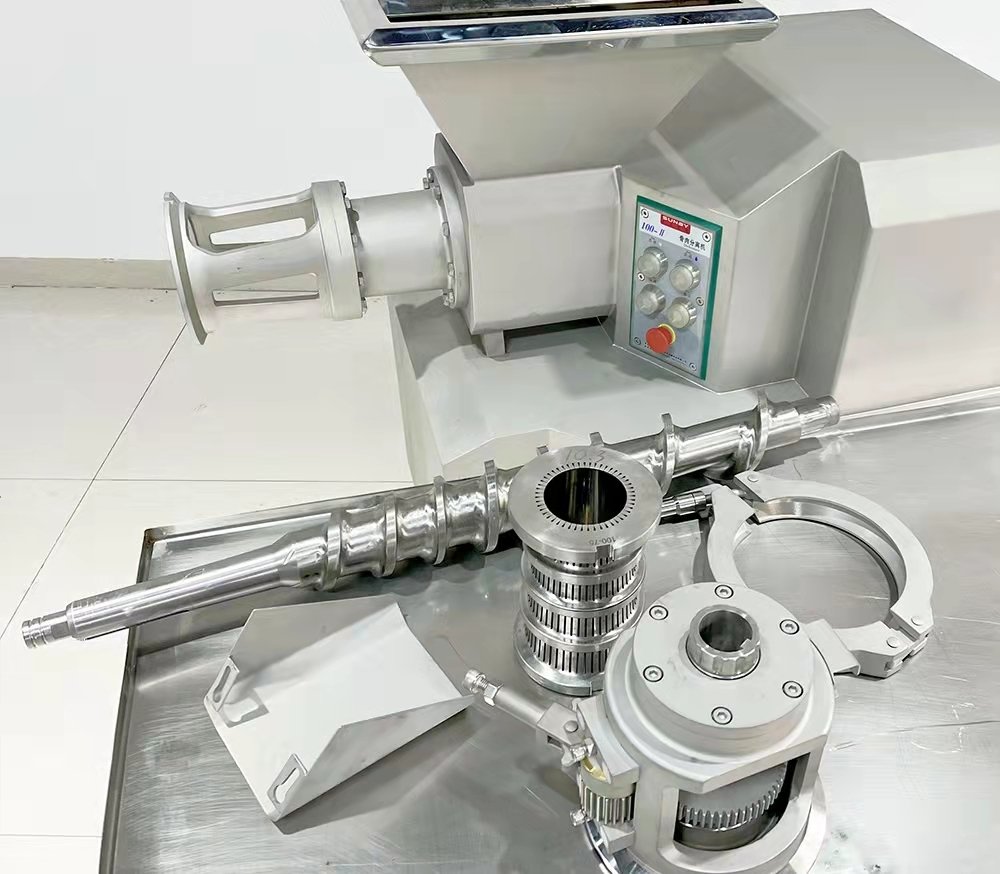
Produces mechanically separated meat and a bone-rich fraction from comminuted or prepared raw material.
Removes a bone from a specific anatomical cut while aiming to preserve a recognizable meat portion.
Reduces bone size for meal, broth, extraction or further milling; it does not recover a separate meat stream.
Guard the hopper and conveyor against reach-in access, interlock opening points and prevent restart after power loss. Jam recovery, pressure adjustment, disassembly and cleaning require documented isolation and zero-energy verification. Larger screws, heads and separation elements need rated lifting tools and stable storage racks.
For sanitation, remove product before rinsing, dismantle the approved contact components and inspect screw flights, perforations, seals, discharge chutes and dead spaces. Verify cleaning time, chemical compatibility, drainage and post-assembly alignment. Environmental monitoring and a validated low-temperature chain are important because separated meat has high surface area.
Define feed preparation, species, anatomical mix, incoming temperature, batch mass and foreign-material controls. Run enough material to reach stable operating conditions. Record accepted throughput, meat yield, bone discharge, losses, motor current, temperature rise, noise, vibration, stops and labor.
Take representative samples across the run for bone or calcium, texture, moisture, fat, protein and microbiology as applicable. Test at more than one pressure or screen setting to identify the operating window. Demonstrate overload response, interlocks, emergency stops, wear-part removal, cleaning, reassembly and restart. Agree numerical acceptance limits and laboratory methods before manufacture.
The exact sources list chicken, duck, goose, rabbit and fish, including frames, necks, whole or segmented birds, wings and other bone-bearing material. Every feed mix requires validation.
No. The main product page explicitly makes the range dependent on raw material. Define preparation and measure all output streams during a representative trial.
The main page uses a “no bone residue” description, while the Group site quantifies a product-dependent value as low as ≤0.9 g/kg. Use an agreed laboratory method and legal limit rather than treating “no bone” literally.
Yes. Video ID HL7xSGNv2aw is exposed by the exact HELPER QGJ product page and is not footage from the chicken-leg deboner or bone crusher.
Receive a QGJ model review covering preparation, separation trials, conveyors, utilities, hygiene and FAT.