
Load
Orient a qualified product within the approved temperature, height, length and bone-geometry window.
Program portion thickness and feed speed while a double-layer top gripper and fixed lower pin row stabilize frozen ribs, steaks, bone-in meat and fish products. Choose the 650 or 800 mm table length for the required product envelope.
This series combines one vertical band blade with servo-controlled automatic feeding. A fully automatic top gripper uses two clamping layers, while a fixed pin row supports the lower end. Together they stabilize the product as the feed system advances it by the programmed portion increment.
The documented application range is approximately -18°C to -4°C for ribs, frozen meat, steak, bone-in meat and fish. Compared with the JGJ-5060 dual-blade platform, this series has one cutting plane and lower published power. It suits operations that value programmable sequential portions over two simultaneous blade lanes.
Orient a qualified product within the approved temperature, height, length and bone-geometry window.
The double-layer top gripper and lower pin row secure material for controlled transmission.
Servo feed presents programmed increments to the single blade operating at a published 34 m/s.
Measure portions, end loss, kerf, fragments, accepted output and interventions for each recipe.
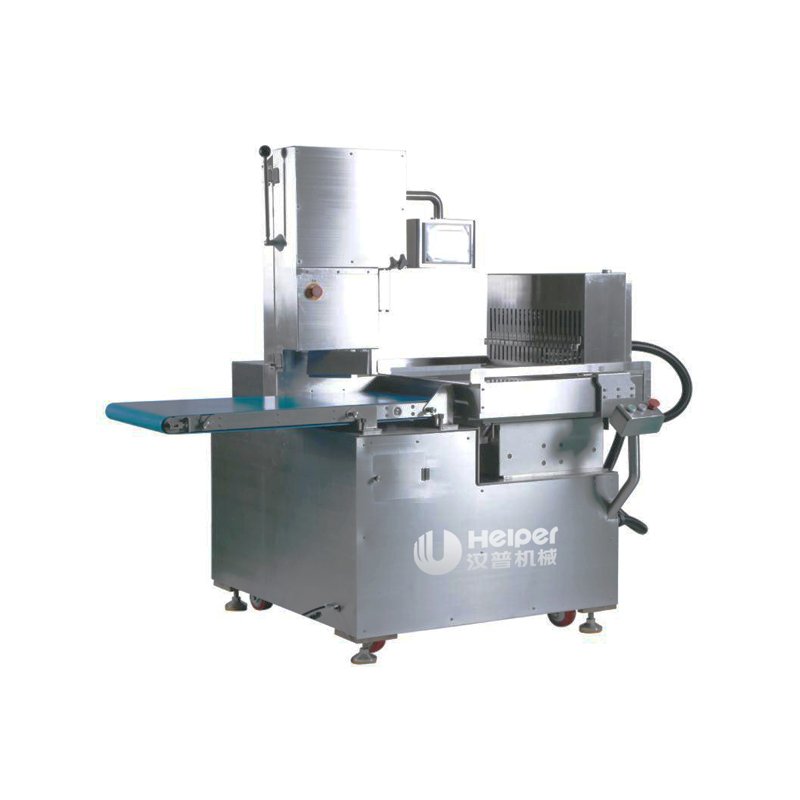
Request the technical file and declaration for the actual serial configuration. The page does not publish feed speed, grip stroke, recipe capacity, ingress rating, safety category or air consumption.
| Parameter | JGJ-6065 | JGJ-6580 |
|---|---|---|
| Table size | 600 × 650 mm | 600 × 800 mm |
| Maximum product height | 150 mm | 150 mm |
| Published cutting accuracy | 0.1 mm | 0.1 mm |
| Blade speed | 34 m/s | 34 m/s |
| Blade specification | 3084 × 16 × 0.56 mm, 4T | 3084 × 16 × 0.56 mm, 4T |
| Maximum cut thickness | 80 mm | 80 mm |
| Power | 3.5 kW | 3.5 kW |
| Air pressure | 0.4 MPa | 0.4 MPa |
| Weight | 1020 kg | 1100 kg |
| Dimensions | 1350 × 2020 × 1700 mm | 1350 × 2170 × 1700 mm |
The verified series video is shown after the mechanism and model table so its feed, grip and discharge actions can be evaluated in context.
Observe how product is placed, when the gripper engages, how the feed carriage indexes and where portions discharge. Note the handling of the final remnant and recovery from an interrupted cycle.
The video confirms architecture but cannot validate the claimed 0.1 mm accuracy, capacity or yield for an individual buyer. These require representative frozen product and an agreed measurement protocol.
Compare programmed advance with measured portion thickness at the beginning, middle and end of a product.
Weigh accepted portions, saw dust, trim and the final clamp remnant against incoming mass.
Inspect for drift, smear, chipped bone and fragments at cold and warm ends of the approved range.
Challenge minimum and maximum products, uneven shapes, surface frost and realistic bone orientations.
Accuracy should be defined statistically, not from a single ideal cut. Establish tolerance, sample count, gauge method and conditioning time. Blade tension, guide alignment, tooth wear and feed grip can all change results even when the servo position is repeatable.
The feed system reduces routine hand exposure but introduces clamp, carriage and automatic-motion hazards. Confirm fixed and interlocked guards, emergency stops, restart prevention, pneumatic isolation and safe control of stored energy. Define a locked-out procedure for jams, broken blades, end pieces and sanitation.
During FAT, test normal stop, emergency stop, guard opening, loss of air, power interruption and power restoration. Measure blade stopping time and verify that the clamp cannot release or move unpredictably.
Bone dust and tissue can collect in the lower pins, layered gripper, feed carriage, blade guides, belt return and wheel cabinet. Require a complete cleaning demonstration and confirm approved spray pressure, chemicals, disassembly tools and blade-handling PPE.
After sanitation, inspect hidden surfaces, reassemble the machine and verify blade tracking, grip alignment, sensors and recipe repeatability. Cleaning time and retained soil should form part of equipment acceptance.
Send species, photographs, minimum and maximum dimensions, core-temperature range, bone layout, required thickness recipes, tolerance and accepted kilograms or pieces per hour. Include shift duration, voltage, compressed-air capacity, sanitation standard, floor plan and downstream transfer height.
For FAT, record loading time, cycle time, accepted output, thickness distribution, kerf, end loss, fragments, stops and interventions. Run the longest product appropriate to the chosen table and repeat recipes across the defined temperature range. Agree numerical limits, retest rules, spare blades and training scope before dispatch.
The published table length is 650 versus 800 mm. The JGJ-6580 is 150 mm longer overall and 80 kg heavier; other listed cutting data is the same.
No. JGJ-6065/6580 is documented as a single-blade automatic-feed series. JGJ-5060 is a separate dual-blade architecture with different dimensions, utilities and power.
It is a published claim without a stated test method. Establish a realistic finished-portion tolerance using representative product during FAT.
Yes. The official product page exposes video ID w82KB81nPtk, embedded here after the process and specification content.
Receive a JGJ-6065/6580 review covering table selection, feed trials, utilities, guarding, sanitation and FAT.