
Qualify
Sort by species, diameter, length, temperature and visible damage; reject pieces outside the validated window.
A purpose-built stainless-steel machine for splitting compatible cow, sheep and pig feet. Two blue food-grade belts grip and guide the product through a single vertical band blade for safer, more repeatable presentation than unsupported manual feeding.
Livestock feet are tapered, jointed and difficult to support on a flat table. The JGJ-360 addresses that presentation problem with opposing conveyor belts that clamp the product and carry it toward the centered saw blade. The belt width can be adjusted to suit hoof diameter, while the published clamping height is 85 mm.
This is a specialized lengthwise splitting machine, not a universal frozen-block saw. Product species, hoof diameter, length, bone maturity, temperature and required split line determine whether the belts can hold the piece consistently. Representative samples should be tested before the configuration is approved.
Sort by species, diameter, length, temperature and visible damage; reject pieces outside the validated window.
With the machine isolated, set clamping width and inspect belt condition, guards, tension and blade alignment.
Orient each foot to the approved split line and let the belts control travel through the protected cutting zone.
Check split symmetry, fragments, cut-face quality, retained material and accepted pieces per hour.
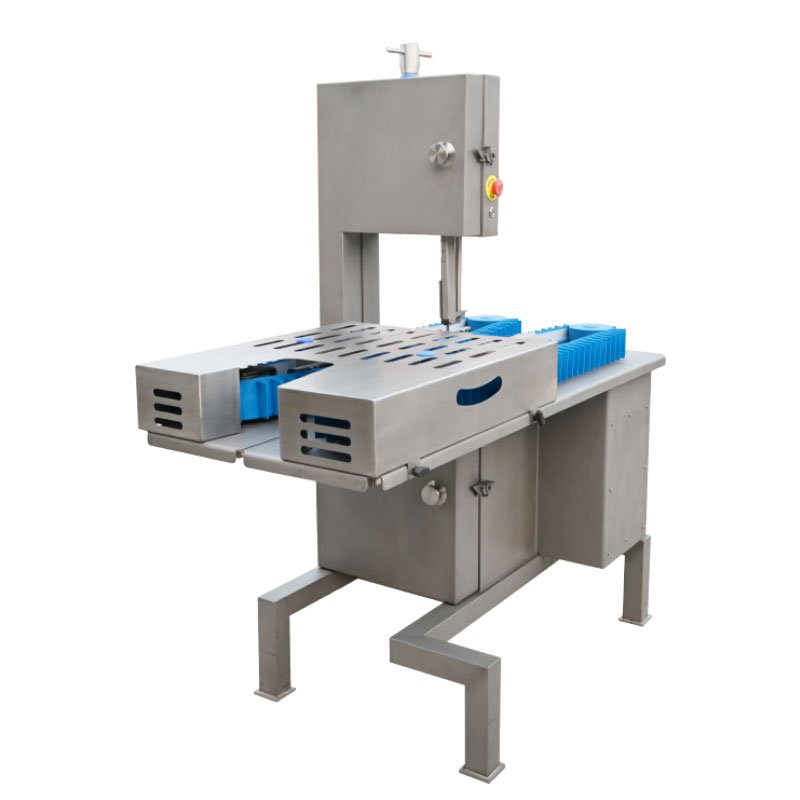
The 0.5-second value is an official claim that must be measured on the supplied machine under a defined test method. Confirm guard interlock architecture, stop category and restart prevention for the destination market.
| Model | JGJ-360 |
|---|---|
| Workbench size | 1400 × 800 mm |
| Maximum cutting height | 150 mm |
| Maximum feeding-inlet width | 100 mm |
| Conveyor clamping height | 85 mm |
| Saw-blade linear speed | 23 m/s |
| Cutting motor | 2.2 kW |
| Conveyor motor | 0.75 kW |
| Blade specification | 2490 × 15 mm, 4T |
| Machine weight | 220 kg |
| Overall dimensions | 1400 × 800 × 1735 mm |
The verified JGJ-360 footage is placed after the process and data sections so engineering teams can evaluate what the mechanism demonstrates—and what still requires a product trial.
Observe how the product is oriented at loading, where the belts first establish grip and whether the center line remains stable as diameter changes. Check whether discharge allows both halves to clear without rebounding or contacting the blade.
Video is useful evidence of machine architecture, but it does not prove throughput, yield or accuracy for a buyer's product. A witnessed trial should include smallest and largest feet, the coldest operating condition and normal upstream variability.
Measure left/right mass and the blade path through joints to quantify centering performance.
Inspect both cut faces and downstream collection for chips, splinters and loose hard particles.
Weigh incoming product, accepted halves, trim and saw residue to calculate actual saleable yield.
Confirm clamping force controls orientation without crushing, slipping or unacceptable surface damage.
Blade tension, tooth condition, belt pressure, feed speed, bone density and temperature all influence the cut. Trend deviations by species and size class. If the split repeatedly shifts at one diameter, the remedy may be belt setup or product sorting rather than increased operator pressure.
Bone dust and tissue can collect around the blade slot, belt profiles, tensioning points, guides and lower cabinet. The sanitation procedure should isolate energy, verify blade stop, release belt tension as approved, remove accessible guards and collect solids before rinsing. Chemical compatibility, spray pressure and ingress rating are not published on the exact product page and must be confirmed.
During sanitation acceptance, disassemble the offered cleanable parts, time the procedure and inspect with adequate lighting. Pay particular attention to hollow profiles, fasteners, belt return paths and drainability. After reassembly, confirm belt tracking, guard interlocks and blade alignment before releasing the machine.
The belts reduce the need to hold an irregular piece at the blade, yet loading, jams, broken blades, cleaning and maintenance remain hazardous tasks. Define minimum product length, approved loading tools, exclusion zones and a locked-out jam-removal method. Test every stop control and guard switch.
Request the risk assessment, electrical diagram and safety-component list for the quoted machine. Compliance claims must relate to the supplied serial configuration. The factory and integrator remain responsible for upstream guarding, floor conditions, operator training and local regulatory review.
Define the FAT batch by species, count, diameter range, length range, incoming temperature and preparation method. Record accepted pieces per hour, split symmetry, incomplete cuts, fragments, belt slips, stops, blade changes and operator interventions. Run long enough to evaluate belt tracking, blade heating, motor current and residue accumulation.
Witness normal stop, emergency stop, guard-opening stop and power-restoration behavior. Measure blade stopping time rather than relying on a statement. Complete a full cleaning demonstration, inspect hidden surfaces and verify repeatable setup afterward. Agree acceptance limits and retest rules before the machine is dispatched.
The exact official page specifies cow, sheep and pig feet. Other products require separate validation and should not be assumed from the blade size alone.
The published maximum feeding-inlet width is 100 mm, with an 85 mm conveyor clamping height. Confirm the full accepted geometry using representative samples.
HELPER publishes a 0.5-second stop after the stop button is pressed or the protective cover is opened. Treat this as a claim to verify during FAT on the supplied machine.
Yes. The exact HELPER page exposes video ID aplDIKdBc7M. No footage from the four-blade or general manual bone saw is substituted.
Receive a JGJ-360 review covering belt setup, product trials, guarding, sanitation, utilities and acceptance criteria.
Application fit
Best suited to centered splitting of livestock feet and other qualified irregular bone-in products that can be clamped and presented repeatably. Final suitability should be confirmed with representative product trials and the agreed acceptance criteria.