
Direct answer
For continuous cooling without phase change, product sensible load equals mass flow multiplied by specific heat and temperature reduction. This is only the heat removed from the product. Final refrigeration capacity also depends on freezing or evaporation, transmission, infiltration, fans, pumps, motors, lighting, people, defrost, packaging, respiration, operating schedule and pull-down requirements.
product sensible load (kW) = kg/h x kJ/(kg.K) x temperature change K / 3600Use product-specific thermal data over the stated temperature range. One default specific-heat value is not valid for every food.What exactly is being cooled?
Continuous product flow
Use accepted kilograms per hour and the actual inlet and target outlet temperatures at the cooling-equipment boundary.
Batch product load
Calculate total energy for the batch, then divide by the allowed cooling time and account for how the load varies through the cycle.
Product plus carrier
Include trays, racks, moulds, trolleys, brine, process water or packaging when they enter hot and are cooled by the same system.
Room or process system
State whether the project covers only a cooler, a freezer, a cold room, a glycol loop or the complete refrigeration plant.
Cool 1,500 kg/h from 75 C to 10 C
Assume an approved average specific heat of 3.6 kJ/(kg.K) over this non-freezing range. The temperature reduction is 65 K.
base product load = 1,500 x 3.6 x 65 / 3,600 = 97.5 kWscreening result with 20% allowance = 97.5 x 1.20 = 117.0 kW117.0 kW / 3.517 = 33.3 refrigeration tonsThe allowance does not prove that 117 kW is the required chiller capacity. Every omitted load must still be calculated, and capacity must be stated at the real evaporating and condensing conditions.Loads outside the simple product formula
Phase change
Freezing, ice formation, evaporation or condensation requires latent heat and temperature-dependent properties.
Transmission
Heat enters through walls, ceilings, floors, doors, thermal bridges and imperfect insulation from warmer surroundings.
Air infiltration
Door openings, conveyors, pressure imbalance and leakage introduce sensible and moisture loads that vary with traffic and climate.
Internal equipment
Fans, pumps, lights, heaters, motors and controls release heat according to location, efficiency and operating time.
People and handling
Occupancy, manual handling and repeated door traffic can become material in busy chilled or frozen spaces.
Defrost and antisweat
Electric, hot-gas or other defrost systems add heat and temporarily interrupt available refrigeration.
Packaging and fixtures
Warm cartons, trays, racks, pallets and trolleys can add sensible load and alter air distribution.
Respiration
Fresh produce can continue releasing metabolic heat in storage, so occupancy and commodity data matter.
Why freezing cannot use one constant specific heat
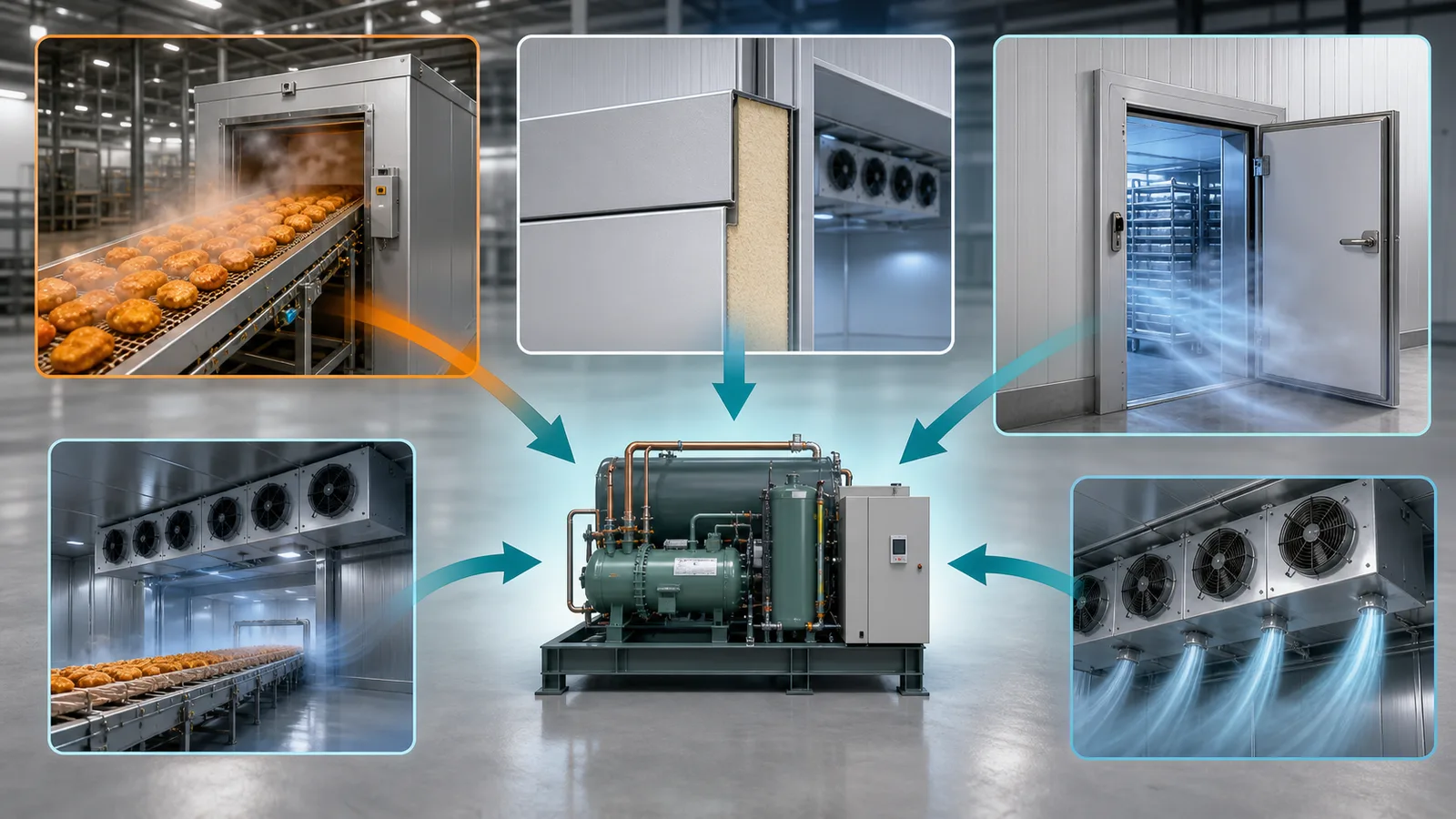
Food does not behave like pure water at a single 0 C transition. Solutes depress the initial freezing point, ice fraction changes through a temperature range, and specific heat, enthalpy and conductivity vary with composition and temperature. A freezing calculation normally separates cooling above the initial freezing region, phase-change energy and cooling of the partially frozen product to its final temperature.
freezing product energy = enthalpy at inlet - enthalpy at final stateUse validated product enthalpy or composition-based thermal-property data. The linked calculator intentionally excludes phase change.Freezing time also depends on product dimensions, geometry, packaging, surface heat-transfer coefficient, air or fluid temperature, velocity, loading pattern and contact resistance. Equal kW does not guarantee equal core-temperature time.
Refrigeration capacity is not compressor power
system COP = useful refrigeration capacity kW / electrical input kWElectrical input includes the defined compressor and auxiliary boundary. COP and delivered capacity change with evaporating temperature, condensing temperature, refrigerant, part load, fouling and controls.A compressor or condensing-unit catalogue rating is valid only at stated conditions. The project quotation should identify refrigerant, suction or evaporating condition, condensing condition, superheat or subcooling basis where relevant, auxiliary loads, defrost strategy and usable capacity at the design point.
Calculate operating scenarios, not one daily average
Steady production
Normal product flow, door traffic, fans, pumps and occupied operating conditions.
Startup and pull-down
Warm equipment, structure, product and secondary fluid may require a temporary load above steady state.
Maximum product arrival
Peak receiving temperature and hourly mass can differ from the daily average.
Defrost and recovery
Available cooling falls during defrost while added heat must later be removed.
Cleaning recovery
Warm water, open doors and wet surfaces can create a distinct post-sanitation cooling and moisture load.
Hot-weather design
Ambient temperature and humidity affect infiltration, heat rejection and condenser performance.

Build a refrigeration design brief
Record product, formulation, geometry, packaging, inlet condition, target core or average temperature and time.
Use hourly peak, batch size, operating hours, arrivals, cleaning and defrost windows.
Obtain specific heat or enthalpy data valid for composition and temperature range.
Separate sensible cooling, phase change and any heat of respiration or reaction.
Transmission, infiltration, internal equipment, people, packaging, defrost and secondary-system loads.
Identify which loads coincide and how much cooling is available during each state.
State refrigerant and real evaporating, condensing, ambient and part-load conditions.
Qualified specialists design safety, controls and heat rejection, then verify product temperature under representative loading.
Data required before refrigeration selection
Thermal capacity is only one design responsibility
Refrigerant safety, machinery rooms, occupancy classification, charge, leak detection, ventilation, pressure relief, emergency response, environmental restrictions and operator competence require current local regulation and qualified design. ISO 5149-1:2014 remains published with amendments but is under revision, so project specifications should identify the exact adopted edition and jurisdiction.
The calculated cooling time also does not establish food safety or shelf life. The site's hazard analysis must define and validate the required product time-temperature path, monitoring, deviations and corrective actions.
Food cooling load FAQ
Can the estimator calculate a freezer?
No. It calculates sensible product cooling without phase change. Freezing requires enthalpy, changing ice fraction and a heat-transfer model.
What specific heat should I enter?
Use measured, literature or composition-based data valid for the actual product and temperature range, documented by the project technologist.
Does a 20% allowance cover room and infiltration loads?
Not reliably. Calculate identifiable loads separately. Use a documented contingency only for remaining uncertainty.
Why can a cooler have enough kW but miss the core-temperature target?
Air or fluid distribution, product geometry, spacing, packaging, surface heat transfer, residence time, fouling and loading pattern can limit heat transfer.
Can refrigeration tons be compared without conditions?
No. Confirm whether values describe evaporator duty, compressor rating or installed system capacity and state the operating conditions.
Calculate the sensible product load first
Use product flow, temperature reduction and controlled specific heat to establish the first line of the refrigeration load schedule.
Open Product Cooling Load EstimatorSources and technical references
- ASHRAE Handbook, Refrigerated-Facility Design - product, infiltration, defrost, handling and respiration load considerations.
- FAO, Freezing and Refrigerated Storage - product freezing-load components and the boundary between product load and total refrigeration requirement.
- ISO 5149-1:2014 - current published safety and environmental framework for refrigerating systems, with revision status noted by ISO.
- Zigunov et al., numerical simulations of food freezing - temperature-dependent properties, phase change and geometry in freezing-time prediction.
- Phinney et al., Journal of Food Science - composition- and temperature-based thermophysical food-property models.
- Codex CXC 1-1969 - validated food-safety controls, monitoring, corrective action and documentation.