
Direct answer
Food-factory compressed air must be specified by intended use, contamination risk, minimum pressure at the machine and time-based flow demand. "Oil-free compressor" is not a complete air-quality specification, and one purity class should not be copied across every application without a hazard assessment.
Classify the use before selecting treatment
Identify whether compressed air contacts food, food-contact surfaces or primary packaging; can indirectly reach exposed product; or operates in a non-contact control application. BCAS places compressed air inside prerequisite and HACCP-based risk management. The required controls depend on the consequence and likelihood of particles, water, oil, microorganisms and other contaminants reaching product.
| Application question | Examples | Design consequence |
|---|---|---|
| Can air directly contact food? | Blowing, drying, agitation, direct product displacement. | Air quality, point-of-use treatment and monitoring become food-safety controls. |
| Can air contact a food-contact surface? | Package opening, cleaning or drying a contact surface. | Assess contamination transfer before the next product contact. |
| Is the use non-contact? | External cylinder or actuator in a protected enclosure. | Still manage condensate, exhaust location and failure routes. |
Purity classes and the current ISO status
ISO 8573-1:2010 classifies compressed-air purity for particles, water and oil and identifies gaseous and microbiological contaminants. ISO shows the 2010 edition as published but "to be revised," with a fourth edition work item under development. Project specifications should identify the exact current edition and measurement method rather than citing "ISO 8573" alone.
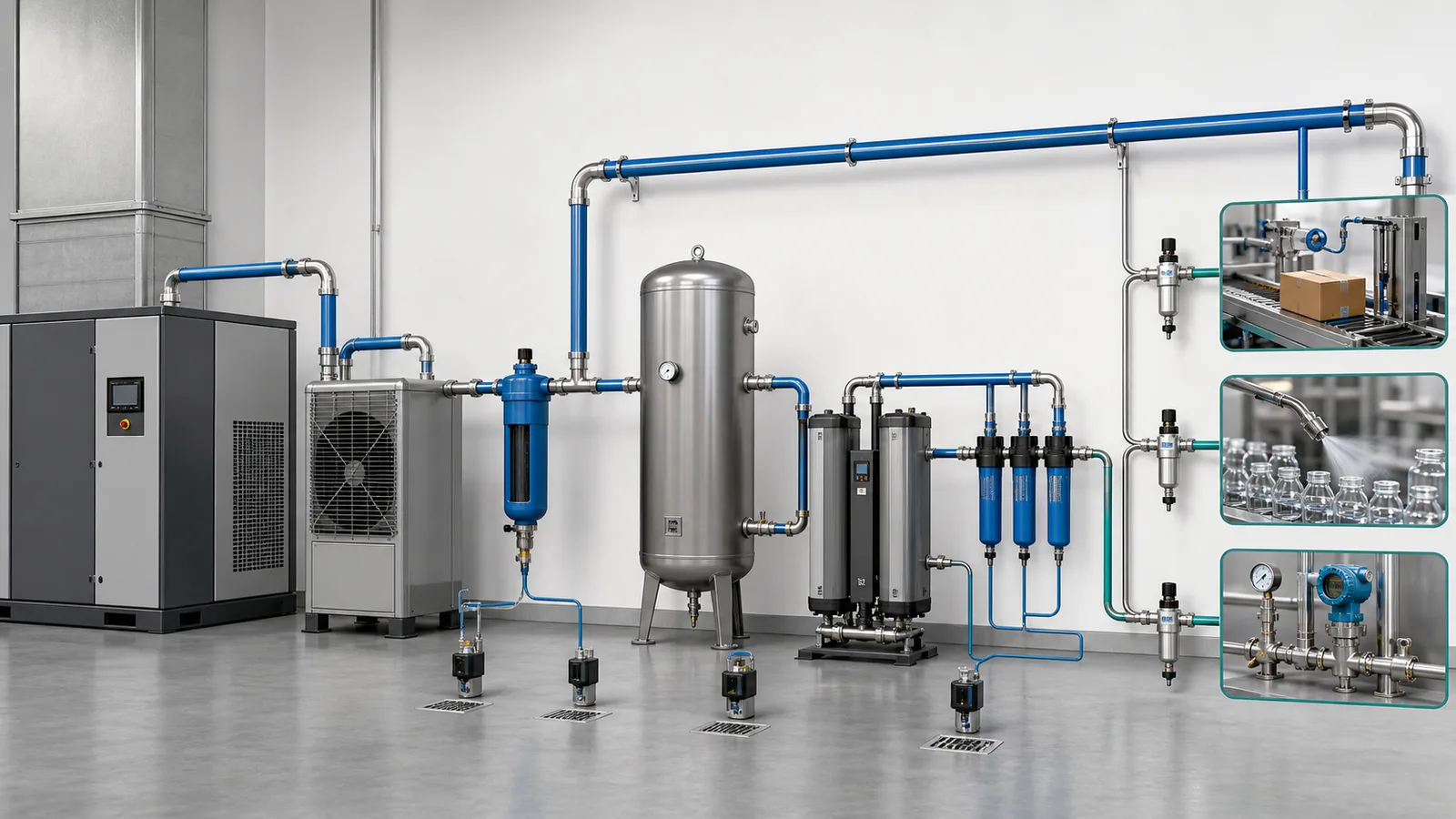
Compressed-air project checklist
Calculate average and peak demand separately
For cyclic equipment, average free-air demand can be estimated from litres per cycle, cycles per minute, machine count and duty. Peak flow occurs when actuators operate together and may require local storage. Final compressor and receiver selection needs a pressure-time profile, not only a daily air volume.
Pressure and energy are connected
Pressure at the compressor is not pressure at the end user. Dryers, filters, undersized pipe and open valves create pressure drop. Raising system pressure to compensate generally increases energy use and leakage. Measure pressure at critical machines during peak production before deciding that compressor capacity is inadequate.
Oil-free does not mean contaminant-free
Compressor technology addresses only part of the contamination chain. Intake air, piping, receivers, dryers, filters, maintenance materials and distribution can introduce water, particles, oil or microorganisms. Define air quality at a stated sampling point and operating condition.

Common mistakes
- Using compressor motor kW as a substitute for delivered free-air capacity.
- Specifying pressure only at the compressor room.
- Applying one air-quality class to all uses without a risk assessment.
- Assuming an oil-free compressor eliminates downstream contamination.
- Ignoring short peak demand, leakage and unloaded compressor power.
- Installing treatment equipment without accessible sampling and maintenance points.
Build an end-use air schedule
List every machine, litres per cycle, cycles per minute, minimum pressure, contact classification and simultaneous operating pattern.
Estimate free-air demandPrimary sources and further reading
- BCAS Food & Beverage Grade Compressed Air Best Practice Guideline - food-sector risk, installation, maintenance, audit and purity guidance.
- ISO 8573-1:2010 - official status and scope for particles, water, oil and other contaminants.
- ISO/AWI 8573-1, Edition 4 work item - current revision status.
- U.S. DOE Improving Compressed Air System Performance - system demand, supply, efficiency, controls and assessment.
Scope note: This guide is educational engineering information. It does not replace a site-specific hazard analysis, applicable law, a purchased standard, or review by qualified food-safety and engineering professionals.