
Who should use this guide?
Production managers
Compare products, shifts and process conditions using one controlled mass boundary.
Process and quality teams
Find where material leaves the intended product path and distinguish normal transformation from abnormal loss.
Cost and sustainability teams
Translate physical losses into material value while keeping by-product, rework and disposal routes separate.
Start with a closed mass-balance boundary
Choose one batch, production order or defined time period. Record opening work in progress, every material addition, closing work in progress and every output crossing that boundary. Use net mass, calibrated scales and one unit.
The current Helper calculator uses a simplified boundary with raw-material input, accepted product, recovered rework, saleable by-product and recorded waste. It is suitable only when opening and closing inventory are equal or immaterial and all additions have already been included in raw-material input.
Four results and what they mean
First-pass yield
Accepted finished product / input × 100. Rework remains separate so the original process result stays visible.
Useful recovery
(Accepted product + reusable rework + saleable by-product) / input × 100.
Recorded waste
Material physically measured and assigned to a controlled route and reason.
Unexplained difference
Input minus all recorded output categories. It can be positive or negative and requires reconciliation.
Worked example: reconcile a 1,000 kg order
| Mass stream | Quantity | Treatment |
|---|---|---|
| Raw-material input | 1,000 kg | Complete production-order input |
| Accepted finished product | 860 kg | First-pass conforming output |
| Reusable rework | 45 kg | Quarantined and controlled for later use |
| Saleable by-product | 30 kg | Measured separate value stream |
| Recorded waste | 40 kg | Measured trim, residue or reject stream |
| Unexplained difference | 25 kg | Input minus all recorded categories |
Useful recovery = (860 + 45 + 30) / 1,000 = 93.5%
Unexplained difference = 1,000 - 860 - 45 - 30 - 40 = 25 kg, or 2.5%
Total recorded plus unexplained loss = (40 + 25) / 1,000 = 6.5%
If raw material costs 2.50 per kg, the calculator reports 62.50 as the raw-material value associated with the unexplained difference. That is not the full financial impact. Conversion labor, utilities, packaging already consumed, disposal cost and lost contribution may also matter, while by-products can have a different recoverable value.
Why heat processing changes weight
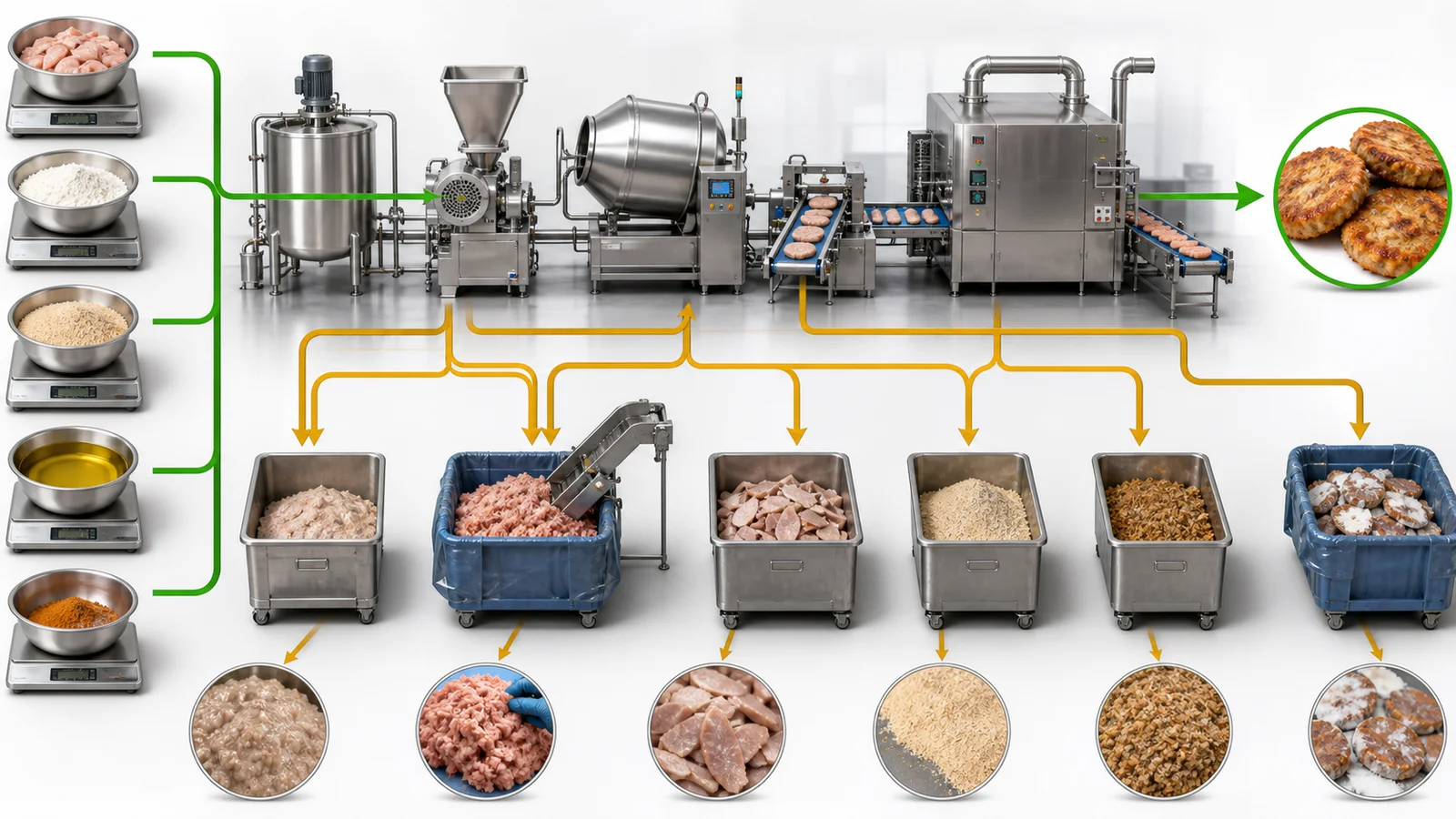
Cooking, drying, cooling and freezing alter mass through evaporation, drip, fat loss, water absorption and surface ice or purge. USDA cooking-yield data explicitly track yield alongside moisture and fat change. Therefore, lower finished mass is not identical to measured solid food waste.
- Measure additions before the process and vapor, condensate, purge or drip where practical.
- Use a consistent weighing point and product temperature.
- Allow equivalent drain, rest and cooling time before comparison.
- Do not compare a hot wet weight with a cold drained standard.
- For moisture-sensitive products, add solids or dry-matter balance to the mass balance.
A dry-matter balance can show whether apparent yield movement comes mainly from water or from loss of valuable food solids.
Keep rework visible and prevent double counting
Reusable material is not first-pass accepted product. Identify it by source batch, quantity, status, allergen profile, age and permitted destination. When rework enters a later order, record it as an input to that order. Do not count the same 45 kg once as recovered output and again as unexplained new material.
Food-safety plans, specifications and applicable law determine whether rework is allowed. A yield calculation cannot authorize reuse or establish shelf life.
Separate by-products from waste
A stream can be a saleable by-product, animal-feed material, donation, wastewater load or waste depending on its specification, legal status and actual destination. EPA and the Food Loss and Waste Protocol distinguish management routes because destination changes the operational and environmental interpretation. Keep edible and inedible parts separate where relevant.
| Category | Required evidence | Do not assume |
|---|---|---|
| Accepted product | Released quantity against specification | Everything packed is accepted |
| Rework | Controlled identity, quantity and permitted use | All recovered material will be reused |
| By-product | Defined specification and actual destination | Potential sale equals completed recovery |
| Waste | Measured quantity, reason and route | Bin volume equals food mass |
| Process loss | Validated moisture, vapor, drip or residue basis | Every mass change is avoidable waste |
Investigate an unexplained difference
A positive gap means recorded outputs are below inputs. A negative gap means recorded outputs exceed inputs. Investigate the data before changing the process:
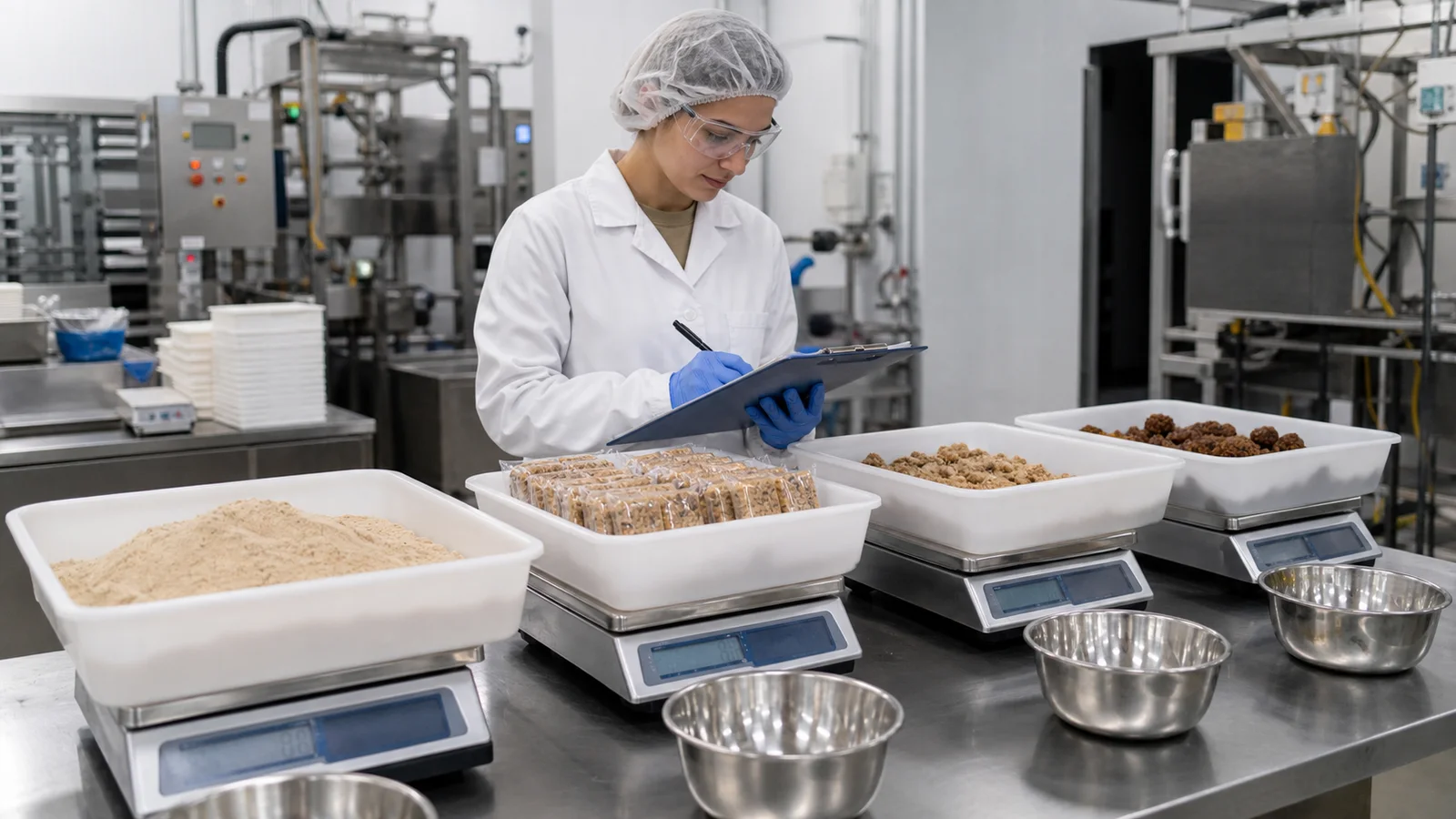
- Check units and tare. Confirm kilograms, net weights, scale zero and container tare.
- Check the time boundary. Reconcile opening and closing tanks, hoppers, conveyors and work in progress.
- Find omitted additions. Include water, brine, oil, coating, ice and transferred rework.
- Check weighing conditions. Align hot/cold state, drain time, sampling and moisture condition.
- Measure hidden routes. Inspect floor loss, equipment hold-up, wastewater, dust extraction and product left in packaging.
- Review count conversion. Validate average unit weight when piece or pack counts are converted to mass.
- Quantify uncertainty. Compare the gap with scale resolution, sampling error and normal variation.
- Repeat under controlled conditions. Confirm whether the difference is persistent before assigning a cause.
Build a yield-loss waterfall by process step
An order-level balance identifies that loss exists but not where it occurred. Add measurement points after preparation, mixing, forming, cooking, cooling and packaging. Use only enough checkpoints to isolate material hotspots without creating excessive handling or contamination risk.
Dough and noodle lines
Track flour and water additions, mixer and sheeter residue, edge trim, dust collection, drying moisture and off-spec portions.
Sausage processing
Track meat and brine input, grinder and filler hold-up, casing and clipping rejects, smokehouse weight change and peel loss.
Vegetable processing
Track soil and foreign matter, peel and trim, wash-water carryover, sorting rejects, cut loss and dewatering condition.
Use control limits, not one generic target
Establish a baseline by product, specification and process route. Review average, variation and measurement uncertainty. A target copied from another product can be misleading because trim requirement, moisture endpoint, formulation and cooking method differ. Escalate statistically unusual batches and persistent trends, not every small rounding difference.
Minimum yield record
Order and batch IDs; product and formula revision; start and end time; opening and closing WIP; every material addition; accepted output; rework status; by-product quantity and destination; recorded waste by process step and reason; moisture or solids where relevant; scale ID and verification; unexplained difference; reviewer; investigation and corrective action.
Frequently asked questions
How is food production yield calculated?
Divide accepted finished-product mass by total input mass measured on the same boundary and multiply by 100.
Should reusable rework count as first-pass yield?
No. Track it separately, then record it as input when it is actually used in a later controlled batch.
Why can unexplained difference be negative?
Common causes are omitted water or rework additions, output from opening inventory, timing mismatch, unit conversion error or scale uncertainty.
Is cooking weight loss always food waste?
No. Evaporation and moisture or fat transfer alter mass. Measure and classify physical streams before calling the difference waste.
Can this calculation approve rework?
No. Rework use requires controlled food-safety, quality, traceability and legal approval.
Reconcile one production boundary
Enter accepted product, reusable recovery, by-product and recorded waste, then investigate the remaining mass difference.
Open the Production Yield and Loss Calculator | Read the food-production OEE guide
Standards and primary references
- Commission Delegated Decision (EU) 2019/1597 - common methodology and minimum quality requirements for measuring food waste, including direct measurement and mass balance.
- Food Loss and Waste Accounting and Reporting Standard, Version 1.0 - scope, quantification and transparent reporting framework.
- USDA Table of Cooking Yields for Meat and Poultry, Release 2 - measured cooking yield, moisture change and fat change under specified protocols.
- U.S. EPA Food: Material-Specific Data - food manufacturing and processing waste measurement and management pathways.
- FAO Technical Platform on Food Loss and Waste Measurement - consistent food-loss measurement resources.
- Codex CXC 1-1969, General Principles of Food Hygiene - hygiene, process control, traceability and HACCP baseline.
Definitions and legal classifications vary by jurisdiction. Confirm current requirements and the allowed destination of each material stream.