
Droplets inside a cucumber-slice pack do not prove that the spinner failed. Start by separating water already present before sealing from droplets that appear on the film during holding. Liquid around softened or damaged slices is another investigation route; appearance alone cannot identify its source.
This guide concerns plain fresh-cut cucumber slices. Salted, dressed and pickled products need separate comparisons. Use it alongside the vegetable washing, cutting and dewatering guide; the observation procedure below is editorial guidance, not a validated production recipe.
Locate the water before changing equipment
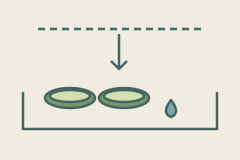


Original explanatory diagrams, not photographs of actual defects.
Water vapor can condense into droplets on a sufficiently cool package surface. Consequently, a pack that looked clear at sealing can develop visible film droplets later. Water already carried into the pack is a different observation. Both may occur together, and droplets can move when a pack is tilted.
Photograph the inside film, slice surfaces and tray bottom separately. Identify whether droplets are inside or outside the pack. External condensation does not establish internal wetness. Record the unopened pack first; opening it changes the environment being investigated.
Use a short observation sequence
| Checkpoint | What to record | Next investigation |
|---|---|---|
| After dewatering | Surface droplets, broken slices, load and discharge time | Review draining, basket loading and handling. |
| Immediately before sealing | Tray water, transfer delay and product temperature | Check whether water arrived before packaging. |
| During sealed holding | Film droplets, bottom liquid, firmness and temperature history | Compare packaging and holding conditions. |
Use the same lot, slice thickness, fill weight, pack orientation and observation intervals. Identify each sample and photograph it under consistent lighting. Keep the plant's established chilled handling controls; do not deliberately warm saleable product to create a visible effect.
Example record: Sample A has visible tray water before sealing and droplets on the lid at the later check. Sample B has no visible tray water before sealing but also develops lid droplets. This shows why a later photograph cannot assign all water to inadequate draining. It does not prove that either pack contains only condensation.
Investigate preparation and packaging separately
If water is already visible before sealing, examine drainage and transfer first. Compare the approved dewatering arrangement at a consistent load, and check whether overlapping slices retain visible surface water. Record damage alongside dryness rather than selecting the treatment that simply removes the most weight.
If clear packs develop film droplets during holding, investigate the product and package temperatures, holding history, film specification and fill weight. Owoyemi and colleagues measured condensation separately from fruit weight loss in a whole-cucumber packaging experiment. Its package-dependent results support checking these outcomes separately, but do not prescribe a film or temperature for sliced cucumber.
When liquid accompanies softer, broken or water-soaked pieces, inspect incoming condition, cutting and subsequent handling. Tissue-related liquid remains a possible contributor, not a diagnosis from a puddle. The cited slice study does not quantify the proportions of retained wash water, tissue liquid and condensation. More spinning cannot be assumed to resolve every cause.
For equipment comparisons, review the DGN-01/02 cutter and SG-50/70 spinner with the intended cut and load. These links identify process stages, not a claim that either machine eliminates pack moisture.
Measure outcomes without confusing them
A whole-pack weight change measures net mass crossing the package boundary. Water moving from slices onto the film can remain inside that boundary. Therefore, unchanged pack weight does not mean that slices released no moisture, and weight loss does not identify where internal liquid originated.
Olawuyi and colleagues evaluated packaged cucumber slices using weight and firmness measurements. For a plant comparison, record those outcomes alongside visible liquid and film droplets. Agree a consistent firmness method and assessment interval rather than relying on an unrecorded finger check.
Compare candidate films under the intended distribution conditions with a packaging specialist. Check moisture behavior, gas exchange, seal performance and product quality together. A clearer lid alone does not establish a better package or a safe shelf life. Whole-cucumber storage guidance from UC Davis must not become a storage instruction for ready-to-eat slices.
Frequently asked questions
Should I increase spinning whenever a pack has droplets?
No. Check the product before sealing first. Visible pre-pack water justifies examining dewatering, while later film droplets also require packaging and temperature-history checks. Compare damage and texture before accepting any cycle change.
Will changing the film replace dewatering?
No. Film selection and removal of water present before packing address different parts of the process. Compare both using matched samples; do not copy the perforations or gas mixture from a whole-cucumber experiment.
Can cucumber salad advice be used for plain sliced packs?
Not directly. Salting, dressing, smashing or removing the seed cavity changes the prepared product. Record these differences and assess that recipe separately instead of treating a household salad method as an industrial drying instruction.
Does a dry-looking pack prove that it is safe?
No. Visible moisture is a quality observation, not a microbiological release test. Use the established product safety controls and shelf-life validation; neither a clear lid nor this troubleshooting comparison replaces them.
Sources and scope
Checked 11 November 2026. Historical technical evidence informs this editorial investigation procedure; no results are HELPER equipment tests.
- Owoyemi, Porat and Rodov: Effects of Compostable Packaging and Perforation Rates on Cucumber Quality, Foods 10(2), 471, 20 February 2021. Israeli whole-fruit experiment; separate condensation and weight-loss measurements. Its film, gas and storage prescriptions are not transferred to cut slices.
- Olawuyi, Park, Lee and Lee: Combined effect of chitosan coating and modified atmosphere packaging on fresh-cut cucumber, Food Science & Nutrition, first published 6 February 2019. Korean slice experiment; methods include packaged weight and firmness. No partition of internal liquid sources.
- Suslow and Cantwell, UC Davis: Cucumber, May 1997. Whole-commodity disorder and handling guidance; not a ready-to-eat sliced-product storage regime.