
JCJ-250 Frozen Meat Pellet Extruder
An integrated lifting, five-knife crushing, mixing and extrusion cell for pet-food strips and portion-controlled pellets.
Turn frozen or thawed meat into consistent shapes
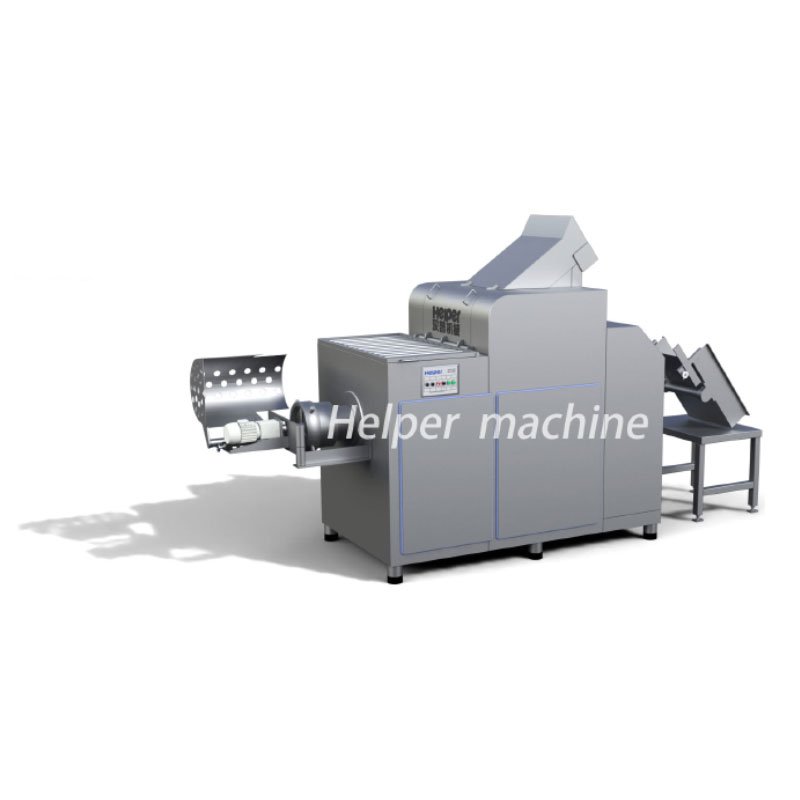
The HELPER JCJ-250 is designed to prepare raw meat for freeze-dried pet-food products. It combines an automatic lifting device, frozen-meat crusher and stirring extruder in one line. The crusher uses five cutting knives to reduce incoming frozen meat before the material moves into mixing and extrusion.
HELPER identifies frozen meat and defrosted meat as suitable inputs, with applications including pet meat strips, freeze-dried pellets, cat-grass strips and chicken strips. Whole-body stainless-steel construction supports food-factory sanitation, while PLC and frequency-conversion control allow operators to adjust production and create different pellet lengths.
This is a forming machine, not a high-temperature puffing extruder. It does not cook dry kibble and it does not freeze-dry the output. A downstream tray-loading and freeze-drying system is still required.
Six controlled steps from meat blocks to dryer-ready portions
A compatible bin and lifting device deliver frozen or tempered raw material at a defined temperature.
Five knives reduce frozen blocks and prevent oversized pieces from reaching the extruder.
The integrated section distributes lean, fat and other recipe components before forming.
A selected die controls the cross-section of strips or pellets without a puffing-cook step.
Feed, screw and cutting settings establish practical piece length and line rate.
Pieces are spaced on trays and transferred to separate freezing and sublimation equipment.
Successful integration depends on continuous cold-chain control. Define incoming block size, core temperature, maximum dwell time and acceptable product-temperature rise. The downstream conveyor or tray-loading arrangement must receive pieces without stretching, sticking, piling or damaging their shape.
JCJ-250 published machine data
| Item | Verified value |
|---|---|
| Model | JCJ-250 |
| Installed power | 46 kW |
| Extrusion speed | 150 rpm |
| Published productivity | 800–1000 kg/h |
| Dimensions | 4030 × 1325 × 2300 mm |
| Crusher | Five cutting knives |
| Controls | PLC with frequency conversion |
| Construction | Whole-body stainless steel |
| Published inputs | Frozen meat and thawed/defrosted meat |
Read the numbers correctly
The stated 150 rpm is an extrusion rotation speed; it is not a guaranteed cutter rate or final pieces per minute. Actual pellet length results from die geometry, material feed, screw speed, cutter arrangement and recipe behaviour.
The 800–1000 kg/h figure is a published productivity range, not an unconditional acceptance value. Throughput should be confirmed during a factory acceptance test using the buyer’s recipe, meat temperature, intended die and acceptable shape specification.
Scope boundary: freezing, tray loading, freeze drying, oil removal and final packaging are not proven parts of the base JCJ-250 supply. List every required interface in the quotation.
See the integrated lifting, crushing and forming sequence
The video is associated with this exact product. Use it to understand general arrangement and material flow, then request a witnessed run with your own recipe for purchasing validation.
Specify the meat and the finished geometry together
Provide the recipe composition, fat level, connective tissue, permissible bone fraction, added vegetable or fibre ingredients, frozen or tempered condition and block dimensions. These variables change load, smear tendency, die pressure and shape retention. A recipe that forms clean chicken strips may behave very differently from a high-fat mixed-meat pellet.
Define target diameter or cross-section, piece length, weight distribution, density and surface finish. Supply representative reference samples and tolerance limits rather than only a marketing photograph. Die-hole geometry and cutting method should be approved as product tooling.
Downstream freeze-drying interface
Piece thickness affects freezing time, sublimation path and finished moisture uniformity. Establish tray loading density, spacing, allowable contact between pieces and maximum time from extrusion to freezing. The extruder must match the real tray-loading capacity, not only the nominal dryer batch size.
Freeze profile, chamber pressure, shelf temperature and final moisture belong to the freeze-dryer process. They should not be inferred from the JCJ-250 forming specification. Treat forming consistency as an upstream quality input to a separately validated drying recipe.
Design cleaning around retained raw meat
Map every food-contact zone in the lift, crusher, mixer, screw, die and cutter. Confirm tool-free or controlled disassembly, access for inspection, drainage and the cleaning procedure for narrow die passages. Product left inside the forming head can warm rapidly and create both microbiological and allergen risks.
Set limits for raw-material temperature, maximum exposure time, room conditions and post-cleaning release. For multiple proteins or allergen-containing recipes, validate changeover with swabbing at the hardest-to-clean points. Stainless construction helps cleanability but does not replace an auditable sanitation method.
Utilities, access and guarding
Confirm voltage, frequency, full-load current, compressed-air demand if applicable, floor loading, drainage and service clearances. The published 4030 × 1325 × 2300 mm envelope should be checked against doors, ceiling services and operator access.
Risk assessment must cover lifting, frozen-block handling, crusher knives, screw rotation, cutter motion and stored energy. Interlocks, emergency stops and lockout points should be demonstrated in the final machine configuration.
Approve output quality, not an empty-machine demonstration
Run the proposed frozen and tempered recipes long enough to reach stable conditions. Record accepted kilograms per hour, motor load, extrusion pressure if available, product temperature before and after forming, dimensional distribution, piece-weight variation, smearing, breakage and reject percentage. Challenge the system with realistic block variation and observe bridging at the lift or crusher.
Change dies and recipes using the proposed production procedure. Time disassembly, retained-product removal, washing, inspection, reassembly and restart. Verify that settings are recipe-controlled and that operator access does not introduce unsafe contact with knives or rotating components.
Finally, load formed pieces on the real tray system and complete a freeze-drying trial. Assess shape after transfer, frozen adhesion, drying uniformity, final moisture and finished-product breakage. This end-to-end test confirms that nominal extrusion capacity translates into saleable freeze-dried pet food.
JCJ-250 buyer questions
Does the JCJ-250 freeze-dry the pet-food pellets?
No. It lifts, crushes, mixes and forms raw meat. Freezing and vacuum freeze drying require separate downstream equipment.
Is this a cooked dry-kibble extruder?
No. The machine is positioned for raw-meat shaping before freeze drying, not high-temperature cooking and puffing.
Can it process both frozen and thawed meat?
HELPER lists both frozen and defrosted meat. The exact acceptable temperature, block size and recipe must be confirmed by a material trial.
What controls pellet or strip length?
PLC and frequency-conversion settings contribute, but practical length also depends on feed, screw speed, die geometry, cutter configuration and material behaviour. Validate the finished tolerance during FAT.
Send your meat condition, target shape and dryer interface
Include recipe composition, block size, temperature, required output geometry, tray layout, shift volume and sanitation standard.
Request a JCJ-250 process proposal