
Load consistently
Record ingredient mass and temperature, confirm usable volume and avoid unvalidated minimum or maximum loading.
A compact twin-shaft platform for 200–220 kg-class batches that require controlled air inclusion and tighter temperature management. Specify the cooling duty around your formulation—the published evidence confirms the mixer, while the thermal package remains project-defined.
HELPER's Chinese catalog names this model ZKJB-300II Vacuum Cooling Mixer. Its body specification matches the established ZKJB-300 vacuum platform: a sealed 300 L chamber, parallel twin shafts, reversible operation and pneumatic lid and discharge functions. HELPER Group material also states that cooling can be supplied as an option for special applications.
Unlike the separately tabulated 650 L and 1,200 L cooling machines, no independent English cooling schedule was found for the 300 L model. This page therefore presents verified base-machine values and treats jacket design, added power, weight, envelope, refrigeration equipment and guaranteed temperature change as quotation-controlled data.
Record ingredient mass and temperature, confirm usable volume and avoid unvalidated minimum or maximum loading.
Close the pneumatic lid and establish the recipe vacuum without uncontrolled foaming or liquid carryover.
Run the validated shaft speed and reversal pattern while monitoring product and coolant temperatures.
Restore pressure safely, confirm endpoint uniformity and transfer promptly to filling, forming or packing.
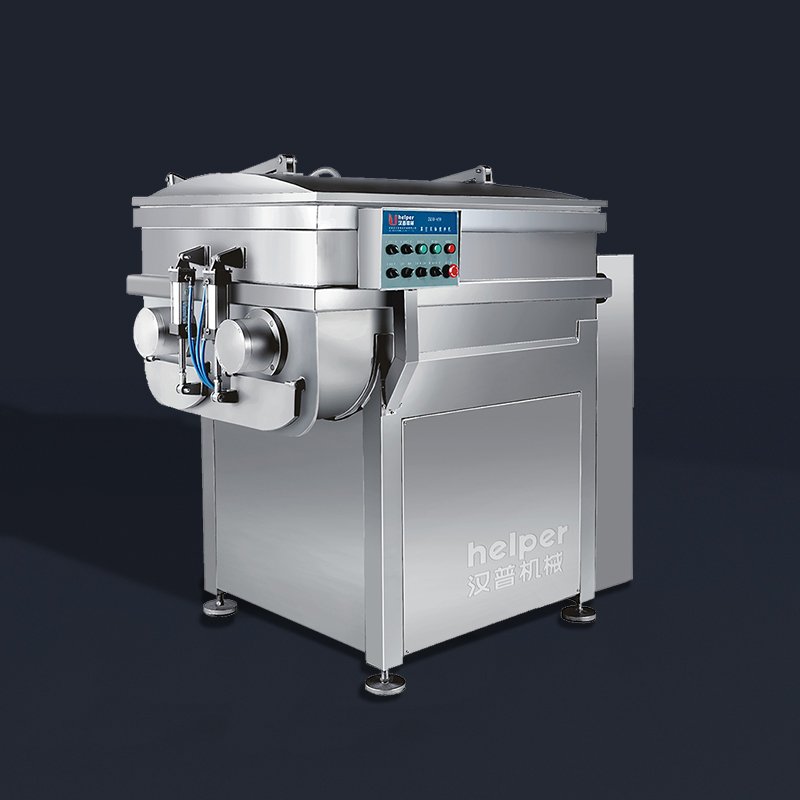
Do not assume that “II” automatically includes a chiller. Define whether the supply includes a jacket and connections only, or a complete loop with tank, pump, refrigeration unit, valves, hoses, sensors and integrated controls.
| Model naming | ZKJB-300II cooling intent / ZKJB-300 base platform |
|---|---|
| Chamber volume | 300 L |
| Published load | 220 kg English maximum; 200 kg Alibaba commercial reference |
| Mixing speeds | 84 / 42 rpm |
| Base-platform power | 5.9 kW (2.4 × 2 + 1.1 kW vacuum pump) |
| Base-platform weight | 600 kg |
| Base-platform dimensions | 1,190 × 1,010 × 1,447 mm |
| Compressed air | 0.5 MPa on Chinese exact page |
| Electrical reference | 380 V, 50 Hz Chinese page; destination supply to be confirmed |
Start with batch mass, product specific heat, ingredient start temperature, desired endpoint and allowable mixing time. Add estimated mechanical heat and ambient gain. The resulting duty establishes the required jacket area, coolant supply temperature, flow, return-temperature rise and refrigeration recovery capacity.
For chilled water or glycol, confirm approved medium, concentration, connection size, design pressure, condensation control and drainage. Review insulation, jacket welds and access around utility connections during sanitation assessment. Where the plant provides utilities, define a clean interface; where it does not, quote the entire thermal loop as one system.
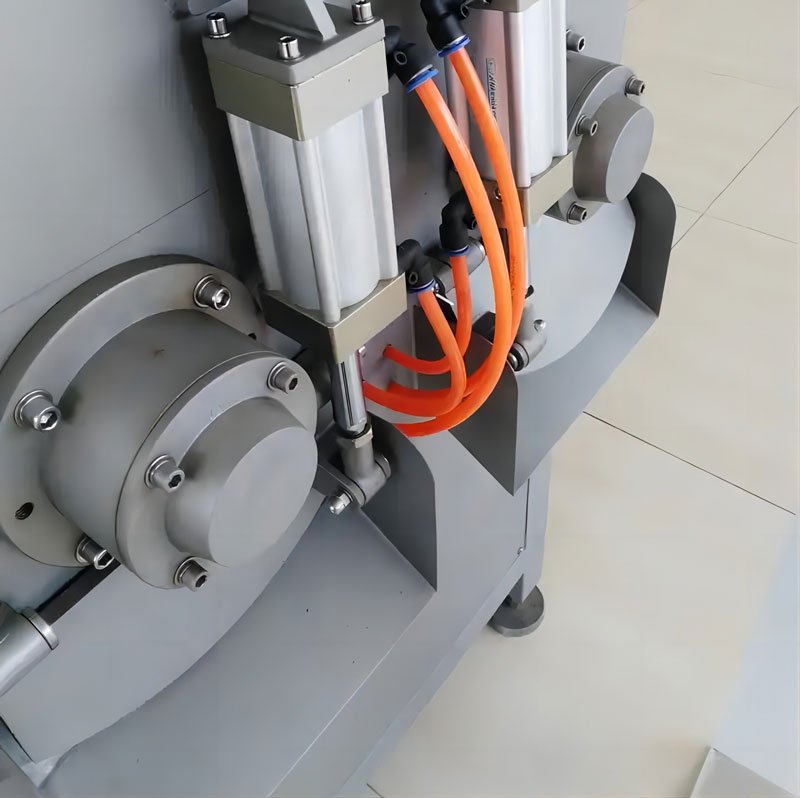
Suitable when ingredients are pre-chilled and the existing room and cycle already protect endpoint temperature.
Add a heat-exchange boundary when the plant can supply a stable, correctly sized coolant circuit.
Specify mixer, jacket, pump, tank, chiller, instrumentation and controls together when a guaranteed cooling curve is required.
Check ingredient distribution, texture, binding, residual air and temperature at multiple chamber positions.
Log product temperature plus coolant inlet, return, flow and pressure against time for the agreed batch.
Verify lid, vacuum, vent and discharge interlocks, emergency stop and safe recovery after utility interruption.
Inspect product-contact surfaces, seals, drainability and access, then document cleaning and inspection intervals.
It is the published maximum for the base ZKJB-300. Confirm the practical range using your product density, fill level, viscosity and mixing objective.
The public pages do not define the complete scope. Require a line-item bill covering jacket, ports, pump, tank, chiller, valves, piping and controls.
Only provisionally. Cooling jackets, insulation and utility connections can change service clearances and final envelope, so use the approved cooling GA.
No stable exact ZKJB-300II cooling run was found. A generic vacuum mixer video is not presented as proof; request a run-off video and cooling log for the quoted configuration.
Share formulation mass, density, starting and target temperatures, cycle time, vacuum target, available coolant, ambient conditions, downstream process and sanitation requirements.
Related decision path