
Black marks revealed by peeling do not automatically mean the peeler caused them. Blackspot bruising can develop beneath intact potato skin after earlier impacts. Unloading and processing transfers can also add injury. Start with incoming-lot comparisons and handling records, rather than changing brush speed because the defect first becomes visible at discharge.
What the location tells you
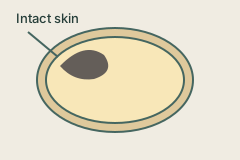
Removing skin can reveal an existing patch. Illustration, not a defect photograph.
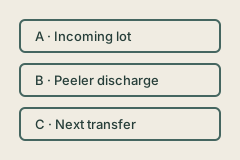
Keep the incoming lot identifiable through each sampling point.
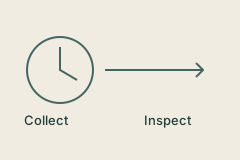
Collection time and inspection time are separate record fields.
INRAE describes internal blackspot as blue-grey patches beneath undamaged skin. Tissue injury allows enzymatic oxidation and dark pigment formation. This is different from simply reporting “the potato turned brown”: the position, shape and condition of the affected tissue matter.
| Observation | Next check |
|---|---|
| Localized patch under apparently intact skin | Compare gently peeled incoming samples with output from the same lot. |
| Split or cracked tissue | Record fractures separately; shatter injury is a different bruise category. |
| Soft, decayed or otherwise unexplained tissue | Refer to the plant's quality disposition procedure; do not classify it from color alone. |
This table organizes observations; it is not a disease diagnosis or a food-safety release rule. Preserve representative photographs with the sample identity and scale.
Why an immediate inspection can miss damage
Colorado State University Extension explains that blackspot can remain hidden without peeling and that handling conditions and tuber condition affect susceptibility. Peeling is therefore both a processing operation and a point where earlier damage becomes observable.
A controlled University of Idaho study compared three Russet cultivars after standardized impacts. Visible color developed over time and differed with cultivar and experimental conditions. Each destructive inspection used separate samples. Its results do not establish a universal waiting period, safe drop height or temperature for your factory.
Do not compare an incoming sample inspected immediately with an output sample inspected much later and call the difference machine damage. Equally, a clean immediate output sample does not exclude injury that has not yet become visible.
Make a matched comparison
- Identify the lot. Keep supplier lot, cultivar where known, size group and incoming condition together. Avoid mixing deliveries during the comparison.
- Define collection points. Use incoming material before the suspect operation, peeler discharge and the next significant transfer. Inspect safely without reaching into running equipment.
- Keep inspection consistent. Use comparable sample groups, peeling method, lighting and observation criteria. Record how long each group spent between collection and inspection.
- Control sample handling. Prevent the inspection itself from adding drops or compression. Keep samples under the plant's approved conditions; do not warm production potatoes to accelerate symptoms.
For later destructive inspections, reserve separate comparable groups rather than peeling one group first and treating its subsequent appearance as equivalent to an intact group.
A filled record that avoids false certainty
Illustrative notation: “Lot P13, group B, peeler discharge, collected 09:10, inspected 09:40, ten tubers, two with localized subskin patches; photo B02.” A matching group A identifies the incoming collection point and its own times. Group C identifies the later transfer. The sample size and interval here explain notation; they are not an acceptance plan.
Record affected tubers over tubers inspected, not just “two marks.” Multiple marks on one tuber are different from two affected tubers. Add actual sample conditions and fractures separately. Repeated matched observations support investigation; this small example cannot prove responsibility.
Improve handling before increasing peel removal
Review unloading drops, conveyor gaps, hard contact points and abrupt changes of direction. Check whether flow creates collisions or accumulation. These are inspection priorities, not permission to remove guards or alter a validated operating procedure.
The Northwest Potato Research Consortium stresses that color alone cannot reliably date every bruise. Combine sample observations with handling events, cultivar, tuber temperature and equipment inspection. A darker output patch is not a timestamp.
For the HELPER potato washing, peeling and polishing line, compare incoming material, surface treatment and discharge interfaces together. Verify peel removal and usable output alongside defects. More aggressive peeling is not automatically the appropriate remedy for internal injury. Use the wash–cut–dewater guide for wider process boundaries.
Frequently asked questions
Did the peeling machine create the black spots?
Possibly, but their appearance after peeling does not establish that. Compare incoming material and downstream groups under matched inspection conditions, then investigate actual handling points.
Can I tell old bruises from new bruises by color?
Color may provide clues, but it is not a reliable clock by itself. Combine it with collection times, inspection conditions and known handling events.
Should we peel deeper until every patch disappears?
Do not adopt that as the first correction. Investigate the source and assess usable yield against the product specification before changing peel removal.
Does a firm dark patch prove the potato is safe?
No. This guide explains a quality-defect investigation, not lot release. Unexplained discoloration and suspected decay require assessment under the plant's quality and food-safety procedures.
Sources and scope
Checked 13 November 2026. Original diagrams and the record example illustrate an investigation; they are not HELPER trial results. Harvest and storage research does not define fresh-cut factory holding or release conditions.
- CSU Extension: Blackspot Bruise in Potatoes, Sastry Jayanty, June 2019, USA. Peer-reviewed extension guidance on injury and handling.
- INRAE e-phytia: Internal black spot, France, updated 24 July 2025. Symptom location and delayed discoloration.
- Hendricks, Olsen, Thornton and Hatzenbuehler: Development of Potato Bruises, published 25 November 2025, volume 103 (2026). Controlled impacts, cultivars and destructive evaluations; no universal factory setting inferred.
- New Bruise or Old Bruise?, Blauer, Olsen and Hendricks, Northwest Potato Research Consortium, 14 August 2026, USA. Color must be combined with handling evidence.