
Start with when the residue first appeared. Grains already present at the end of mixing send you back to the ingredient and mixing records. Lumps that first appear during powder addition send you to the feed sequence and dispersion step. A deposit that develops during a hold or after transfer sends you to the time and conditions between mixing and use. These observations narrow the investigation. Identify the material using the plant’s approved procedure.
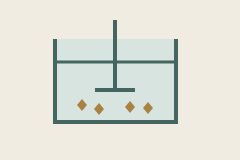


Choose the first check
| What you saw | Where to start |
|---|---|
| Grains when mixing ends | Check actual water and ingredient weights, salt grade, liquid temperature and mixing time after the last addition. |
| Lumps while adding powder | Check the ingredient identity, order and pace of addition, then review the supplier’s dispersion and hydration instructions. |
| Deposit after a hold | Compare the end-of-mix observation with the later one. Check elapsed time, temperature, circulation status and the transfer route. |
Grains are present when mixing ends
Compare the actual weights with the approved batch sheet. Confirm whether the salt target is based on finished solution mass, finished solution volume or starting water mass. The brine concentration guide explains how to read each basis. Check for a change in salt grade or particle size, then compare temperature and the actual mixing time after the final ingredient went in with a normal batch.
In a simple salt solution, an undissolved portion of the weighed salt is still outside the liquid phase. Salt particle size, temperature and concentration can affect dissolution. Note whether grains were observed across the vessel, only near the bottom, or first at the discharge point. Use the observation to guide sampling and record review. A pale grain can have more than one source in a formulated brine.
Lumps appear as powder is added
Identify the ingredient being fed when the lumps first appeared. Compare the actual sequence and pace with the approved preparation instructions. Record whether the powder reached moving liquid or collected in one area. Check the powder lot and whether the formulation calls for that ingredient to dissolve or for it to disperse and hydrate.
Some stabilizers can form agglomerates during preparation. A lump in this branch may therefore need a different investigation from separate salt grains. Compare how the same ingredient was introduced in a normal batch and whether the expected hydration period was observed. Record the appearance at the end of that period so that samples taken at different stages are not treated as equivalent.
A deposit appears after holding or transfer
Build a short timeline from the last mixing step to the first sign of residue. Check the elapsed time in each vessel, the temperatures, any interruption to circulation, and where the later observation was made. A sample from the top at the end of mixing and a deposit found near the outlet later describe different locations as well as different times.
Use the plant’s approved sampling points to compare the same batch at comparable stages. If the deposit is first seen at discharge, identify whether it came from the mixing vessel, a holding vessel or the transfer route. This can narrow the review to the stage where material first becomes visible. A single sample cannot show how material was distributed throughout the vessel.
For example, suppose the mix record describes a uniform sample at the approved sampling point, but the first discharge after the hold contains a deposit. Compare the hold conditions and sampling locations before changing the mixing step. Check whether the discharge sample represented the start, middle or end of transfer.
Bring the observation to the equipment discussion
For a brine maker and mixing tank, discuss the working batch range, powder addition point, where operators can take samples, and how the vessel discharges. Include the planned hold and transfer steps in the discussion. A trial with the intended formulation can document observations at mixing completion and again at the planned handoff.
Frequently asked questions
Can cloudy brine tell me that salt has failed to dissolve?
Cloudiness describes appearance. Check which ingredients the formula expects to disperse and use the approved method to investigate any unexpected residue.
What if the residue appears only after a hold?
Compare the before and after records, including where each observation was made. Check elapsed time, temperature and circulation during the hold.
Can one Brix reading identify the deposit?
Brix is an optical reading of the sample. Use the Brix and salt measurement guide to distinguish the reported reading from a measurement of a named constituent.
Where should I look if the first symptom is needle blockage?
Check the injector filtration and needle compatibility guide for the downstream path. Bring any earlier observations from the tank to that investigation.
Sources and scope
This guide covers observations in freshly prepared brine. The timing branches help locate the process step to investigate.
- Oregon State University Extension Sea Grant, Preparation of Salt Brines for the Fishing Industry, Kenneth S. Hilderbrand Jr., reprinted March 1999, page 4. Salt dissolution in simple seafood brines.
- Silverson, Preparation of Brines for the Meat Industry, manufacturer application report, pages 2–3. Dissolution, dispersion, hydration and settling in meat brine preparation.