
A Brix reading is not automatically the salt percentage of a formulated meat brine. First identify the instrument’s scale and measurement principle. Then establish whether the method suits the actual recipe. Record the sample, temperature, preparation and units with the result. A number labelled only “concentration” leaves production, quality and equipment teams comparing potentially different quantities.
1. Name the quantity before comparing numbers
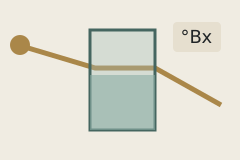


Original measurement concepts, not instrument diagrams, real laboratory results or HELPER-supplied instruments.
Brix is based on a sucrose-and-water scale: for that solution, it expresses grams of sucrose per 100 grams of solution. Other dissolved ingredients affect the measured physical property, so a brine’s displayed °Bx is not a separate measurement of its salt or sugar content. [4]
A refractometer measures an optical property and can convert that response to a concentration scale. ATAGO’s guide explains that, in a salt-and-sugar mixture, a refractometer responds to both components. It cannot separate the salt contribution from that one reading. [1]
| Reported quantity | What to clarify |
|---|---|
| Brix / °Bx | Which optical scale is displayed, and what relationship has been established for this recipe? |
| Salt as NaCl | Is this a direct method result or an equivalent calculated from conductivity, chloride or another measurement? |
| Sodium | Does the method measure sodium, including sodium from ingredients other than sodium chloride? |
| Chloride | Which chloride sources are present, and what assumptions support reporting the result as NaCl? |
METTLER TOLEDO distinguishes sodium and chloride determinations. Ingredients other than sodium chloride can contribute either ion, so the analytical target matters. [3] These are measurement distinctions, not a nutrition-labelling conversion guide.
2. Why a recipe change can break the comparison
Suppose a revised brine contains the same salt addition but a different sugar addition. The optical reading can change even though the salt addition has not. Conversely, a matching Brix number does not establish matching salt content. This qualitative example follows the salt-and-sugar distinction in ATAGO’s guide; it is not a numerical calibration for meat brine. [1]
Do not subtract a nominal sugar percentage from Brix to invent a salt result. Likewise, automatic temperature compensation does not, by itself, demonstrate that a method distinguishes the ingredients in a changed formulation. Revisit the method when the recipe or measurement purpose changes.
3. Compare methods on the actual sample
A conductivity instrument may provide a useful rapid method, but its salt conversion is not automatically suitable for every formulation. Thermo Fisher’s 2016 application note compares a defined conductivity method with Mohr titration on selected foods. Its settings and sample preparation belong to that method, not every factory brine. [2]
Ask the quality team which quantity is required and which comparison method is appropriate. Agree the sample preparation, reporting basis and criteria for interpreting differences. Include calibration checks and duplicate measurements where the chosen method requires them. A disagreement should trigger review of methods and samples before anyone adjusts the recipe merely to make two displays match.
4. Make each reading traceable
Use the following compact record alongside the factory’s approved procedure. It is an editorial handoff suggestion, not a laboratory standard or a finished-product release specification.
- Identity
- Recipe revision, batch and sample IDs, sampling point and time.
- Instrument
- Model, measurement principle, displayed scale and method reference.
- Conditions
- Sample temperature, preparation and any dilution details.
- Result
- Raw reading with units; separately identify any calculated result and its basis.
- Comparison
- Reference-method result, observed difference and reviewer’s disposition.
Keep an original reading separate from a corrected or calculated value. If the sample was diluted, the record should show that fact rather than presenting an unexplained final percentage. This makes later comparisons interpretable without asking the operator to reconstruct the measurement.
5. Carry the method into the equipment discussion
For a brine maker and mixing tank discussion, identify the intended sampling point and measurement arrangement. The published HELPER tank page does not promise built-in Brix or salt instruments. Confirm that scope separately. Link this record with the formulation-change brief. Use the filter and needle guide for material-path questions; injection pickup and yield concern product mass, not this brine measurement.
Frequently asked questions
Can I use a Brix refractometer to measure salt in meat brine?
Do not read °Bx directly as NaCl percentage. Establish what the instrument reports and demonstrate a suitable relationship or method for the actual recipe. [1]
Does sugar change the reading if salt stays the same?
Yes, the optical response of a salt-and-sugar mixture can change with either component. One Brix reading does not independently identify their separate concentrations. [1]
Is a conductivity salt meter correct for every recipe?
No automatic equivalence should be assumed. Evaluate the conversion, sample matrix, preparation and operating range against a defined comparison method. A published application example does not validate your formulation. [2]
Are sodium content and salt content the same result?
No. Sodium is a different analytical quantity from sodium chloride. Other sodium-containing ingredients and the method’s reporting assumptions affect interpretation. [3]
What should accompany a reading sent to an equipment supplier?
Include recipe and sample identification, instrument model and scale, units, sampling point, temperature, preparation or dilution, and the applicable comparison method. State the required equipment interface separately.
Sources and scope
Reviewed 5 November 2026. Historical technical material and manufacturer method explanations, not HELPER brine tests, global operating limits or a recipe-release procedure.
- ATAGO, In-line Refractometer Guide, B8–B9. Undated; salt-and-sugar optical response. Read with its Salt Meter Guide; one manufacturer source family. Marketing and instrument-specific parameters are not generalised.
- Thermo Fisher Scientific, Measuring salt as NaCl in food using conductivity. Application Note 026, 2016 RevA. Selected foods and a specified instrument/method, not validation of formulated meat brines.
- METTLER TOLEDO, Salt Measurement in Food. Undated manufacturer explanation of sodium, chloride and method selection.
- Anton Paar, Brix. Undated manufacturer explanation of the sucrose scale and matrix-dependent optical and density results; reviewed 5 November 2026.
Reading the recipe rather than the instrument? Check the denominator behind a brine percentage →