

The process begins with frozen meat blocks and ends with separated cooked sausages ready for the customer's selected cooling, inspection and packing route. The line is not one continuously rated machine: it combines continuous equipment, a batch vacuum mixer, manual or semi-automatic trolley circulation, and a smokehouse whose time-and-temperature recipe normally determines the daily schedule.
How the sausage is produced
- 01
Cut frozen meat into controlled pieces.
Frozen meat blocks enter the QK-2000 guillotine. The cutting stage reduces large blocks to pieces that the downstream conveyor and grinder can receive consistently. Operators verify raw-material condition and remove packaging or foreign matter before loading.
- 02
Transfer the pieces without floor-level handling.
A food-grade cleated conveyor collects the cut meat and carries it directly to the JR-D120 grinder hopper. This interface reduces manual lifting and keeps the preparation route compact. Belt speed, cleat spacing and discharge height are finalized with the plant layout.
- 03
Grind to the recipe's target particle size.
The JR-D120 reduces the meat to the required particle structure. The selected grinding plate must suit the sausage style: a visible-particle cooked sausage and a finer product require different preparation. Product temperature should be monitored because excessive warming affects texture and downstream mixing.
- 04
Load, season and mix under vacuum.
Ground meat is collected in a 200 L bin. The YT-200 hoist raises and tips the bin into the ZKJB-1200 mixer. Meat, salt, seasonings, water or ice and other recipe ingredients are mixed under vacuum to distribute ingredients and develop the binding structure required for stable filling.
- 05
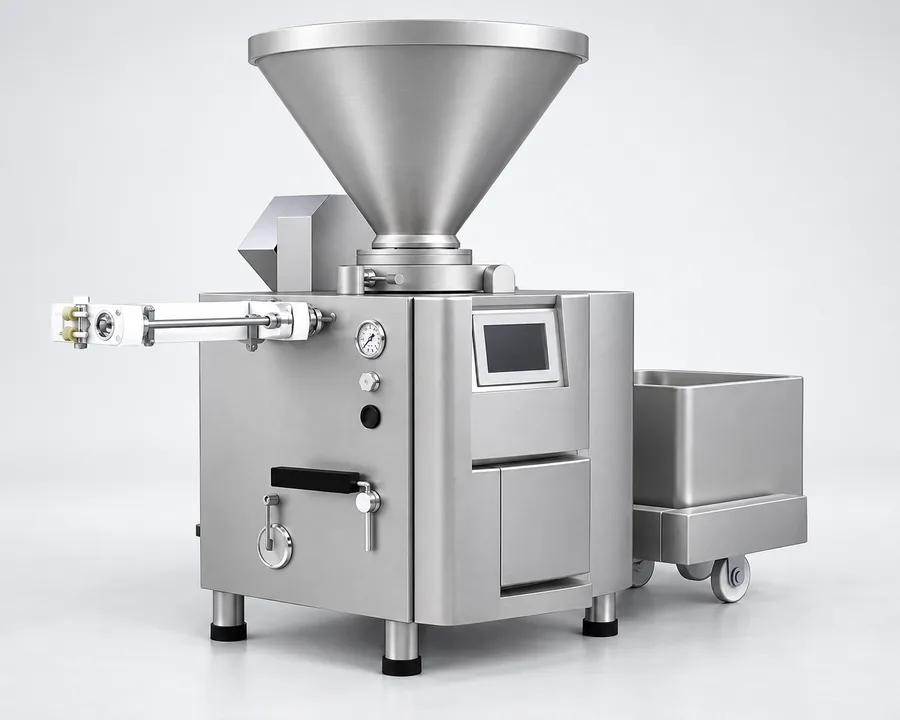
Fill the casing with controlled portions.
Prepared sausage batter is transferred to the ZKG-6500 quantitative vacuum filler. Vacuum filling reduces trapped air and feeds a repeatable mass into the casing. Actual output depends on casing type, diameter, portion weight and particle size rather than the filler nameplate alone.
- 06
Link and hang as one connected operation.
The GN-1200III is treated as one linking-and-hanging system, not two unrelated machines. Its linking section forms the selected sausage length; the following conveyor organizes the chain and places it on rods for thermal processing.
- 07
Load rods onto smokehouse trolleys.
Operators arrange the hanging rods on stainless trolleys with enough spacing for air, smoke and heat circulation. Twelve trolleys support loading, processing, unloading and empty-return circulation while four trolleys occupy the chamber during one cycle.
- 08
Dry, smoke and cook to the validated endpoint.
The double-door four-trolley smokehouse applies the product recipe through drying, smoking, cooking, exhaust and cleaning stages. This is normally the capacity-defining operation. Chamber loading, cycle duration and core-temperature requirements must be validated for the actual sausage.
- 09
Cool before mechanical separation.
Cooked sausages must be cooled to the agreed handling and packing condition before cutting. The final project should define showering or air cooling, drip control, transfer time and the hygienic boundary between raw and cooked areas.
- 10
Separate linked sausages for packing.
The GJ-1000 detects the linked sections and cuts the chain into individual sausages. The discharge then moves to inspection and the customer's chosen packing system. A packaging machine is not included in this concept unless it is added to the final project scope.
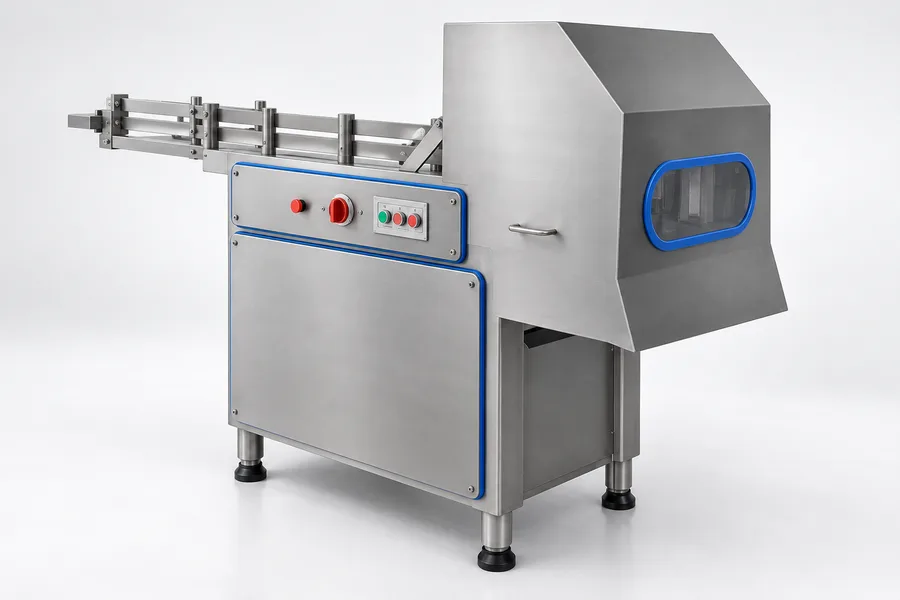
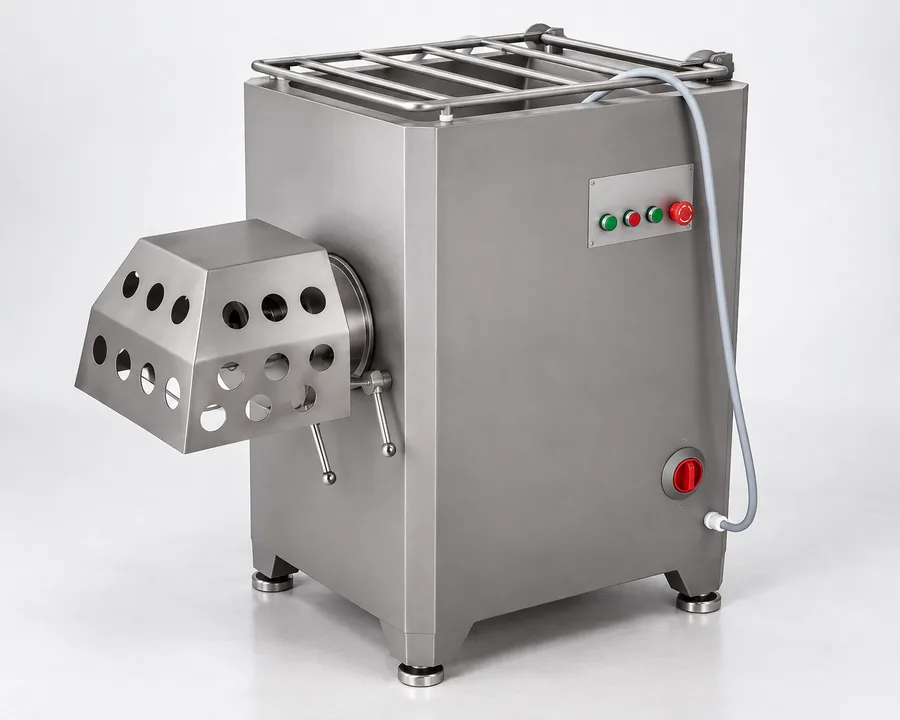
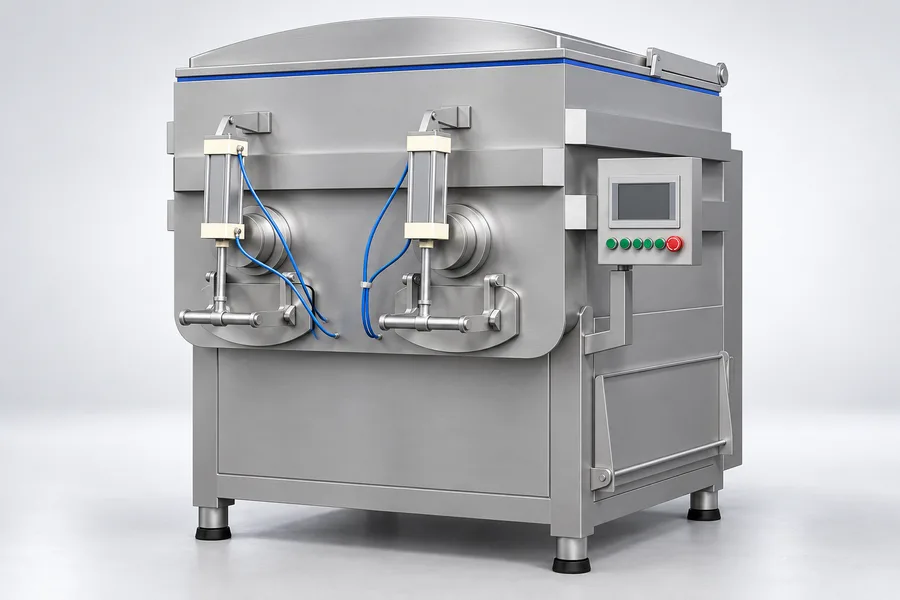

The equipment visuals illustrate the proposed line concept. They explain the proposed process and appearance, but they are not photographs of one completed customer installation.
Equipment included in the concept
| Frozen meat preparation | QK-2000 guillotine - 1255 x 720 x 1420 mm |
|---|---|
| Automatic transfer | Food-grade cleated conveyor - 3.5 x 2.4 x 0.9 m project reference |
| Grinding | JR-D120 - 1-2 t/h reference capacity |
| Vacuum mixing | ZKJB-1200 - 1200 L, 17.2 kW, 2160 x 1500 x 2000 mm |
| Mixer loading | YT-200 mobile bin hoist - 1400 x 1130 x 2700 mm |
| Vacuum filling | ZKG-6500 - 240 L hopper, 2210 x 1400 x 2140 mm |
| Linking and hanging | GN-1200III combination system - 30-180 mm link-length range |
| Hanging accessories | 100 stainless rods and 12 smokehouse trolleys |
| Thermal processing | Double-door, four-trolley smokehouse |
| Separation | GJ-1000 - 14-33 mm applicable diameter, 1140 x 830 x 1350 mm |
The smokehouse sets the production rhythm
Cutting, grinding and filling equipment can move material faster than the average 714 kg/h design rate. The batch mixer and smokehouse cannot be evaluated from maximum machine speed alone. The project schedule must balance mixer batch mass and cycle time with trolley loading, smokehouse load, drying and cooking time, cooling and changeover.
For a supportable 5 t/day claim, the customer and HELPER engineering team should agree the actual sausage diameter, unit weight, casing, recipe, chamber load, core-temperature endpoint and acceptable daily operating losses. A trial recipe and a documented cycle provide better evidence than a catalogue speed.

Factory and utility information required
A final layout needs the available room dimensions, column positions, doors, drainage, floor loading, raw-material access, cooked-product exit and trolley circulation route. The double-door smokehouse should support a clear raw-side and cooked-side workflow where the factory zoning allows it.
Confirm before engineering release
- Product recipes, casing types, sausage diameters, lengths and unit weights
- Required saleable output and seven-hour shift definition
- Electrical voltage and frequency, water, drainage, steam or heating source, exhaust and compressed air where required
- Cooling method, inspection method and downstream packing format
- Cleaning method, allergen changeover, sanitation verification and operator access
- Installation, commissioning, product trials, training, spare parts and documentation scope
What this project page means
This page gives other sausage producers a concrete starting point: a named production target, a complete equipment sequence and the critical interfaces that make the machines operate as one line. It is a concept project, not a claim that one identical layout fits every product or factory. The final system is engineered from the customer's recipe, plant, utilities and acceptance criteria.