
QXJ-200 Automatic Euro Bin Washer
Load, wash and rinse standard 200-litre food bins at a published 50–60 bins per hour.
Replace manual hose washing with a controlled cycle
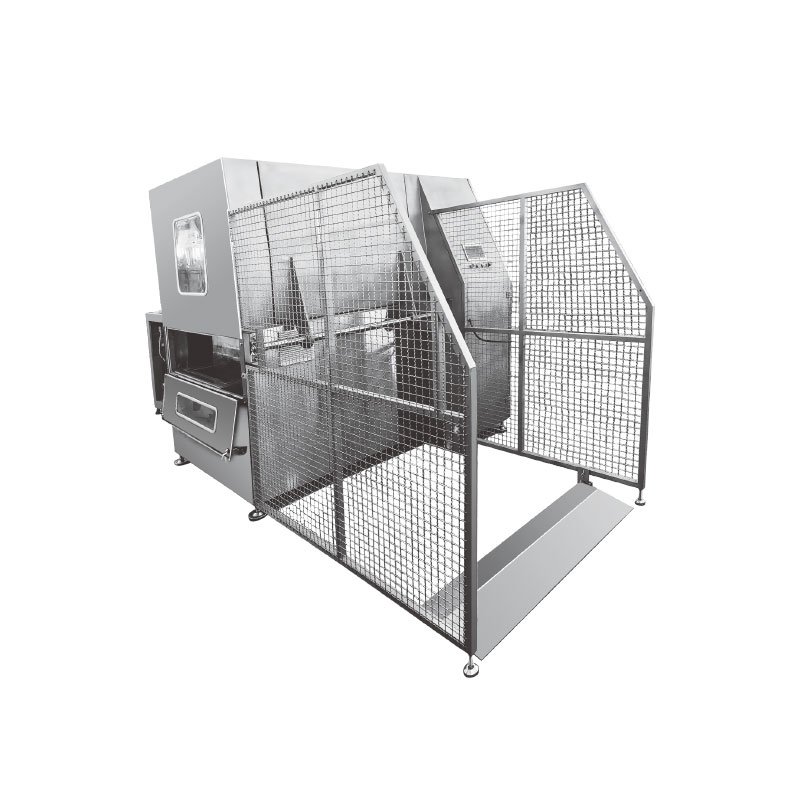
The HELPER QXJ-200 is a fully automatic single-bin washer designed for standard 200-litre Euro bins used in food factories. Its loading mechanism transfers one bin into the guarded wash position, where high-temperature, high-pressure cleaning reaches internal and external surfaces. After the programmed cycle, the machine unloads the bin for removal.
The official process uses two stages. The first circulates heated water containing cleaning agent to remove food soil and grease. The second rinses with clean water. Rinse water then enters the circulation tank for reuse, reducing fresh-water demand compared with once-through manual washing.
One-button control and automatic handling reduce repetitive labour and exposure to hot chemical spray. Guarding around the loading and tipping envelope is an essential part of the machine, because the bin moves while the wash chamber operates.
Four controlled stages from dirty bin to rinsed container
Position a compatible empty bin and start the guarded automatic cycle.
Circulate heated cleaning solution across internal and external surfaces.
Remove loosened soil and chemical residue with clean-water rinsing.
Return rinse water to the designated tank and unload the bin.
The page does not publish wash pressure, detergent concentration, dwell time or nozzle arrangement. These cannot be inferred from the phrase “high pressure.” They must be defined against the plant’s normal soils and sanitation validation plan.
QXJ-200 technical schedule
| Item | Published value |
|---|---|
| Cleaning capacity | 50–60 bins/hour |
| Heating options | Electric or steam |
| Total power | 55 kW electric / 7 kW steam-heated |
| Electric heating | 24 kW × 2 = 48 kW |
| Cleaning pump | 4 kW |
| Water temperature | 50–90°C, adjustable |
| Tap-water supply | 0.5 MPa, DN25 |
| Water consumption | 10–20 L/min |
| Steam pressure | 3–5 bar |
| Water tanks | 230 L × 2 = 460 L |
| Dimensions | 3305 × 1870 × 2112 mm |
| Machine weight | 1200 kg |
Choose the heating method by total utility cost
Electric heating produces a 55 kW published connected load and may be simpler where plant steam is unavailable. The steam-heated configuration reduces published electrical power to 7 kW but requires stable 3–5 bar steam plus condensate and isolation design. Compare installation capacity, warm-up time, operating cost and maintenance—not only purchase price.
Temperature is not a sterilization claim: 90°C is the published maximum cleaning-water setting. Hygienic performance depends on surface temperature, exposure, chemistry, coverage and soil removal, and must be validated by the factory.
Media policy for this machine
The exact official page and its source code provide the QXJ-200 image and technical data but no product-specific video ID or media file. HELPER’s general YouTube channel link is not evidence for an exact machine video.
Accordingly, this page does not embed an unrelated washer demonstration. Request current QXJ-200 running footage or a live factory acceptance test using the intended bin before approval.
What useful footage should show
Require one uninterrupted cycle including docking, guard closure, lift or tip, detergent wash, rinse, drain and unload. The video should show a dirty bin before washing and all internal corners after completion, plus the control screen and alarm response.
Confirm that any machine shown has the same heating method, tanks, pump, loading mechanism and guarding as the quotation.
Define a clean result before selecting the cycle
List the worst credible soils: raw-meat protein, fat, starch, dough, vegetable debris, allergens or dried residues. State maximum time between emptying and washing, because dried soil may require a different temperature, chemistry or pre-rinse. Provide bin material, dimensions, wheel configuration, drains, handles and damaged areas that can shadow spray.
Validate visual cleanliness, ATP or microbiological limits, detergent residue and allergen removal where applicable. Sample hard-to-reach corners, wheel mounts, handles, undersides and damaged seams—not only broad internal panels. Establish verification frequency and corrective action for failed bins.
Water management controls operating cost
Recirculation saves water but concentrates soil and chemistry. Define tank filtration, skimming, refill, dump frequency, temperature recovery and cleaning of the washer itself. Monitor conductivity or chemical concentration where required and prevent rinse quality from degrading over a shift.
Layout must provide floor drainage, ventilation for heat and moisture, service clearance, chemical storage, safe steam or electrical isolation and separation between dirty-bin entry and clean-bin exit.
Prove 50–60 accepted bins per hour
Run representative bins carrying the plant’s normal and worst-case soils. Record loading time, wash time, rinse time, unloading time, accepted bins per hour, water use, temperature recovery, detergent concentration, residual soil and rejected bins. Include tank warm-up and periodic water changes when calculating shift output.
Challenge low water, low temperature, pump fault, open guard, misplaced bin, blocked nozzle, emergency stop and restart after power interruption. Verify that hot water and chemical spray remain contained and that the loading mechanism cannot move with personnel inside the hazard zone.
For site acceptance, repeat hygiene tests with production water, chemical and drainage conditions. Record baseline nozzle inspection, filter cleaning, tank sanitation, pump maintenance and energy use so performance deterioration can be detected.
QXJ-200 washer questions
How many bins can the machine clean?
The published capacity is 50–60 standard 200L Euro bins per hour. Actual accepted output depends on soil, cycle settings and water-change requirements.
Does it use fresh water for the whole cycle?
No. It uses circulating hot detergent wash followed by clean-water rinse, with rinse water recovered into the circulation system.
Is electric or steam heating better?
It depends on site utilities. Electric heating has a higher published electrical load; steam heating requires a stable 3–5 bar steam supply.
Does 90°C sterilize the bin?
Not automatically. It is the maximum published water setting. Sanitizing or disinfection performance must be validated by time, chemistry, coverage and microbiological results.
Send bin drawings, soils and hygiene targets
Include bin dimensions, hourly demand, residue types, available steam/electric capacity, water supply, drainage and acceptance limits.
Request a QXJ-200 configurationApplication fit
Applications for QXJ-200 Automatic Euro Bin Washer
Best suited to controlled washing of 200 L Euro bins and compatible reusable containers used in hygienic food-production environments. Final suitability should be confirmed with representative product trials and the agreed acceptance criteria.