Load
A bin lifting system transfers prepared raw materials into the bowl, reducing manual handling at this scale.
Engineer high-volume meat emulsions in a sealed, automated process. The ZKZB-550 combines six-knife cutting, frequency-controlled bowl movement, hydraulic buggy loading and automatic discharge for large sausage, prepared-meat and pet-food plants.
Vacuum chopping combines rapid size reduction and intensive mixing inside a closed chamber. Reduced air inclusion can support denser batter, cleaner appearance and more consistent downstream filling. Actual results depend on recipe, feed temperature, vacuum level, knife condition and cycle design, so performance should be confirmed with a product trial.
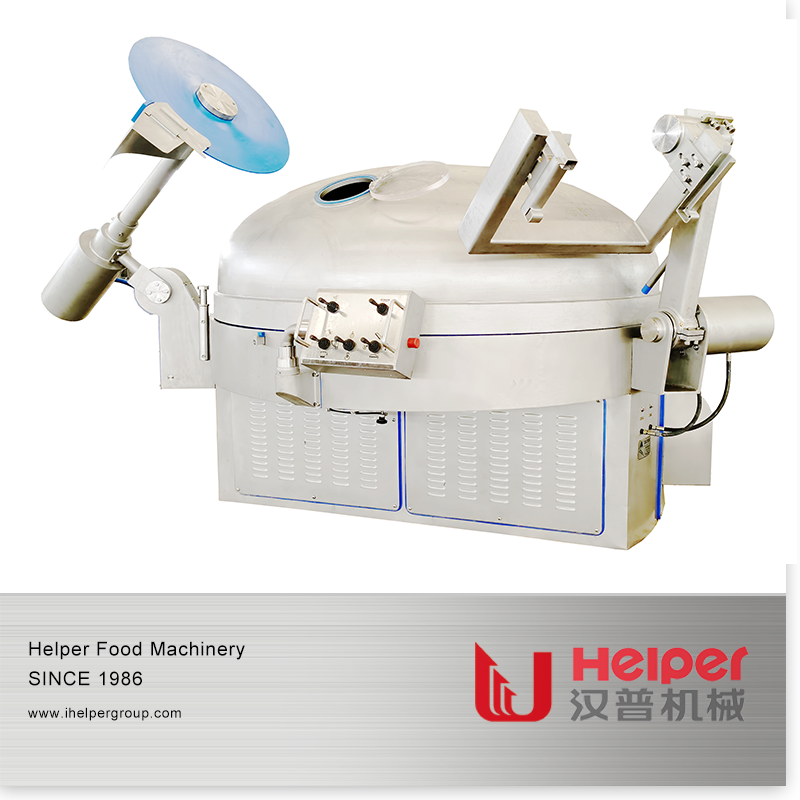
The ZKZB-550 is the largest documented HELPER vacuum bowl cutter in this series. Its mechanical system handles 200 L buggies at loading and uses an automatic discharge device, reducing manual transfer around a 450 kg batch. Applications include frankfurters, luncheon meat, meatballs, dumpling fillings, pet food and other emulsified formulations.
A bin lifting system transfers prepared raw materials into the bowl, reducing manual handling at this scale.
The powered lid closes the processing chamber so the specified vacuum program can be established.
Knife speed, bowl speed, elapsed time and product temperature are monitored to reproduce the validated recipe.
A variable-speed unloading device removes the processed batter for downstream filling, forming or thermal processing.
Official HELPER footage is placed here—after the process explanation—so buyers can evaluate loading, chamber operation and material handling in context.
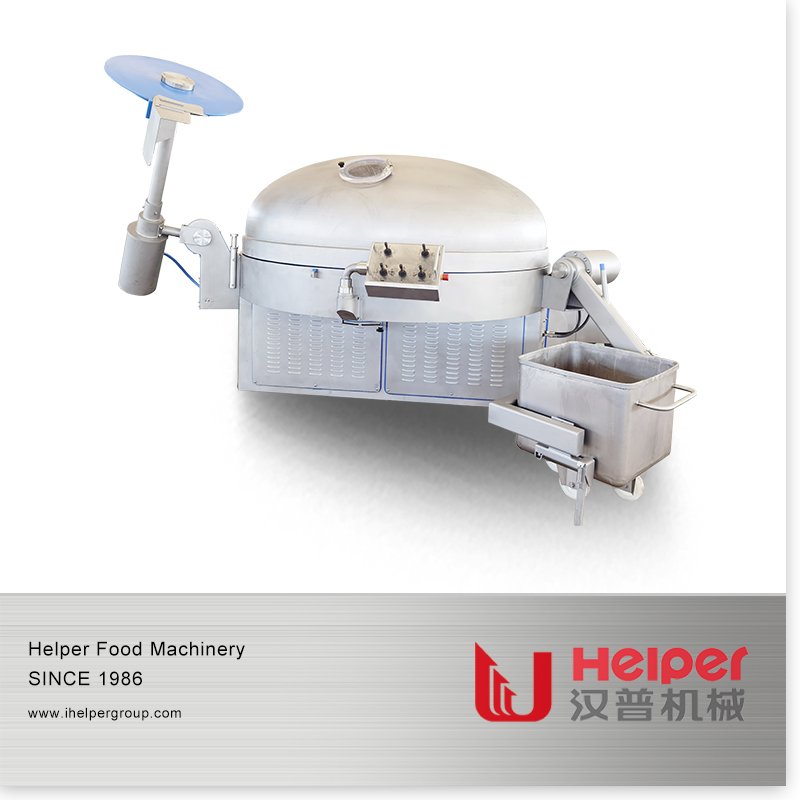
The current HELPER Group exact-model record is used as the primary schedule because it supplies the fullest machine-specific data and operational media.
| Current model | ZKZB-550 |
|---|---|
| Published working volume | 518 L |
| Productivity | 450 kg / batch |
| Total power | 125 kW |
| Knife quantity | 6 |
| Knife speeds | 200 / 1,500 / 3,000 / 3,600 rpm |
| Bowl speed | 3–8 rpm, frequency controlled |
| Loading / discharge | Hydraulic 200 L buggy loading / automatic discharge |
| Net weight | 6,500 kg |
| Dimensions | 3,999 × 3,985 × 2,100 mm |
The footprint alone is insufficient. Allow room for the loading arc, discharge trolley, dome opening, knife service, cleaning access and removal of major components. Confirm floor loading, drainage, electrical supply, compressed air, vacuum system and safe operator routes against a signed general-arrangement drawing.
For factory acceptance testing, record starting temperature, batch mass, vacuum setpoint, each knife stage, bowl speed, processing time, final temperature, amperage and discharge time using the buyer's actual recipe. Include cleaning and changeover checks.
A 450 kg batch and mechanical 200 L buggy workflow fit the plant, and 125 kW power plus the larger service envelope are justified.
Typical recipes fit a 200–240 kg batch, utilities or floor space are tighter, or more frequent product changeovers favor smaller batches.
Match cutter cycle output to grinding, filling, thermal processing and packaging. A larger bowl only adds value when downstream equipment can absorb each batch.
ZKZB-550 is the commercial model class; the current exact page publishes 518 L. Confirm whether quoted volume is geometric, working or nominal and never infer usable mass from liters alone.
It appears in an older HELPER family table as the 550 L vacuum unit, but its speeds, weight and dimensions differ. Treat it as a legacy or alternate revision until serial-specific documents confirm equivalence.
No. Published productivity is recipe-dependent. Product density, expansion, frozen fraction, temperature limit, knife loading and required texture determine validated batch size.
Require model revision, usable load, bowl definition, vacuum level, knife and bowl schedules, voltage, buggy interface, metallurgy, spare knives, GA drawing, FAT protocol and commissioning scope.
Share raw-material condition, batch size, finished product, target texture, temperature limit, utilities and downstream equipment. HELPER can prepare a matched ZKZB-550 proposal and trial plan.