
A tumbler's drum litres and its batch kilograms answer different questions. Litres describe space; kilograms describe mass. Before comparing offers, establish whether the quoted load means meat alone or the complete charge, including brine. A larger number without that definition does not establish a larger usable batch.
Start with the capacity label
Read the unit and its basis together. Gross drum volume is not a promise that the vessel can process the same numerical quantity of meat in kilograms. A working-load specification applies to the product and configuration described by its supplier.
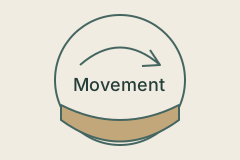
Illustrative cross-section, not an approved fill level.
| Label | What it establishes |
|---|---|
| Drum volume, L | Vessel space, not meat mass or finished output. |
| Meat load, kg/batch | Meat mass at a defined weighing stage; check added ingredients separately. |
| Meat + brine, kg/batch | A combined charge, subject to the stated product conditions. |
| Output, kg/hour | A rate requiring a time basis and a defined output stage. |
Manufacturer literature illustrates why the wording matters. Lutetia's tumbler brochure labels its capacity table as meat plus brine and qualifies the maximum by marinade or injection proportion and density. That explicit basis belongs to those machines; it does not define every supplier's rating.
Count everything charged, once
Consider a fictional batch with 200 kg of meat weighed before addition and 40 kg of brine added at the tumbler. With no other ingredients or transfer losses, the charged mass is 240 kg. The brine addition is 20% of the starting meat mass: 40 divided by 200, multiplied by 100.
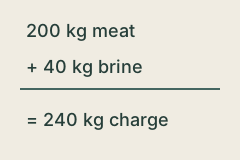
Fictional arithmetic, not a machine rating or retained yield.
This calculation proves neither that a particular tumbler can process that charge nor that 240 kg will become saleable product. Liquid remaining in the drum, discharge losses and subsequent processing require separate measurements. Use the pickup, retention and cooking-yield guide when evaluating those outcomes.
If the meat has already been injected, identify its weighing stage. A 200 kg scale reading after injection already includes whatever injected solution remains at that moment. Add only the further material entering the tumbler; do not add the original injection amount again. Record dry ingredients and any other additions in the same mass balance.
When brine is dispensed in litres, convert using its applicable density or weigh the addition directly. Density has units such as kg/L. Do not silently substitute litres for kilograms or treat an unspecified recipe percentage as both a volume and a mass fraction.
Working load depends on the actual application
Henneken's Type B brochure explicitly makes its loading range product-dependent. This supports checking application limits rather than adopting a universal fill percentage. Its range is not a loading instruction for HELPER equipment.
Identify the species, cut form, bone condition, incoming state and recipe associated with a proposed batch. Then establish the permitted working range for that configuration. The drum must perform its intended mechanical action; fitting a charge inside the opening is not an acceptance test. A permitted maximum also does not establish a suitable minimum for every product.
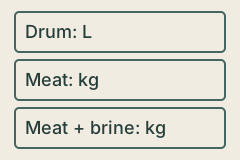
Keep the unit, material basis and batch conditions together.
The HELPER GR-2500 product page lists drum volume separately from batch capacity and notes material and process dependence. Its published batch row does not explicitly define brine inclusion. Keep that basis unresolved until the selected configuration's documentation defines it; do not infer it from the model number.
Turn a comparison into a usable specification
Write each candidate's drum volume, load basis, permitted product conditions and weighing stage in separate columns. Mark missing definitions as unknown. A meat-only figure and a combined-load figure need reconciliation before they can be compared.
For example, two offers both marked 240 kg may describe different charges. One might mean 240 kg of meat before additions; another might mean the combined charge in the fictional example above. Matching the number alone leaves the comparison incomplete.
Keep batch capacity separate from hourly output. Loading, processing, discharge and cleaning occupy time; a quoted batch mass alone supplies no hourly rate. For the wider process decision, see immersion, injection and vacuum tumbling. This capacity check supplies no universal speed, vacuum, temperature or cycle recipe.
Frequently asked questions
Does a 2,500 L drum mean 2,500 kg of meat?
No. Litres measure volume and kilograms measure mass. Use the machine's defined working-load specification for the intended product and configuration.
Does batch capacity include added brine?
Only when the specification defines it that way. Read the table heading and footnotes. If inclusion is unstated, keep it unknown and resolve the basis before comparing loads.
Can I add more liquid to reach the rated capacity?
Do not use the capacity label as a recipe target. Additional liquid changes the charge and formulation; it does not prove suitability, retention or acceptable finished quality.
Is kg per batch the same as kg per hour?
No. An hourly rate needs the complete elapsed cycle and a defined output mass. Batch capacity alone cannot establish production throughput.
Sources and scope
Checked 16 November 2026. Manufacturer documents illustrate specification wording for their own equipment. Calculations and diagrams are editorial examples, not HELPER trials or approved loading instructions.
- Henneken: Vacuum Tumbler brochure, identifier 202501, Germany; exact publication date not displayed. Type B section, printed page 7, describes product-dependent loading. No loading percentage is transferred to HELPER equipment.
- Lutetia: Tumblers brochure, France, undated manufacturer document hosted by the official exhibition directory. Final-page capacity heading and footnote define combined meat-plus-brine capacity and application qualifications.