
Lifting Conveyor Unit
An inclined belt conveyor for transferring dough material between process stages at different heights. Match the conveying path and end transfers to your equipment arrangement.
Discuss your conveyor layout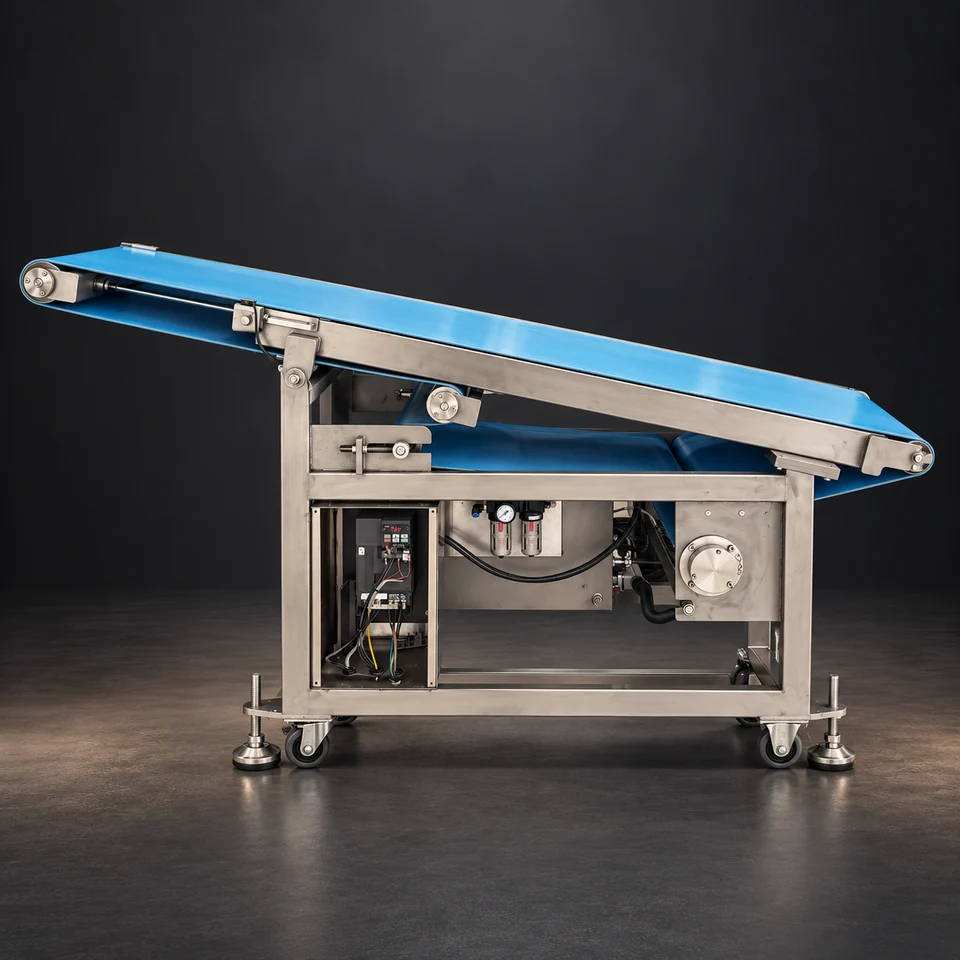
- Working function
- Inclined transfer between working stages
- Supply concept
- One transfer unit within the selected process route
Bridge the height difference between units.
The inclined belt connects the agreed discharge and receiving heights. Specify the direction of travel, inlet and outlet positions and supported material condition. The photographed incline does not establish a rated lifting height.
The conveyor provides a connection between working stages. Agree the required material condition, orientation and continuity at the receiving machine before selecting the arrangement.
Review the machine arrangement.
The unit view shows a blue belt, end rollers, stainless open frame, return belt and adjustment components. Consider the drive area, caster wheels and leveling pads when planning positioning and access.
Confirm belt material, guarding, drive access and cleaning arrangements against the selected drawing. The image does not establish material grades, electrical ratings or certified hygiene performance.
Upstream: define the discharge interface.
The preceding unit may be a sheeter, rolling unit, forming head or another conveyor, depending on the process. Specify whether the material is a continuous band, separated strands or portions, and record its condition at transfer.
Confirm discharge position, material width, support requirements and operating speed. Review the transfer gap and travel direction on the layout.
Downstream: match the receiving stage.
The next machine must receive material at the agreed height, direction and condition. Match its receiving position and speed, including how the connected units start and stop.
Further rolling, cutting, forming or transfer may follow within the selected route. These are interfaces to assess, not a fixed sequence for every recipe.
Information needed for selection.
- Product and material condition at transfer
- Supported width and conveyor length
- Inlet and outlet heights and travel direction
- Operating speed and control coordination
- Transfer gaps and surrounding machine layout
- Cleaning method, utilities and service access
No fixed length, width, lifting height, power or capacity is specified here. Request the confirmed drawing and specification for your configuration.
Check the handover with your material.
Observe material stability on the incline and support at both ends. Check for sliding, sticking, unintended folding or stretching during transfer.
Use representative material and record settings and observations. Confirm access for cleaning and belt adjustment, and review guarding and emergency-stop integration before installation.
Common planning questions.
Can it connect to an existing line?
Review the existing discharge and receiving positions, material condition, speed range, controls and available space. Compatibility requires a configuration review.
Does this conveyor perform another processing operation?
Its defined function here is transfer. Additional resting, dusting or accumulation duties must be specified separately; do not infer them from the conveyor image.
Which dimensions should be confirmed?
Confirm overall length and width, usable belt width, inlet and outlet heights, support footprint and maintenance clearances on the approved layout.
Plan the connection between your machines.
Send the material type, transfer length and heights, plus photos or drawings of the units on both sides.
Request a conveyor configuration