
Smooth-Roller Dough Rolling Unit
A separate rolling station with smooth cylindrical rollers, specified to reduce and calibrate an incoming dough sheet for its next working stage.
Discuss this rolling stage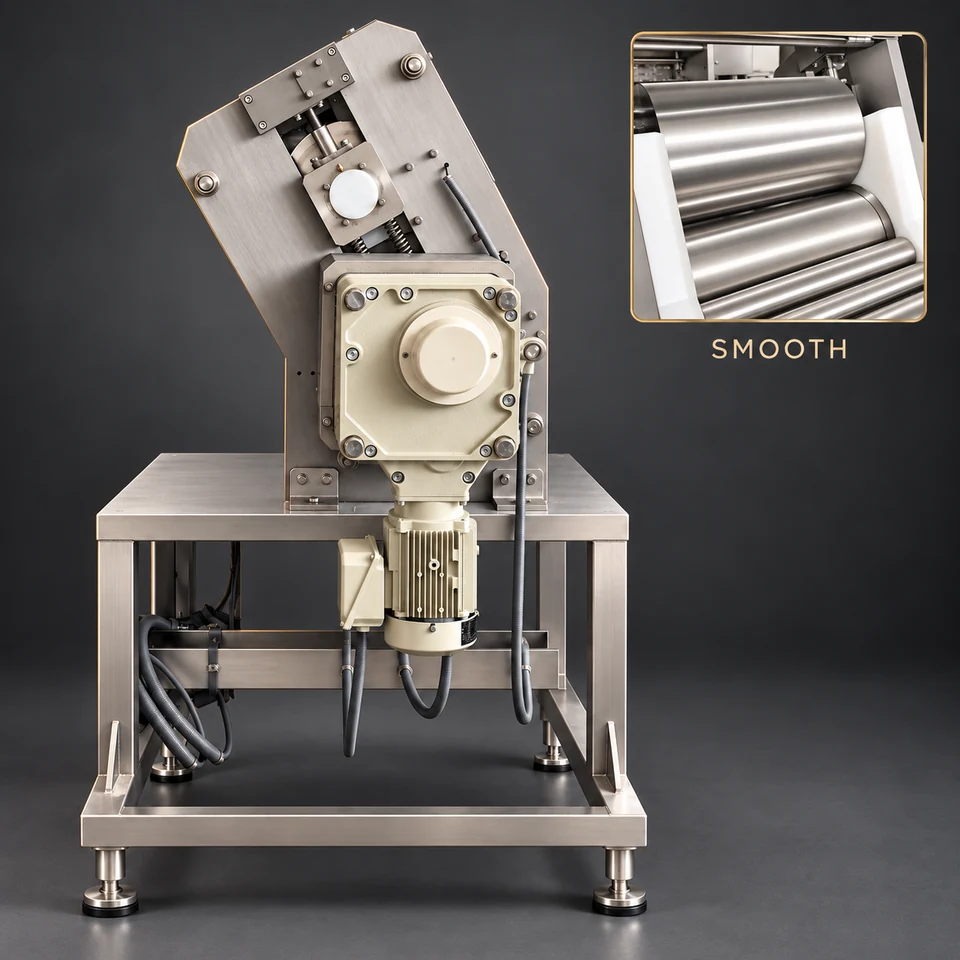
- Working surface
- Smooth cylindrical rollers
- Working duty
- Dough-sheet reduction and thickness control
A smooth surface for the selected rolling pass.
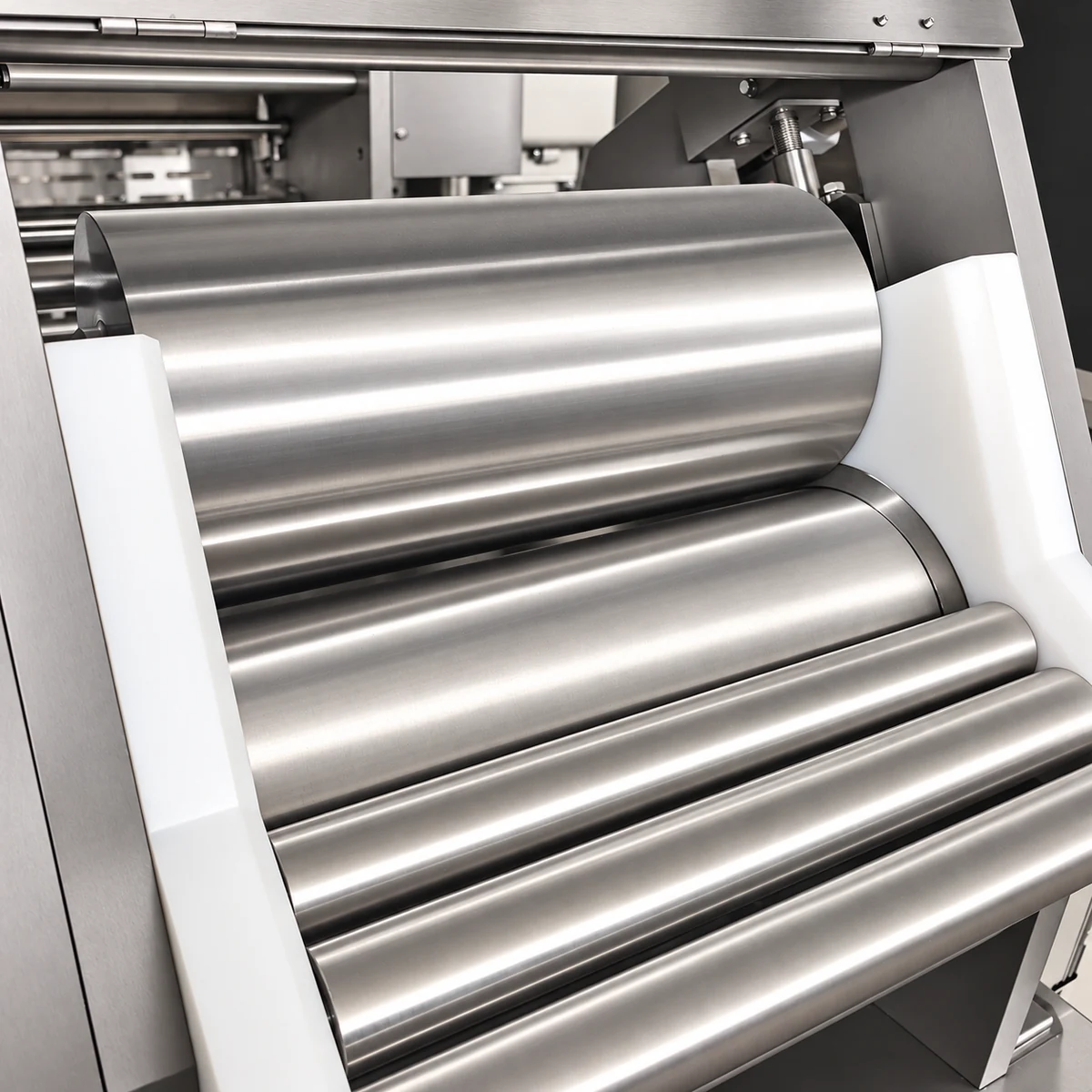
The supplied close-up shows smooth roller faces and white side guides. The smooth working surface distinguishes this unit from the large, medium and small corrugated profiles in this equipment family.
A smooth rolling stage receives an already formed band and works it through the selected roller gap. Its purpose is to bring the sheet toward the thickness and condition needed by the following operation. Final product results depend on the dough and the complete process route.
The gear-side view shows the sloping support body, adjustment and spring assemblies, gearbox, motor and steel stand. Working width, drive arrangement, guarding and installation details are confirmed for the selected configuration.
Upstream: receive a supported dough band.
Depending on the recipe, the incoming sheet may come from a compound sheeter, a resting stage or another rolling pass. Define its width, thickness and condition at this unit rather than specifying only the finished noodle size.
Downstream: prepare for the next operation.
The outgoing band can pass to another reduction station or, once the required sheet condition is reached, to cutting or forming equipment. Agree the transfer height, support, direction and coordinated speeds with the next machine.
Noodle slitting and cutting: process connections →
One smooth-roller unit is one working stage. The number of rolling passes and their sequence are selected around the product and incoming dough; this page does not define a complete automatic line.
Gap setting and product thickness.
Discuss the incoming band and required reduction together. The mechanical roller gap is a machine setting; the outgoing sheet thickness must be measured under agreed sampling conditions. Do not assume that a gap value alone defines the finished sheet.
For commissioning, record the recipe, incoming sheet condition, selected gap, operating speed and measured outgoing thickness. Inspect tracking, edge continuity, sticking and the handover to the next station.
Information needed for selection.
- Finished food and recipe range
- Incoming sheet width, thickness and condition
- Required outgoing sheet and next operation
- Working width and roller arrangement
- Transfer heights, factory layout and service access
- Electrical supply, control coordination and agreed guarding
Confirm dimensions, power, adjustment range and accepted output in the equipment specification. No fixed numerical performance is inferred from these images.
Smooth or corrugated?
Choose the working surface for the job required from this pass. Corrugated versions have a visible wave profile; the smooth version has a continuous cylindrical surface. Neither the profile name nor the appearance alone establishes the best route for every dough.
Large corrugation → · Medium corrugation → · Small corrugation →
Does a smooth roller replace every corrugated stage?
Not automatically. Specify the incoming sheet, the work required from the pass and the downstream product condition. Compare alternative routes with representative dough.
Can it be the final rolling pass before cutting?
It can be discussed for that duty when its specified arrangement and trial results meet the required outgoing sheet condition. A smooth surface alone does not establish the final thickness or cutting readiness.
Is the working width shown by the photograph?
No. Confirm the usable width and installation dimensions from the selected machine drawing.
Define the next pass in your dough route.
Send the incoming sheet, target thickness, recipe range and machines before and after this unit.
Request a configuration review