
Dough Folding & Rolling Unit
A dedicated folding and rolling stage for a prepared dough band. Plan the layering task, subsequent rolling duty and material handover around the product you want to make.
Discuss this working stage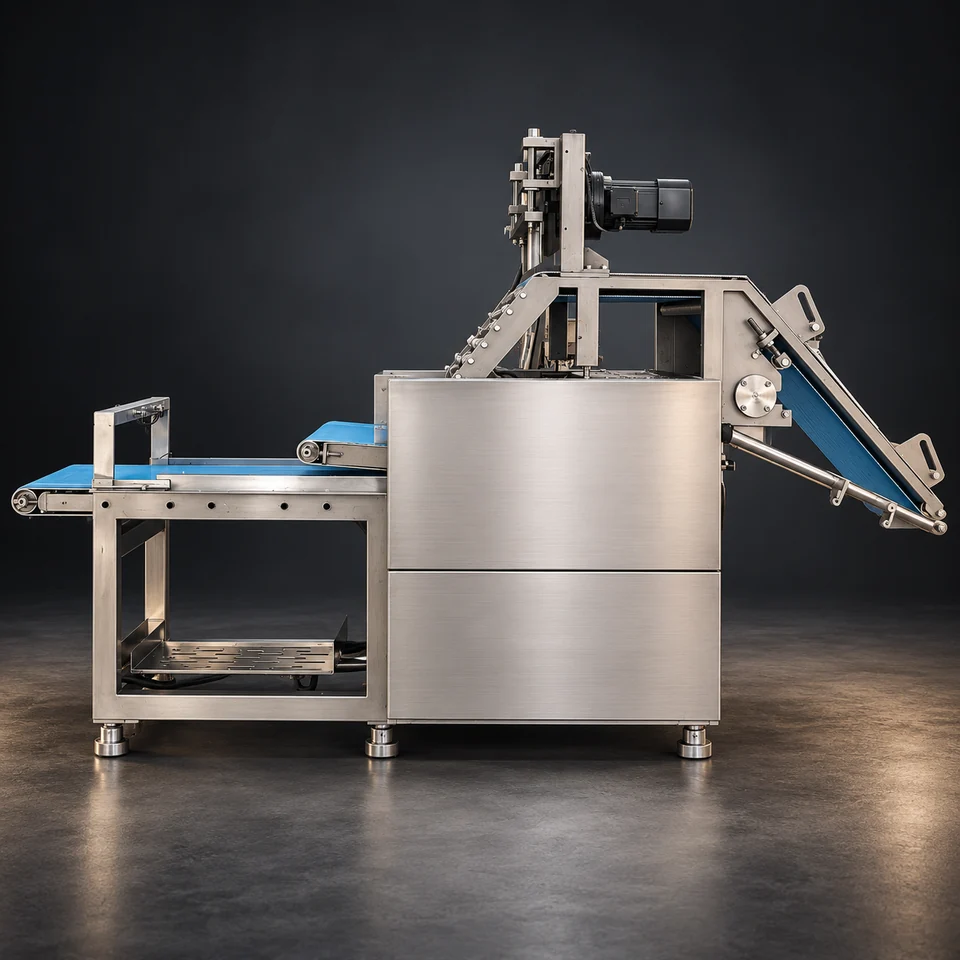
- Working function
- Dough-band folding and rolling
- Supply concept
- One defined working unit within the agreed process route
Introduce a folding stage into the dough route.
This unit is identified as a dough folding and rolling unit. Folding brings the band into a layered arrangement for the specified rolling operation. Its contribution depends on the incoming dough and the job required from this stage.
Define the intended folding pattern, material condition and outgoing band before selecting the configuration. The number of layers, folding cycle and reduction schedule are not established by the external photograph.
Review the individual machine boundary.
The illustration shows a main stainless cabinet, a horizontal blue-belt conveyor, an attached inclined belt assembly and an upper drive structure. The open supporting section and machine feet are included in the unit view.
Neighboring equipment was removed from the source image to make this machine easier to identify. Confirm its feed direction, internal working arrangement, guarding and service access from the selected configuration and drawing.
See the dough band fold onto the conveyor.
This short HELPER Machinery video shows the folding stage and its receiving conveyor, helping you understand the material handover before the next rolling operation.
- Watch the dough band turn back onto itself at the folding point.
- Follow the layered band onto the horizontal conveyor.
Folding prepares the band for the next processing stage. The selected recipe, sheet width and downstream equipment determine the required setup.
Upstream: receive a prepared dough band.
The preceding operation may be initial sheeting, a resting stage or another rolling pass, depending on the recipe. Define the incoming band width, thickness, continuity and support at this unit.
Match the transfer height, direction and coordinated feed to the folding task. Do not choose a route solely from the machine names.
Downstream: specify the next sheet condition.
The outgoing band may continue through a smooth-rolling or other specified reduction stage before cutting or forming. Define its required width, thickness and surface condition at that handover.
Confirm whether the folding unit's rolling duty reaches the next operation directly or whether an additional pass is required. One unit does not establish a universal complete-line sequence.
What to define before selecting the unit.
- Finished noodle or other dough-sheet product
- Recipe range and incoming dough condition
- Incoming band width and thickness
- Required folding pattern and rolling duty
- Outgoing band and the next operation
- Layout, transfer heights and electrical supply
Working width, power, dimensions, speed range and accepted capacity require the confirmed equipment specification.
Check folding and rolling in a trial.
Use representative dough to inspect entry support, folding alignment, repeatability and how the layered band enters the rolling stage. Observe tracking, sticking and continuity at both edges.
Record recipe, incoming condition and settings with the outgoing band measurements. Evaluate the material after the following operation as well, using agreed acceptance criteria.
Common planning questions.
Is this the same as the standalone compound sheeter?
They are listed as separate working units. This page concerns the owner-identified folding and rolling stage; specify its folding task and material interfaces separately from the initial forming or combining duty of a compound sheeter.
Does it define a fixed number of dough layers?
No layer count is supplied here. Confirm the folding pattern, operating sequence and intended outgoing band for the selected configuration.
Can one setup be used for every noodle recipe?
Do not assume that. Review the recipe range and trial observations, including folding behavior, rolling duty and downstream handling.
Define the folding task within your process.
Send your product, incoming dough band, intended folding duty and the machines before and after this unit.
Request a configuration review