
Noodle Forming Head with Smooth Rollers
A combined working unit with smooth rolling and noodle-slitting assemblies. Review the sheet handover, cutter arrangement and discharge guides as one defined stage in your noodle route.
Discuss this forming stage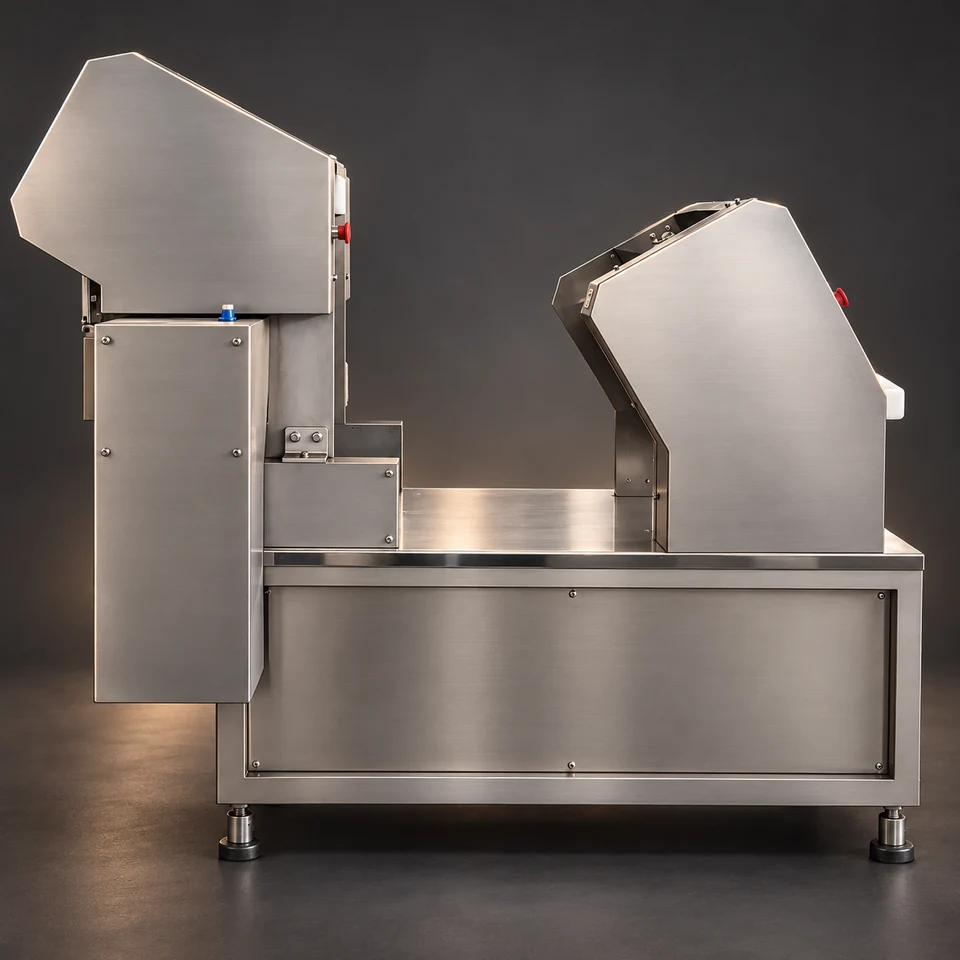
- Incoming material
- A prepared dough sheet
- Working stages
- Smooth rolling, slitting and guided discharge
Prepare the sheet at the rolling head.
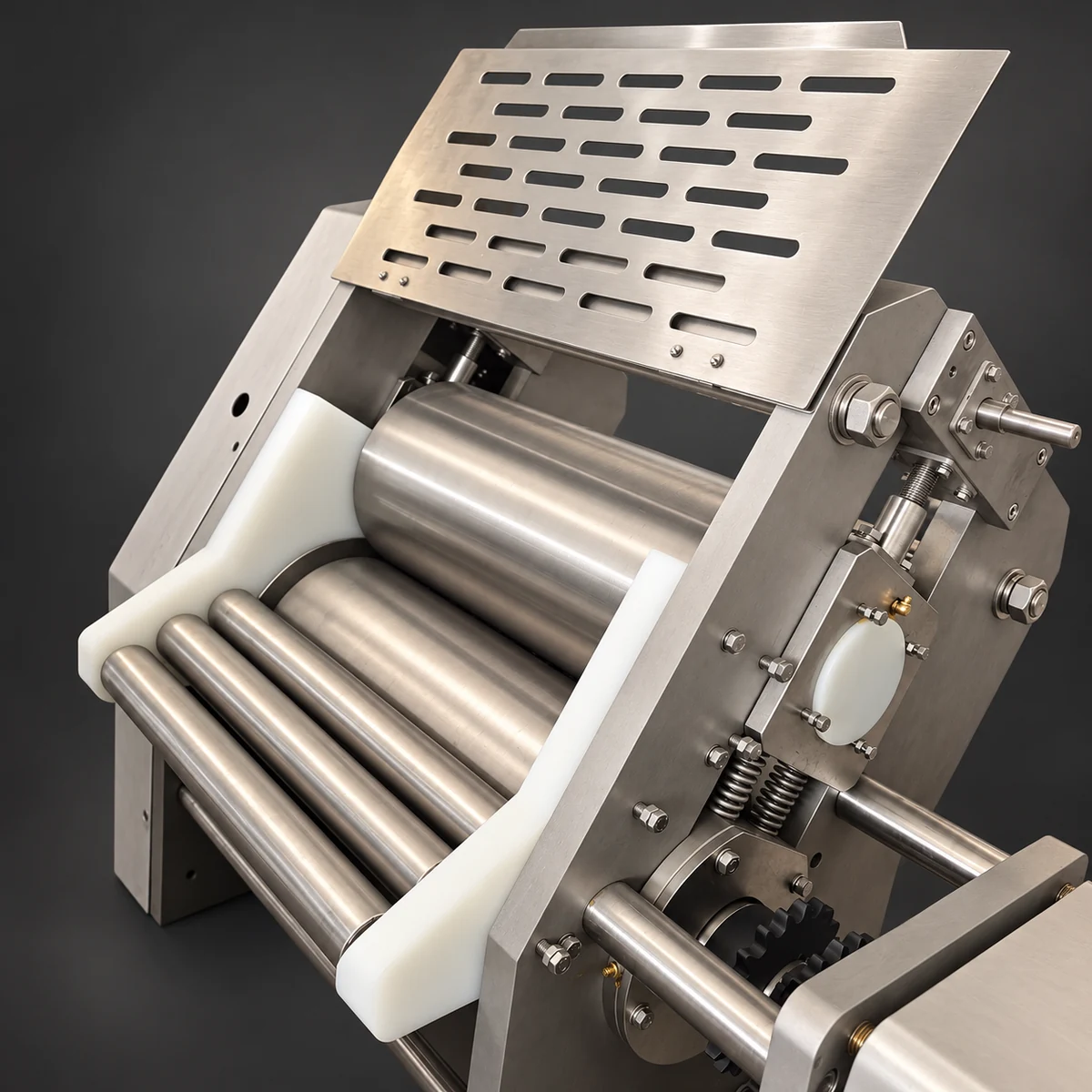
The smooth cylindrical roller assembly works the incoming sheet before the specified cutting operation. The supplied detail shows the roller faces, white side guides, sloping supports, adjustment components and raised perforated cover.
Define the incoming thickness and the condition needed at the cutter. The roller-gap setting must be checked against the measured outgoing sheet rather than treated as a complete product specification.
The open-cover image shows the component arrangement for inspection. Operating guards and access arrangements are confirmed in the supplied configuration.
Slit the band and guide the outgoing strands.
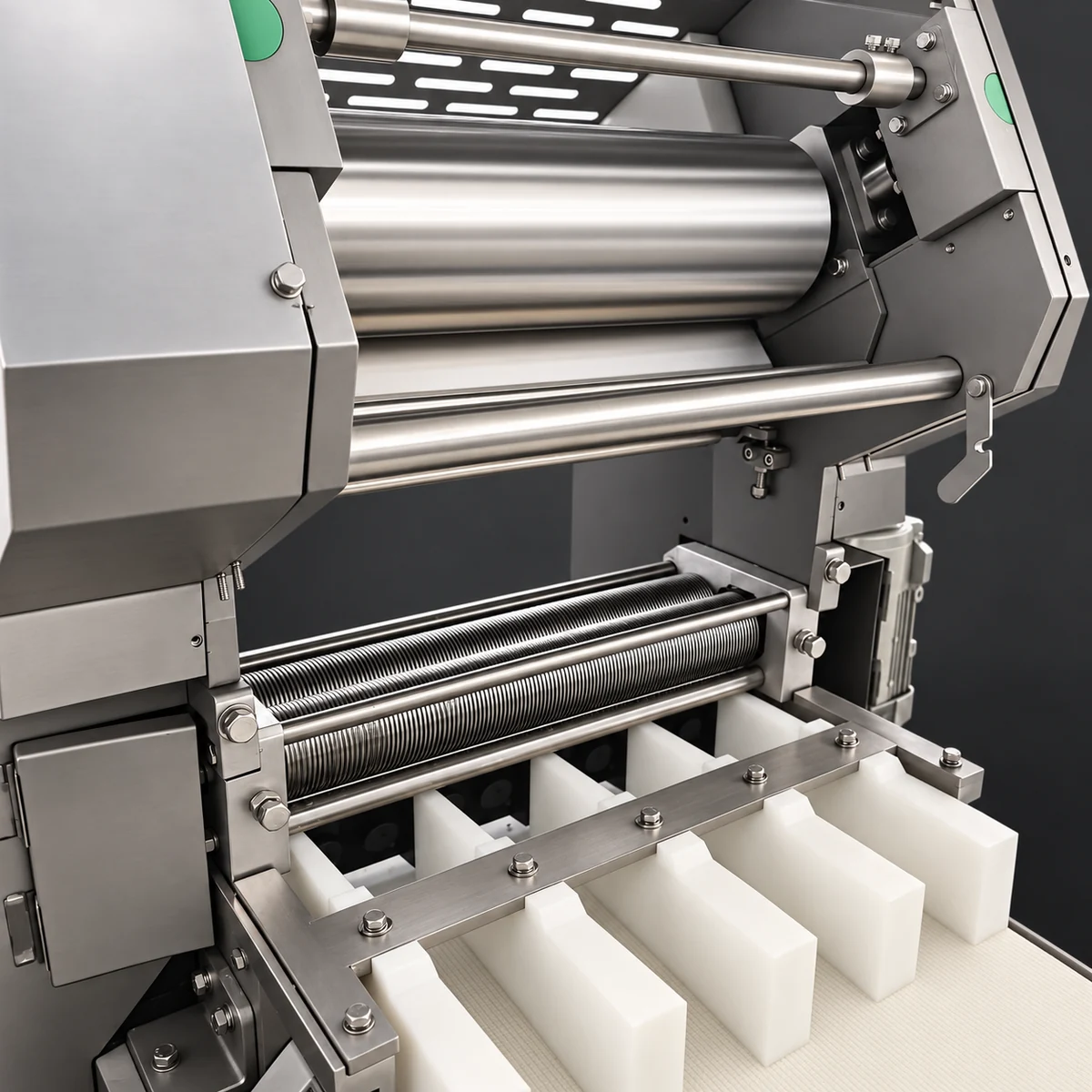
The second detail shows the fine parallel-disc cutter assembly below the smooth roller area. This is the noodle-slitting section, distinct from a corrugated roller used to work a dough band.
White guide blocks and the discharge surface are visible after the cutter. Their arrangement is part of the material handover to the following equipment. Check separation, tracking and discharge during a representative dough trial.
Noodle width follows the selected cutter arrangement; sheet thickness is a separate requirement. Confirm the cutter specification and the needed product section rather than estimating dimensions from a photograph.
Before the forming head.
The incoming band may come from a smooth-rolling station, another specified reduction stage or a resting operation within the agreed process route. Match sheet width, support, direction and transfer height at the inlet.
Smooth-roller dough rolling unit →
After the forming head.
The next operation depends on the finished noodle: transfer, portioning, cooking, drying or another agreed stage may follow. The photographed unit does not by itself establish the complete downstream route.
Specify the required strand condition and supported discharge. If portion length, waving or portioning is required, define those functions separately; their inclusion is not established by these images.
What to confirm before selection.
- Finished noodle and representative recipe range
- Incoming band width, thickness and condition
- Required noodle width and cross-section
- Cutter arrangement and guide configuration
- Inlet/outlet heights and neighboring equipment
- Electrical supply, drive coordination and operating access
Power, working width, cutter dimensions, operating speed and accepted output require the selected equipment specification.
What to inspect during a trial.
Record the incoming sheet, gap setting and measured thickness. Inspect cutting continuity, strand separation, sticking, tracking and the handover to the next conveyor or process.
Check normal running and coordinated stop/restart behavior. Agree the inspection access and cleaning procedure for the supplied machine, including the cutter and guide area.
Questions about the combined unit.
Is the lower disc assembly a corrugated dough roller?
No. The photographed lower assembly is the noodle-slitting cutter. The smooth roller and cutting assembly perform different jobs.
Can the pictures establish noodle width or capacity?
No. Confirm the selected cutter dimensions, usable width, drive specification and trial acceptance requirements.
Does this unit also set portion length?
Do not assume that from the photographs. Define any length-cutting or portioning requirement and confirm the required additional mechanism.
Connect sheet preparation to noodle forming.
Send the incoming sheet, intended noodle size, recipe range and next operation for a configuration review.
Discuss your forming head