
Automatic Compound Dough Sheeter
A six-model industrial series that compounds, progressively sheets, powders, slits and rewinds dough bands ready for high-volume dumpling forming machines.
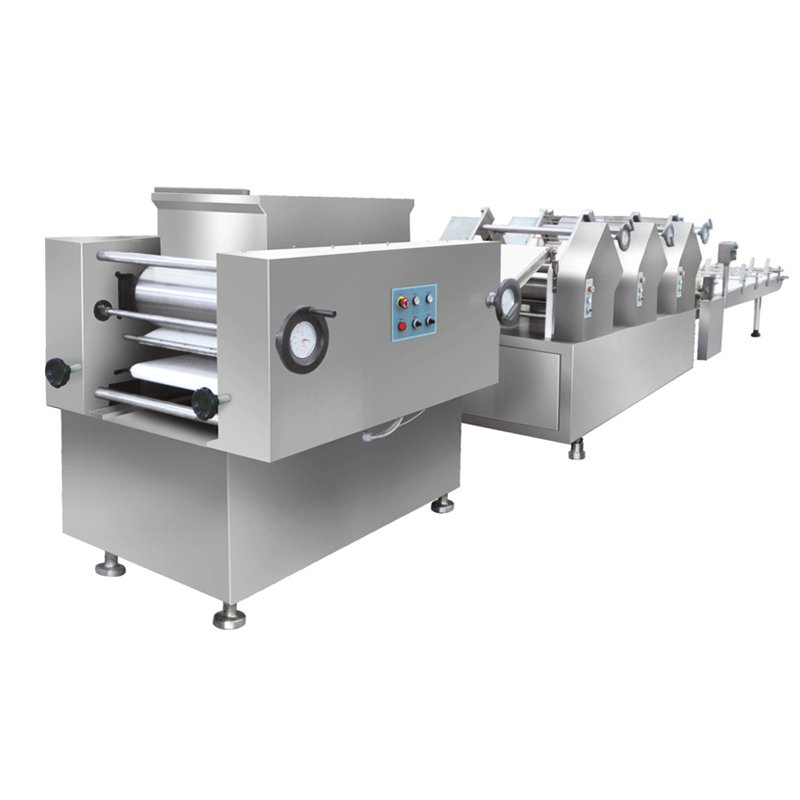
Build a stable wrapper roll through progressive reduction
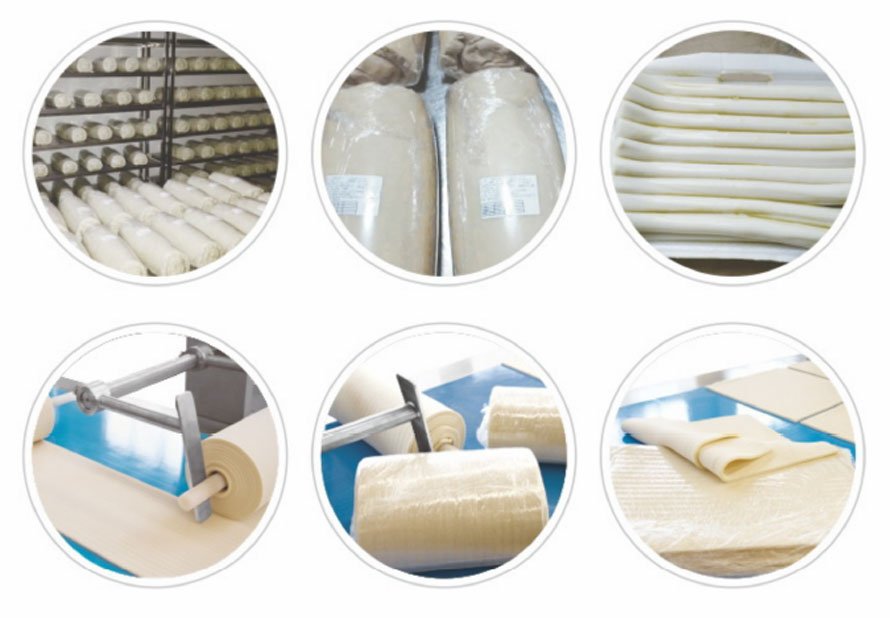
Each independently driven stage reduces the dough band under sensor-coordinated speed control. The line then applies dusting flour, slits the web to the required lanes and rewinds each lane for downstream forming.
Independent drives for stable multi-roll control
Each roller section uses an independent drive for coordinated operation.
Stepless speed regulation supports recipe and forming-machine matching.
Distance sensors coordinate stages and stabilize the rolling ratio.
Single-side handwheel adjustment and a graduated dial support repeatability.
Designed for corrosion resistance, surface precision and reduced sticking.
Cut lanes are dusted and rewound for efficient downstream handling.
Compare the MY-440 to MY-700 series
The printed data table lists six standard models. Model selection follows the required line width, wrapper-roll layout and receiving forming machine.
| Model | Total power | Composite | Precision press | Roll-up | Line speed | Weight | Catalogue dimensions |
|---|---|---|---|---|---|---|---|
| MY-440 | 9.92 kW | 4.75 kW | 3.35 kW | 1.82 kW | 0–17 m/min | 3,900 kg | 8350 × 1250 × 1340 mm |
| MY-540 | 9.92 kW | 4.75 kW | 3.35 kW | 1.82 kW | 0–17 m/min | 4,000 kg | 8350 × 1250 × 1340 mm |
| MY-600 | 9.92 kW | 4.75 kW | 3.35 kW | 1.82 kW | 0–17 m/min | 4,200 kg | 8350 × 1360 × 1340 mm |
| MY-640 | 9.92 kW | 4.75 kW | 3.35 kW | 1.82 kW | 0–17 m/min | 4,300 kg | 8350 × 1400 × 1340 mm |
| MY-680 | 9.92 kW | 4.75 kW | 3.35 kW | 1.82 kW | 0–17 m/min | 4,400 kg | 8350 × 1460 × 1340 mm |
| MY-700 | 9.92 kW | 4.75 kW | 3.35 kW | 1.82 kW | 0–17 m/min | 4,500 kg | 8350 × 1480 × 1340 mm |
The P17/P18 heading lists MY-440/540/600/640/700, while its technical table also includes MY-680; this page follows the complete printed table. Published dimensions describe the catalogue configurations. Confirm the active model, lane arrangement and signed general-arrangement drawing before factory planning.
Configure full-width sheet and slit-roll delivery
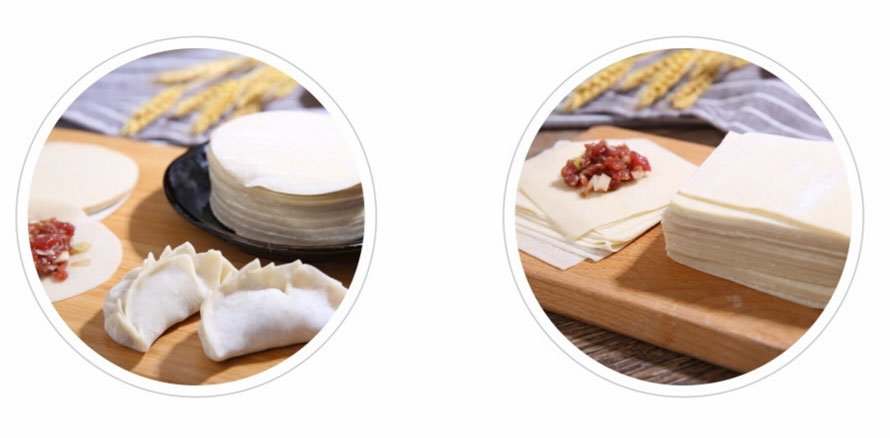
Wrapper-roll preparation—not filled-product forming
This line prepares dough bands and rolls. Filling, portioning, folding and sealing are performed by a separate dumpling, wonton or shumai forming machine.
Place the compound sheeter between mixing and forming
Data needed before quotation
Compound sheeting for handmade-style dumpling wrappers
Compound sheeting brings two dough bands together before progressive reduction. This can improve sheet structure and uniformity compared with forcing mixed dough directly to final thickness. The benefit depends on controlled hydration, resting and reduction ratios; the machine cannot compensate for inconsistent flour or large batch-to-batch temperature changes. Roller gaps and line speed should be saved as recipes only after the physical product has passed forming and cooking tests.
For a dumpling line, the sheeter must be synchronized with the downstream cutter or former so the sheet is neither stretched nor accumulated. Confirm working width, final thickness, edge trim, flouring, transfer height and stop/start buffer. Cleaning access around rollers and scrapers should be evaluated with the plant sanitation method.
Define formula, dimensions, moisture, appearance and the test used to accept finished output.
Match batch or sheet output to upstream supply and the downstream machine’s real demand.
Confirm voltage, air, cooling, drainage, access and service clearances before approval.
Test the actual material for an agreed duration and record output, temperature and quality variation.
compound dumpling dough sheeter FAQ
How should the model be selected?
Use the real recipe, product dimensions, accepted output and downstream process. Nominal chamber volume or working width alone is insufficient.
Can published capacity change with the product?
Yes. Moisture, thickness, product size, trim, batch cycle and quality tolerances all affect sustainable accepted output.
What should be tested before delivery?
Agree representative materials, run duration, quality measurements, sanitation checks, changeover scope and utility conditions in the factory-acceptance plan.
What information is needed for a proposal?
Provide formula, photos or samples, batch or hourly target, voltage, utilities, floor plan and upstream/downstream equipment.
Related decision path
Continue from this page
Match the sheeter to your forming machine
Send the wrapper dimensions, dough formula, target speed and downstream dumpling machine model. We will confirm roll width, lane count, roller stages and the final line layout.
Ready to discuss your project?
Use our single online inquiry form to send your product, capacity, utility and layout requirements.
Go to contact form