
Noodle Cooking & Steaming Unit
Apply the required thermal process using the specified cooking method. Boiling and steaming are alternative operations with different transfer, water and steam interfaces; they are not interchangeable names for one standard tunnel.
See upstream & downstream units →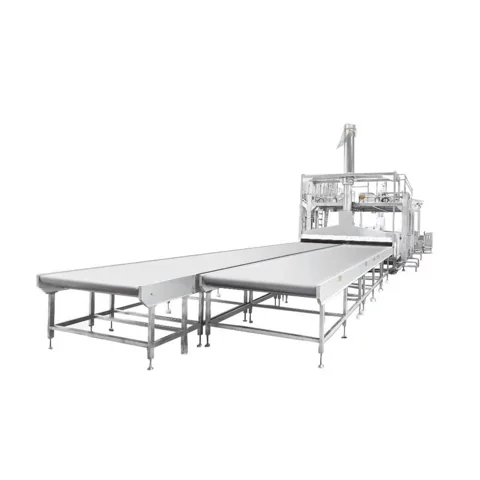
- Input to this unit
- Formed strands or supported noodle portions
- Output to the next unit
- Thermally processed noodles for the selected route
Where this unit connects.
These are typical neighboring operations. The route may omit a unit, use it more than once, or integrate functions into the same frame. The material condition at the handover determines the actual connection.
Why the arrangement changes.
Product thickness, recipe and presentation influence the required treatment. A pre-cooked frozen noodle route and an instant noodle route may use different cooking duties. Thermal performance must be established on the actual product. No universal cook time, safety validation or steam consumption is assigned by this process overview.
The 270, 330, 360, 440, 540, 600, 640, 700 and 800 line-width platforms are starting points for discussion. A width name does not establish this unit’s transfer rate, the usable product width or compatibility with every other module. Review the actual inlet, outlet and controls on the agreed layout.
Define before selecting equipment
- Boiling or steaming and the product acceptance endpoint
- Infeed load, portion presentation and residence arrangement
- Water or steam supply, extraction and drainage
- Discharge transfer and the required next cooling stage
Check the handover in a product trial.
Evaluate the intended reheat or serving condition as well as the product immediately after cooking. Agree how time, temperature, loading and the relevant food-safety controls will be validated for the installation.
Agree the incoming material, sampling method and acceptable outgoing condition before the run. Record what the next unit receives during normal operation and after a stop. An isolated machine demonstration is useful for understanding a mechanism, but it does not prove that the full selected route meets the project target.
Related HELPER equipment and line routes.
The links below lead to existing equipment specifications or complete project routes. A complete-line page is a configuration reference, not evidence that this unit is offered as a separately priced standard machine.
Is this unit required in every line?
No. Select it when its function is required by the intended product and process. Use the process-unit route maps to compare fresh, dried, cooked-frozen and wrapper-sheet examples. The maps show planning relationships, not a universal sequence.
What should the engineering inquiry include?
Send the recipe or representative product sample, current upstream and downstream equipment, proposed width platform, required good output, factory layout and available utilities. State whether you need a standalone machine, a connected section or an addition to an existing line.
Make the connection part of the specification.
Discuss the incoming product, outgoing condition and operating relationship with both neighboring units before the machine scope is finalized.
Discuss this unitBack to all process units → · Browse complete noodle lines →