
Medium Corrugated Rolling Unit
A standalone corrugated rolling unit with the intermediate wave profile shown in the detail image. Specify the medium corrugation class around the incoming band and the job required from this particular stage.
Discuss this unit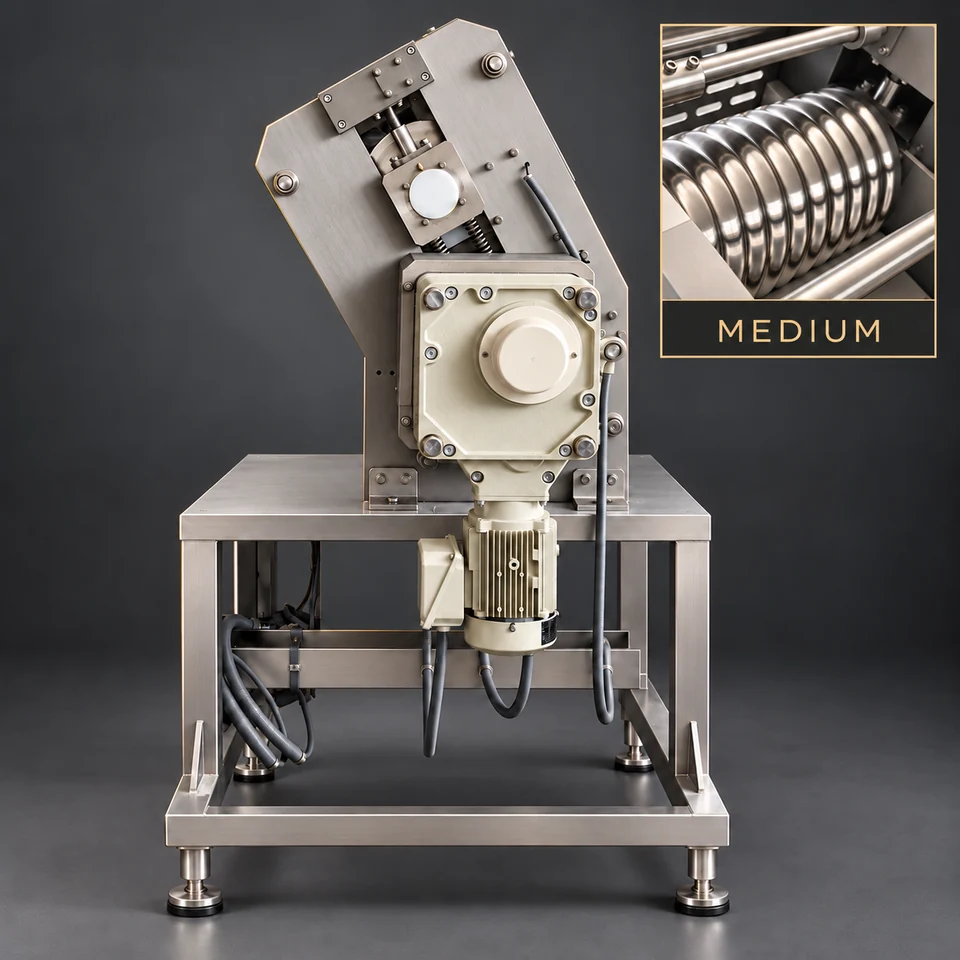
- Wave class
- Medium — Intermediate rounded-wave spacing
- Supply concept
- One individually specified rolling unit
What distinguishes the medium-wave version?
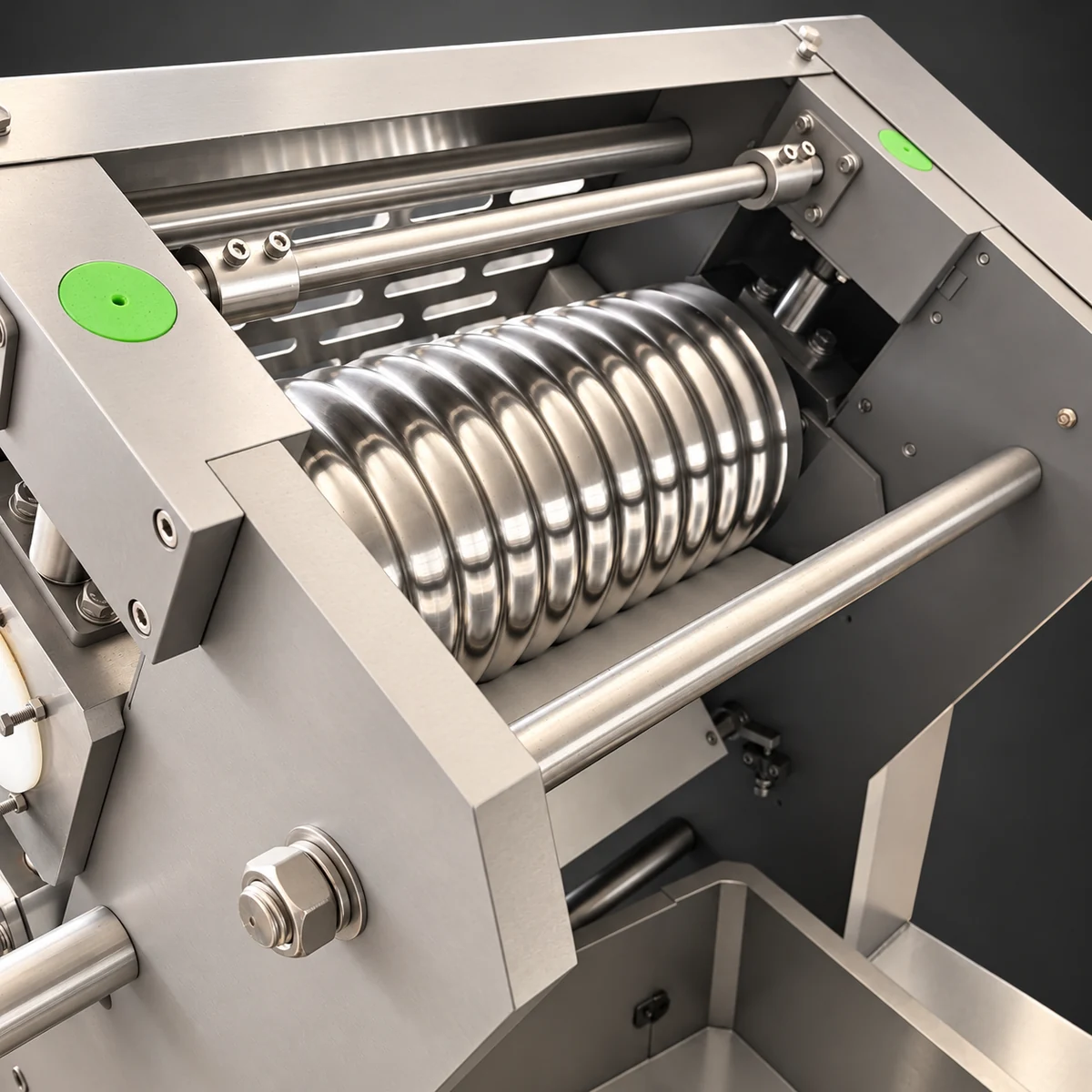
The medium-wave reference shows an intermediate corrugation pattern: broader and less closely spaced than the small-wave profile, with more visible crests than the large-wave version over the comparable roller span. Medium is a profile class, not a measured pitch or a claim about machine size.
Consider this profile when discussing a separate dough-working pass or the replacement of an existing rolling station. The name does not make it an automatic middle station in every line. Confirm what the preceding operation delivers and what the following operation must receive.
The numerical pitch, wave depth, roller diameter and usable working width belong in the approved drawing. They are not read from the illustration.
The working function.
A corrugated rolling stage works an incoming dough band through the selected roller arrangement and gap. Its contribution must be assessed together with the dough condition, feed behavior and the next operation. A wave-class name is not a recipe, a final thickness setting or a complete-line specification.
The illustrated unit has a sloping roller support body, adjustment and spring assemblies, a geared drive and motor, and a supporting frame. Confirm the operating access, guarding and installation arrangement for the supplied configuration.
Connections before and after.
Upstream equipment may deliver an initial band from a compound sheeter, a rested sheet or the output of another rolling stage. Define the incoming width, support and dough condition at that handover.
Downstream equipment may be another rolling or conditioning station, followed by cutting or forming where the route requires it. Match transfer height, alignment and coordinated operation. The three wave classes do not impose a universal large–medium–small sequence.
What to check in a product trial.
Trial the medium profile with representative dough rather than transferring a setting from another roller. Inspect band tracking, continuity and the outgoing surface across the width. Where alternative profiles are being compared, record incoming dough condition, gap, feeding and the sampling point so the comparison is useful.
Agree the required outgoing condition before the run. Keep the incoming recipe and material condition visible in the trial record, and include normal feeding as well as stop-and-restart observations.
Information needed for selection.
- Intended noodle, wrapper or other dough-sheet product
- Recipe range and incoming band condition
- Required outgoing condition and next machine
- Usable width, layout and transfer heights
- Electrical supply, controls and operating access
- Drawing-confirmed roller profile and included assemblies
Power, dimensions, operating range and accepted output are confirmed for the selected configuration. Do not transfer a capacity or setting from another unit.
Compare the other wave classes.
- Large corrugated rolling unit — Broad, widely spaced rounded waves
- Small corrugated rolling unit — Fine, closely spaced rounded waves
Does “medium” describe the size of the whole machine?
No. Here it identifies the corrugation class shown in the roller detail. Overall dimensions and working width are separate specifications.
Is the same roller suitable for every dough recipe?
Suitability follows the intended working duty and product trial. Confirm the roller profile and interfaces using representative dough rather than choosing from the label alone.
Define this working stage in your route.
Send the dough sample or recipe range, the machine before and after this stage, and the outgoing band you need.
Request a configuration review