
Who should use this guide?
Factory owners and users
Define the business and operating result before selecting equipment.
Engineering and food-safety teams
Translate process, hygiene, safety and utility needs into testable requirements.
Procurement and suppliers
Compare proposals against one scope and control deviations before purchase.
Project brief, URS and supplier design are different
| Document | Owner | Purpose |
|---|---|---|
| Project brief | User or project sponsor | Starts discussion with product, capacity, site, schedule and scope. |
| User Requirement Specification | User, approved cross-functional team | States measurable needs and acceptance criteria without unnecessarily prescribing design. |
| Supplier proposal and compliance matrix | Supplier | Defines offered scope, design basis, inclusions, exclusions and deviations. |
| Functional/design specification | Supplier and integrator, approved by user | Explains how the system will meet each approved requirement. |
| FAT/SAT protocols | Agreed by user and supplier | Defines tests, instruments, samples, duration, evidence and pass criteria. |
Write each requirement so it can be verified
Vague requirement
“The line must be high capacity and easy to clean.”
Measurable result
“The line shall produce 500 kg/h accepted Product A averaged over the agreed test period.”
Test basis
Add recipe, product dimensions, quality criteria, test duration, utilities, exclusions and measurement method.
Use one requirement per row. Give each requirement a stable ID so it can be traced through proposal, design, FAT, SAT and change control.
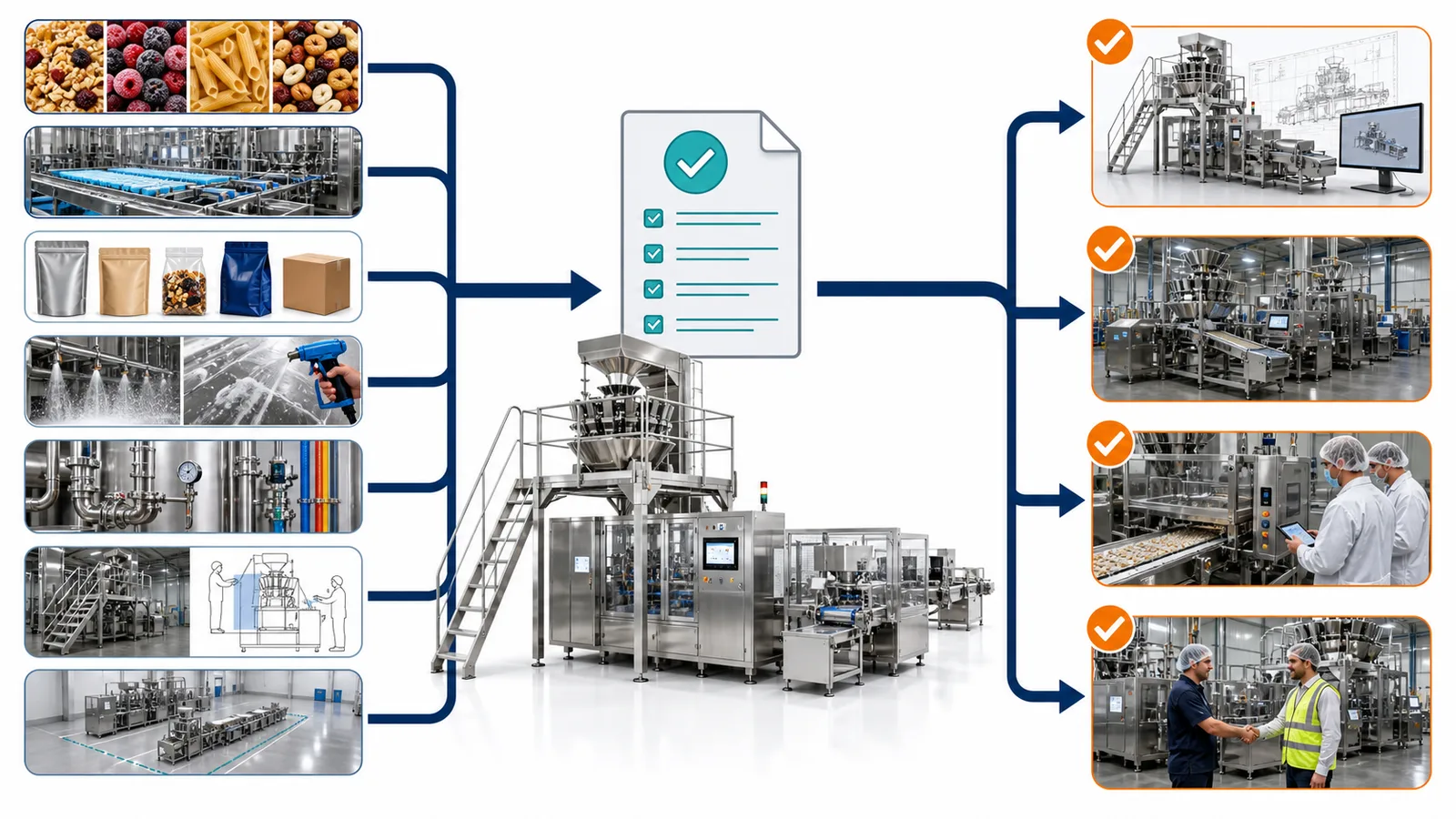
Core URS sections
1. Business and intended use
Products, markets, demand, production schedule, project objective and expected service life.
2. Product and process
Raw materials, formula ranges, temperatures, dimensions, sequence, holds, rework and downstream interfaces.
3. Capacity and quality
Accepted output, run length, yield, giveaway, reject basis, changeover and ramp-up.
4. Hygiene and food safety
Product-contact materials, zoning, cleanability, access, drainage, cleaning method and verification.
5. Machinery safety
Intended use, foreseeable misuse, risk assessment, guards, interlocks, emergency functions and safe access.
6. Automation and data
Recipes, users, alarms, records, interfaces, backups, cybersecurity and data ownership.
7. Site and utilities
Voltage, frequency, air, steam, water, cooling, drainage, floor loads, room, environment and codes.
8. Documentation and lifecycle
Drawings, manuals, certificates, parts, training, warranty, service, obsolescence and end-of-life support.
Worked example: 500 kg/h fresh ramen line
The brief states: fresh ramen in two widths, 500 kg/h accepted output, new production area, 400 V 50 Hz, with mixing, resting, sheeting, cutting, portioning and packaging interface. The URS converts that brief into controlled rows:
| ID | Requirement | Verification | Priority |
|---|---|---|---|
| PROC-001 | The line shall produce at least 500 kg/h accepted Product A, averaged over a continuous four-hour performance test after agreed startup, using approved recipe R1 and utilities within stated limits. | SAT production test and mass reconciliation | Must |
| QUAL-001 | Accepted noodles shall meet approved width, thickness, portion-weight and appearance limits listed in Product Specification PS-01. | Calibrated measurement and sample plan | Must |
| CHG-001 | Change from width format A to B shall be completed by trained operators within the approved method and time limit, excluding sanitation only where explicitly stated. | Observed timed SAT test | Should |
| HYG-001 | Product-contact zones shall be accessible for the approved cleaning method and shall pass the site's agreed post-clean inspection and verification protocol. | Design review, inspection and cleaning trial | Must |
| UTIL-001 | The complete offered line shall operate from 400 V, 3 phase, 50 Hz and shall declare connected load, normal demand and maximum simultaneous demand. | Document review and site measurement | Must |
| DOC-001 | Supplier shall provide approved-layout, electrical, utility, spare-parts, operation, cleaning and maintenance documents in the agreed language and format before SAT. | Document register review | Must |
Product information suppliers need
- Representative samples, photos, drawings and target specifications.
- Formula and ingredient ranges, including allergens and particulates.
- Temperature, viscosity, moisture, dough or emulsion behavior.
- Unit weight, dimensions, casing, wrapper or package format.
- Required shelf-life process, cooking, cooling or freezing interfaces.
- Permitted rework and product-change sequence.
- Known variability, difficult products and future formats.
Protect confidential formulas through appropriate agreements, but do not conceal physical properties required to size and test equipment.
Hygiene requirements need an actual cleaning method
“Food grade stainless steel” is not a complete hygienic requirement. Define product-contact scope, material evidence, surface condition where relevant, joints, hollow sections, seals, drainage, access, tool use, disassembly, cleaning chemistry, temperature, pressure, time and verification method.
Codex hygiene principles provide the food-safety baseline. ISO 14159:2002 remains the published international hygiene standard for machinery as of the research date, while ISO shows a replacement draft under development. Contracts should identify the exact published edition or another agreed standard and track revision risk.
Safety requirements start with intended use
State operators, cleaning and maintenance tasks, product formats, modes, access, foreseeable misuse and site interfaces. ISO 12100:2010 remains published and provides machinery risk-assessment and risk-reduction principles, while ISO reports a revision project in progress. The supplier's risk assessment does not replace the user's site and integration review.
Requirements should cover safe loading, jam clearing, tool changes, sanitation, maintenance, stored energy, lifting, noise, ergonomics, guarding, interlocks, restart and emergency behavior under the law applicable at the installation site.
Define utilities as ranges and quality conditions
| Utility | Define | Avoid |
|---|---|---|
| Electrical | Voltage, phase, frequency, tolerance, earthing, connected and normal demand | “Power available” |
| Compressed air | Pressure at point of use, free-air peak/average, quality class and connection | Compressor motor size only |
| Steam | Pressure, condition, peak/average flow, condensate and culinary requirements if applicable | One kg/h value with no pressure |
| Water | Quality, temperature, pressure, peak/average flow and connection | Daily total only |
| Cooling | Fluid, supply/return temperatures, flow, pressure drop and heat rejection | Nominal chiller tonnes alone |
| Drainage | Peak flow, temperature, solids, chemistry, connection and floor conditions | Assuming floor drains can accept every discharge |
Build a responsibility and interface matrix
For every boundary, state who designs, supplies, installs, connects, tests and approves. Include unloading, foundations, platforms, utilities, network, upstream/downstream conveyors, product and packaging for trials, travel, permits, waste disposal, lifting equipment and production support.
Words such as “turnkey” do not eliminate interface risk. The signed scope and responsibility matrix do.
Plan FAT and SAT before purchase
Factory Acceptance Test
Before shipment, verify offered build, documentation, functions, alarms, safety behavior and agreed product trials possible at the supplier.
Site Acceptance Test
After installation, verify real utilities, interfaces, site safety, product performance, cleaning and records under agreed operating conditions.
Each protocol should define prerequisites, calibrated instruments, sample and raw-material responsibility, product quantity, trained personnel, duration, quality criteria, permitted stops, data collection, deviations, retest and approval authority.
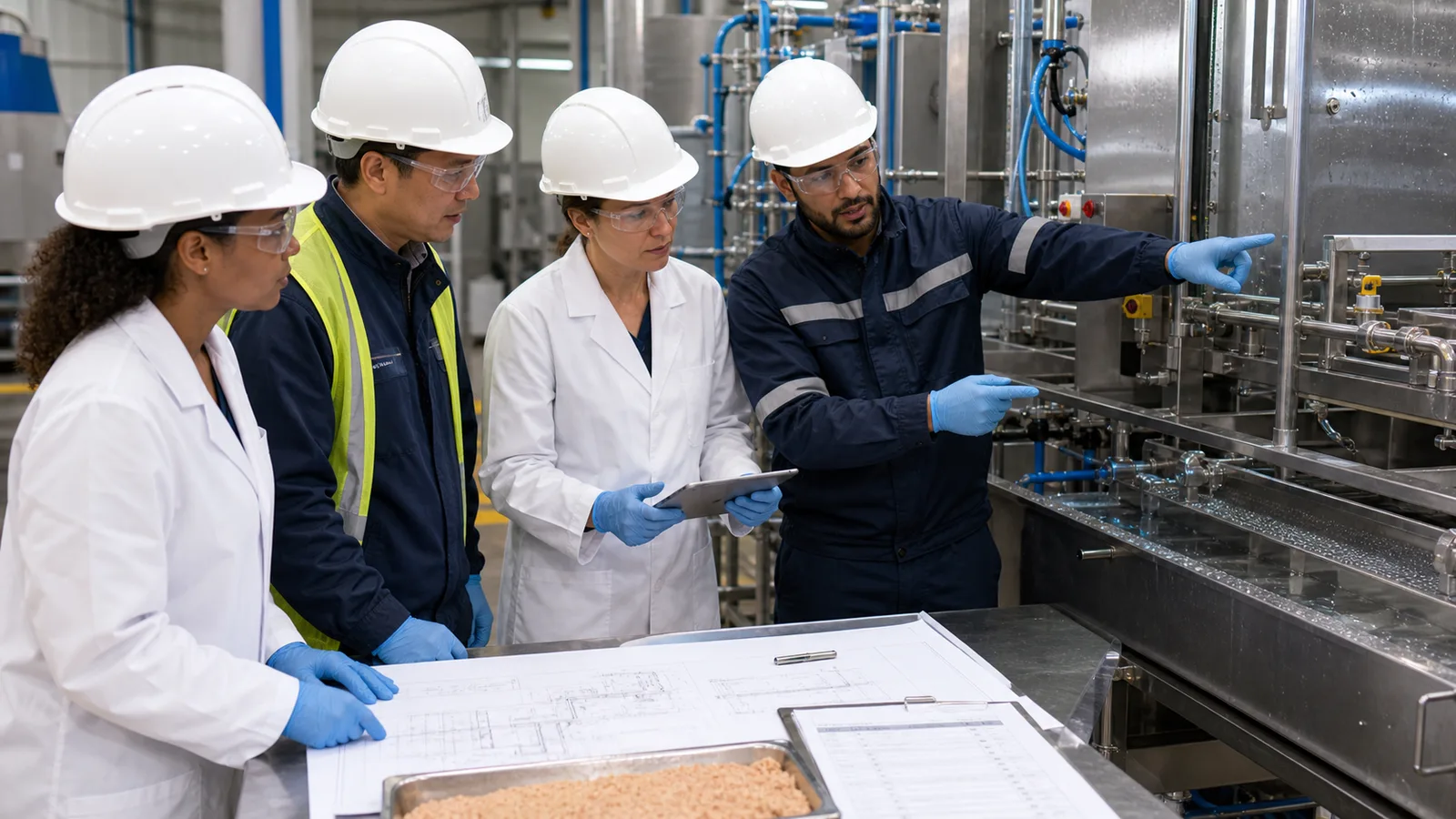
Verification methods
| Method | Use | Evidence |
|---|---|---|
| Document review | Materials, drawings, calculations, certificates and manuals | Approved document and revision |
| Inspection | Construction, access, labels, interfaces and workmanship | Checklist, measurement and photos |
| Functional test | Modes, controls, alarms, interlocks, failure and restart behavior | Protocol results and event record |
| Performance test | Accepted capacity, quality, yield, utility and changeover | Raw data, calculations and samples |
| Cleaning trial | Access, disassembly, drainage and post-clean result | Timed procedure and verification record |
Ten-step URS workflow
- Nominate the user owner. One person controls the requirement baseline.
- Create the project brief. Capture product, accepted capacity, site, scope, schedule and open questions.
- Map the process and interfaces. Include upstream, downstream, people, cleaning and utilities.
- Gather product evidence. Use specifications, samples and representative difficult SKUs.
- Write unique requirements. Use one measurable “shall” statement per ID.
- Assign priority and verification. Separate must, should and optional items.
- Complete cross-functional review. Include production, quality, food safety, engineering, safety, maintenance, IT and procurement.
- Issue to all suppliers equally. Require a clause-by-clause compliance matrix and deviations.
- Freeze the contract baseline. Link scope, URS, drawings, FAT/SAT and commercial terms.
- Control changes and close traceability. Record approval, cost, schedule and retest impact for every change.
Minimum controlled package
Approved project brief; URS with requirement IDs; product and process specifications; site and utility data; layout and interface matrix; standards register; supplier compliance matrix; deviations; design review record; risk assessments; document register; FAT and SAT protocols; punch list; training; spare-parts list; change log; acceptance and handover approvals.
Frequently asked questions
What is a food machinery URS?
It is the user's controlled statement of what equipment must achieve, under which conditions, how it will be verified and who owns each interface.
What is the difference between a brief and a URS?
A brief starts technical discussion. A URS is a measurable, traceable baseline for design, quotation and acceptance.
Should capacity use nameplate output?
No. Specify accepted output for defined products, quality limits, utilities and test duration.
What is the difference between FAT and SAT?
FAT occurs at the supplier before shipment; SAT verifies the installed system and real site interfaces.
Does a URS replace supplier engineering?
No. The URS defines required outcomes. The supplier develops and documents the compliant design.
Start with a structured project brief
Capture the minimum product, capacity, site and process information, then develop it into the controlled URS described here.
Open the Food Machinery Project Brief Generator | Open the Factory Utility Checklist
Standards and primary references
- ISO 12100:2010, Safety of machinery - Risk assessment and risk reduction - current published machinery safety design framework; ISO records revision activity.
- ISO 14159:2002, Safety of machinery - Hygiene requirements for machinery design - current published hygiene standard; ISO records a replacement draft under development.
- Codex CXC 1-1969, General Principles of Food Hygiene - premises, equipment, hygiene and HACCP baseline.
- U.S. FDA, General Principles of Software Validation - cross-industry method reference for documented intended use, operating environment, objective criteria and testable automated-equipment requirements; not presented here as food law.
- U.S. FDA, Process Validation: General Principles and Practices (2011) - lifecycle and documented validation principles; drug-industry guidance used here only as a method reference.
Identify the exact standards, laws and customer requirements applicable to the installation country and product. Draft standards are not equivalent to published editions.